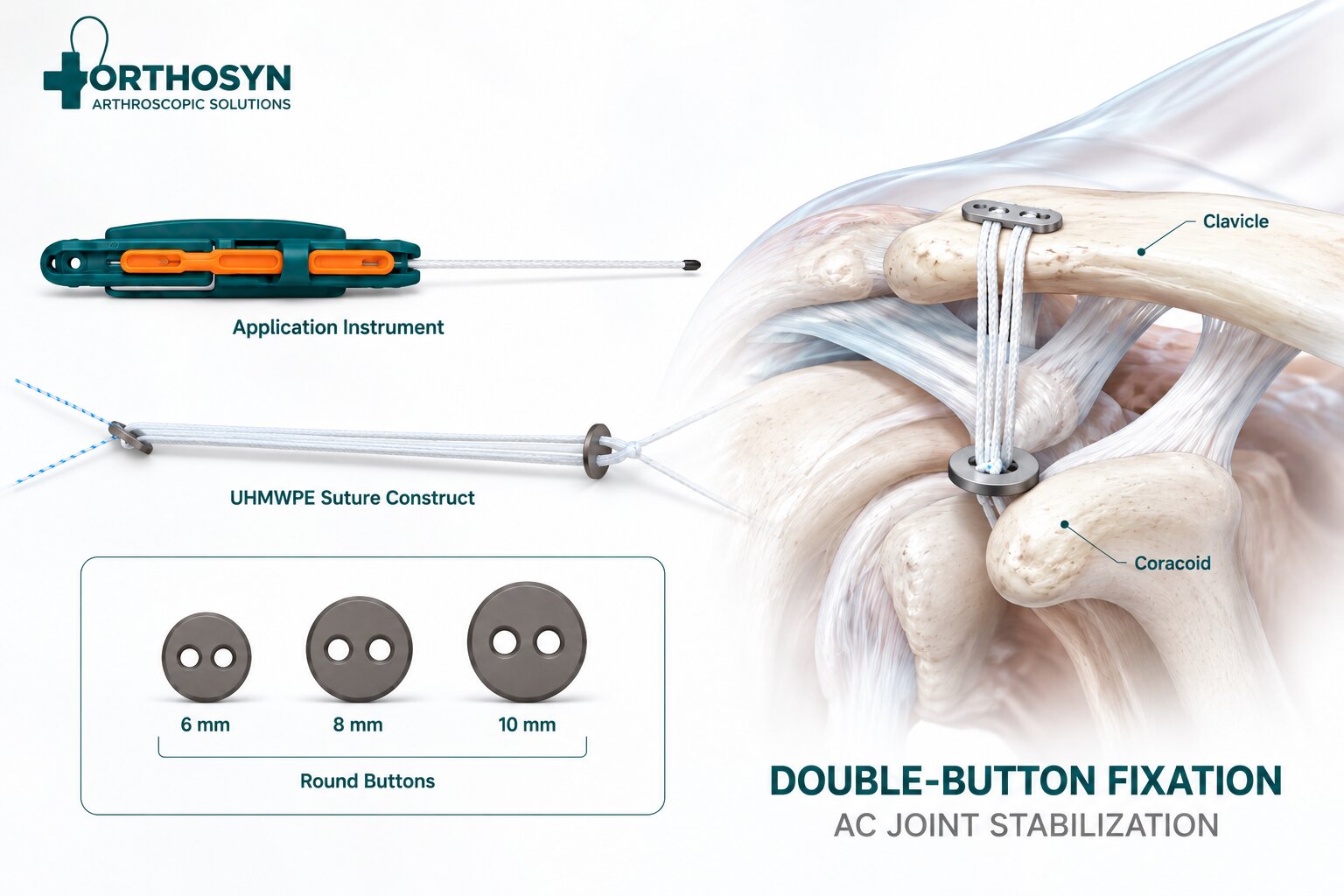
The acromioclavicular (AC) joint connects the distal clavicle to the acromion and plays an important role in the relationship between the clavicle and scapula. Traumatic disruption of the AC joint can damage the acromioclavicular and coracoclavicular ligament complex, resulting in abnormal displacement and instability.
In selected cases requiring surgical stabilization, a double-button fixation system can be used to create a strong connection between the clavicle and coracoid. The construct generally combines cortical buttons with high-strength sutures, creating suspensory fixation rather than relying on a conventional screw positioned across the AC joint.
The basic concept can be represented as:
Clavicle → Cortical Button → High-Strength Sutures → Coracoid → Cortical Button
Within the ORTHOSYN arthroscopy portfolio, the ORTHOSYN Double Button Lift System combines titanium buttons and UHMWPE sutures for cortical fixation applications, including AC joint stabilization.
The acromioclavicular joint is located at the top of the shoulder where the distal end of the clavicle meets the acromion.
Stability in this region depends on several structures.
The acromioclavicular ligaments contribute primarily to local AC joint stability, while the coracoclavicular (CC) ligaments provide important vertical stability between the clavicle and coracoid.
The CC ligament complex consists mainly of:
Together, these structures help maintain the normal relationship between the clavicle and scapula.
An AC joint separation occurs when trauma disrupts the stabilizing structures around the acromioclavicular joint.
A common mechanism is a direct impact to the lateral shoulder, such as during:
The severity can range from a relatively minor ligament injury to substantial displacement involving disruption of both the AC and CC ligament complexes.
Not every AC joint injury requires surgery. Treatment depends on injury severity, displacement, symptoms, functional requirements and patient characteristics.
When the coracoclavicular ligaments are significantly disrupted, the normal relationship between the clavicle and coracoid can be lost.
The clavicle may appear elevated relative to the shoulder complex, producing the characteristic deformity associated with higher-grade AC joint injuries.
Therefore, one objective of stabilization is to restore and maintain an appropriate relationship between these structures.
A simplified concept is:
AC/CC Injury → Loss of Stability → Reduction → Coracoclavicular Stabilization
Double-button fixation addresses this by creating a suspensory connection between the clavicle and coracoid.
A double-button fixation system uses two cortical buttons connected by high-strength suture material.
One button is positioned on the clavicular side, while the second provides fixation on the coracoid side.
The construct can be represented as:
Upper Button
↓
Clavicle
↓
High-Strength Suture Construct
↓
Coracoid
↓
Lower Button
Once positioned and tensioned, the construct helps maintain the reduced relationship between the clavicle and coracoid.
Double-button fixation works according to a cortical suspensory fixation principle.
Rather than using a screw to rigidly connect the clavicle and coracoid, the system uses buttons on the cortical surfaces and high-strength sutures between them.
The buttons distribute the fixation force over the cortical bone surfaces, while the suture construct connects the two fixation points.
The basic mechanical pathway is:
Clavicular Cortex → Button → UHMWPE Sutures → Button → Coracoid Cortex
After reduction and tensioning, the construct helps resist separation between the clavicle and coracoid.
The exact surgical technique varies according to the system, injury pattern and surgeon preference, but the general concept involves several stages.
The AC joint and coracoclavicular relationship are evaluated.
The displaced clavicle is reduced toward the intended anatomical relationship with the shoulder complex.
A bone tunnel or fixation pathway is prepared according to the selected surgical technique and implant system.
Accurate tunnel positioning is important because the construct must correspond appropriately to the clavicle and coracoid anatomy.
The double-button construct is passed through the prepared pathway.
Depending on the implant design, dedicated passing instruments may or may not be required.
The buttons are positioned against the cortical bone surfaces.
The concept becomes:
Clavicular Button → Clavicle → Suture Construct → Coracoid → Coracoid Button
The suture construct is tensioned while maintaining the desired reduction.
The final construct provides suspensory stabilization between the clavicle and coracoid.
Cortical buttons provide a fixation surface against cortical bone.
Instead of concentrating the complete fixation concept inside a bone tunnel, the button rests against the cortical surface.
This creates a broader interface between the fixation device and cortical bone.
The principle is similar to other suspensory fixation technologies used in orthopedic and sports medicine procedures:
Bone Tunnel → Suture/Loop → Cortical Button → Cortical Surface
However, implant geometry, dimensions and surgical technique differ according to the anatomical application.
In a double-button construct, the buttons provide the cortical fixation points, while the sutures connect them.
UHMWPE — ultra-high-molecular-weight polyethylene — is widely used in high-strength orthopedic sutures.
The fixation chain can therefore be represented as:
Titanium Button → UHMWPE Suture → Titanium Button
The sutures transfer force between the two buttons and allow the construct to maintain the relationship between the clavicle and coracoid after tensioning.
Suture configuration and tensioning are important parts of the overall fixation strategy.
Different surgical strategies have been developed for AC joint stabilization.
A conventional screw-based construct can provide rigid fixation between the clavicle and coracoid. Double-button systems instead use suspensory fixation.
| Feature | Double-Button Fixation | Screw Fixation |
|---|---|---|
| Fixation principle | Cortical suspensory | Rigid screw fixation |
| Main components | Buttons + sutures | Screw |
| Connection | Flexible suture construct | Rigid metallic construct |
| Cortical fixation | Yes | Different mechanical principle |
| Implant concept | Suspensory | Transosseous rigid fixation |
The appropriate technique depends on the injury, anatomy, fixation strategy and surgeon preference. No single method should be considered universally appropriate for every AC joint injury.
Bone tunnel placement is an important consideration in button-based fixation.
The clavicle and coracoid have limited dimensions, and tunnel position affects both the direction of the construct and the surrounding bone stock.
Important considerations can include:
For this reason, the fixation system must be used according to the selected technique and applicable instructions for use.
Suspensory fixation systems can use different button configurations.
In a double-button system, fixation is established at both ends of the construct:
Clavicular Cortex ↔ Coracoid Cortex
This creates a complete cortical fixation pathway connected by high-strength sutures.
Depending on the surgical system, button shape can also differ according to the intended position and available cortical surface.
The ORTHOSYN Double Button Lift System provides a cortical button and high-strength suture construct for fixation applications including AC joint stabilization.
The system uses:
The product is designed around the principle of:
Titanium Cortical Button + UHMWPE Suture + Titanium Cortical Button
This creates a double-button suspensory fixation construct.
ORTHOSYN offers different Double Button configurations for selected fixation applications.
One configuration incorporates:
An earlier passing-pin configuration uses:
The appropriate configuration should be selected according to the specific surgical application, technique and product instructions.
A handle-based delivery system can simplify the implant passage workflow by integrating the delivery mechanism into the device.
In the ORTHOSYN handle-based Double Button configuration, the system is designed so that a separate passing pin is not required for implant passage.
Conceptually:
Tunnel Preparation → Handle-Based Passage → Button Positioning → Tensioning
This differs from older configurations in which an additional passing pin is used as part of the implant passage process.
The mechanical principle of double-button fixation can be relevant to several orthopedic applications requiring cortical fixation between bone structures.
Within the ORTHOSYN portfolio, Double Button technology is associated with applications including:
AC Joint → Syndesmosis → Hallux Valgus
However, each anatomical application has different biomechanical requirements, surgical techniques and fixation objectives.
The specific product configuration must therefore be selected and used according to its intended application and instructions for use.
AC joint injuries are common in sports where athletes may fall directly onto the shoulder or experience high-energy contact.
Examples include:
The clinical and educational pathway can be represented as:
Shoulder Trauma → AC Joint Separation → AC/CC Instability → Reduction → Double-Button Fixation
This connects procedure-focused searches naturally with terms such as AC joint stabilization, coracoclavicular fixation, cortical button fixation and double-button systems.
Within the ORTHOSYN arthroscopy portfolio, the Double Button Lift System provides a cortical suspensory fixation concept relevant to AC joint stabilization.
Its fundamental construction combines:
Ti-6Al-4V ELI Buttons + UHMWPE Sutures
The system creates fixation between cortical surfaces while the high-strength suture construct connects the buttons.
For AC joint stabilization, the principle can be summarized as:
Clavicle → Titanium Button → UHMWPE Suture Construct → Titanium Button → Coracoid
Final implant configuration, tunnel preparation and surgical technique should always follow the specific product indications and instructions for use.
Double-button fixation in AC joint stabilization works by creating a cortical suspensory connection between the clavicle and coracoid.
Two cortical buttons are connected by high-strength sutures. After the AC/coracoclavicular relationship is reduced, the construct is positioned and tensioned to help maintain stabilization.
The fundamental principle is:
Clavicular Cortex → Button → High-Strength Suture → Button → Coracoid Cortex
Within the ORTHOSYN arthroscopy portfolio, the Double Button Lift System combines Ti-6Al-4V ELI titanium buttons and UHMWPE sutures to provide this fixation concept for relevant orthopedic applications, including AC joint stabilization.