Hyaluronic acid (HA) is used in knee osteoarthritis because it is a natural component of synovial fluid and contributes to the lubrication, viscosity and viscoelastic behavior of the knee joint.
In osteoarthritis, the joint environment changes. These changes can affect the quantity, molecular characteristics and rheological behavior of naturally occurring hyaluronic acid in synovial fluid.
For this reason, intra-articular hyaluronic acid formulations are used within viscosupplementation strategies to introduce exogenous HA directly into the joint space.
However, not all HA injections are the same. Products can differ in molecular weight, concentration, total dose, structure and injection protocol.
Knee osteoarthritis is a degenerative joint condition involving changes in multiple structures of the knee.
These can include:
Although cartilage degeneration is one of the most recognized features of osteoarthritis, the condition affects the entire joint environment.
This is why the properties of synovial fluid and hyaluronic acid are also relevant.
In a healthy knee, hyaluronic acid is naturally present in synovial fluid.
It contributes to several important physical characteristics, including:
These properties help synovial fluid support smooth movement between joint surfaces.
Hyaluronic acid is therefore closely linked to the mechanical environment of the knee.
In osteoarthritis, endogenous hyaluronic acid may undergo changes in:
A shift toward lower effective molecular weight and altered concentration can influence the rheological properties of synovial fluid.
As a result, the joint fluid may not behave in the same way as in a healthy joint.
This provides part of the rationale behind viscosupplementation.
Viscosupplementation refers to the intra-articular administration of hyaluronic acid.
The concept is based on the relationship between HA and the viscoelastic properties of synovial fluid.
An HA formulation is injected directly into the joint space, where it becomes part of the intra-articular environment.
The exact characteristics of the product depend on factors such as:
Intra-articular administration places the formulation directly into the joint space.
This is different from oral supplements or topical products, which do not deliver HA directly into the synovial environment.
The intra-articular route allows the formulation to interact locally with the joint environment.
For this reason, intra-articular HA products are commonly used in the context of knee viscosupplementation.
Hyaluronic acid contributes to the viscosity and flow behavior of synovial fluid.
Its long polymer chains influence how the fluid moves and responds under different mechanical conditions.
This supports a low-friction environment between articular surfaces.
Joint lubrication is especially important in the knee because it is exposed to repetitive movement and loading throughout the day.
The knee experiences repeated mechanical forces during:
The viscoelastic properties of synovial fluid help the joint respond to these forces.
Hyaluronic acid contributes to this viscoelastic behavior.
This is why HA is commonly associated with both lubrication and mechanical cushioning.
The molecular weight of hyaluronic acid refers to the size of its polymer chains.
Molecular weight can influence:
Different intra-articular products may use different molecular-weight profiles.
However, molecular weight should not be evaluated alone.
A more complete evaluation should consider:
molecular weight + concentration + total dose + molecular structure + volume + injection protocol
Concentration describes how much hyaluronic acid is present per milliliter.
For example:
Concentration can influence the physical behavior of a formulation.
However, a higher concentration does not automatically mean a higher molecular weight or a better product.
Concentration should always be interpreted together with the rest of the formulation profile.
Linear hyaluronic acid consists of HA polymer chains without an intentionally created cross-linked network.
Linear HA formulations may differ in:
The AlkaFlex Linear Intra-Articular Hyaluronic Acid portfolio includes linear formulations designed for intra-articular use.
Explore AlkaFlex Linear Hyaluronic Acid:
https://orthosynmed.com/product/39/alkaflex-intra-articular-injections-with-hyaluronic-acid---linear-linked
Cross-linked hyaluronic acid contains a modified molecular network formed by connecting HA chains.
Cross-linking can influence:
These properties are especially relevant in formulations designed for higher viscosity or single-injection protocols.
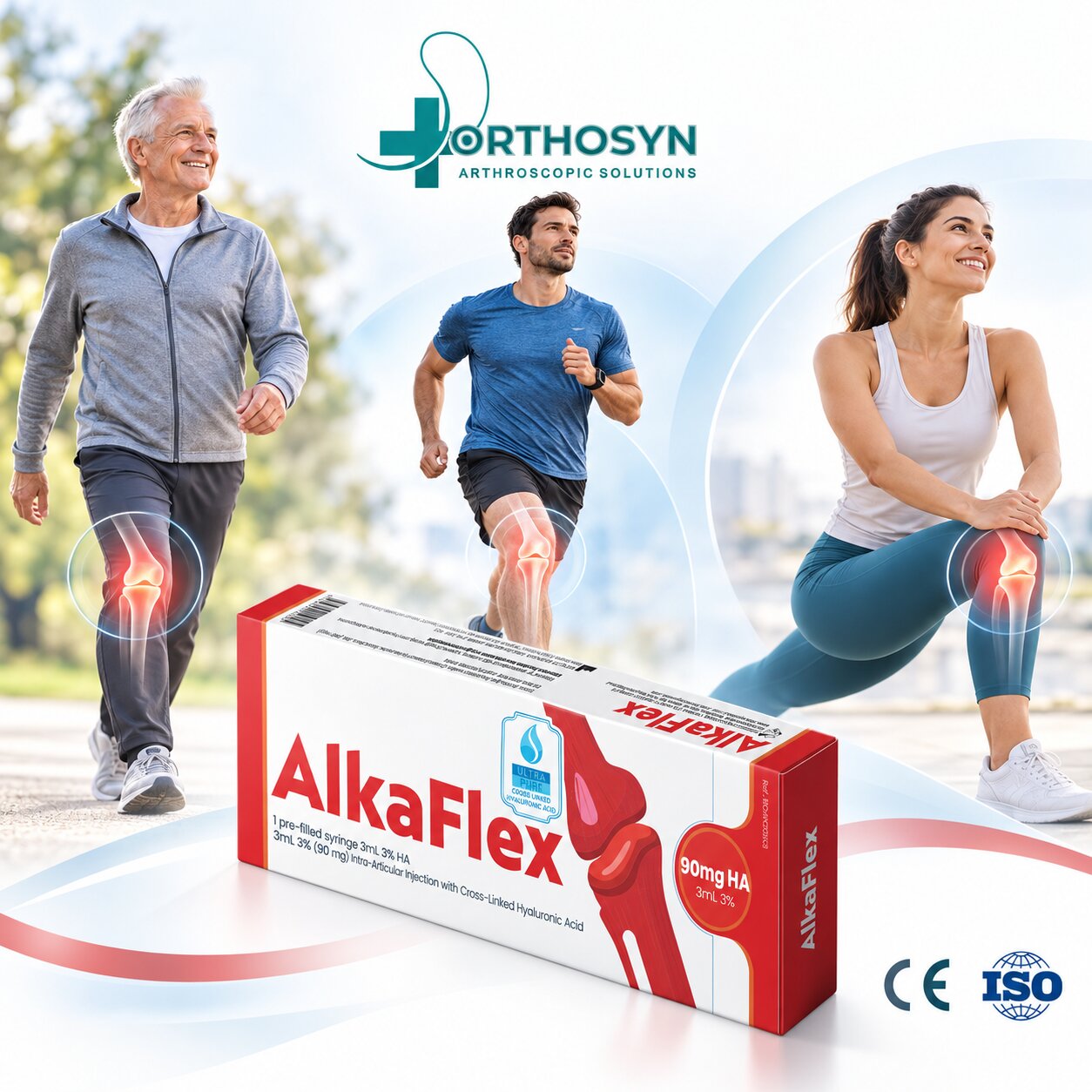
The AlkaFlex Cross-Linked Intra-Articular Hyaluronic Acid portfolio represents this formulation approach.
Explore AlkaFlex Cross-Linked Hyaluronic Acid:
https://orthosynmed.com/product/44/alkaflex-intra-articular-injections-with-cross-linked-hyaluronic-acid
No.
Products within the same general HA category can differ significantly.
Important differences include:
For this reason, products should not be compared solely according to brand name or total milligrams.
Some HA formulations are designed for multiple injections.
Others are developed for a single-injection protocol.
Single-injection formulations may use:
However, injection frequency alone does not determine the quality or clinical suitability of a formulation.
The complete technical profile should be considered.
Not necessarily.
Patient selection, indication and treatment planning should be determined by a qualified healthcare professional.
Clinical recommendations regarding intra-articular HA can differ between guidelines and healthcare systems.
The decision to use viscosupplementation should therefore be individualized according to factors such as:
When reviewing an intra-articular hyaluronic acid product, useful questions include:
These questions provide a more complete basis for product comparison.
AlkaFlex is Orthosyn Medikal’s international brand for intra-articular hyaluronic acid formulations.
The AlkaFlex portfolio includes:
This allows AlkaFlex products to be evaluated according to the technical parameters commonly used when comparing viscosupplementation products.
Hyaluronic acid is used in knee osteoarthritis because of its natural role in the synovial fluid and mechanical environment of the joint.
It contributes to:
In osteoarthritis, changes in endogenous HA and synovial fluid provide the context for the use of intra-articular HA within viscosupplementation strategies.
Because HA products can differ considerably, molecular weight, concentration, total dose and molecular structure should all be considered when evaluating a formulation.
AlkaFlex offers both Linear and Cross-Linked intra-articular hyaluronic acid formulations within Orthosyn Medikal’s international HA portfolio.
AlkaFlex Linear Intra-Articular Hyaluronic Acid
https://orthosynmed.com/product/39/alkaflex-intra-articular-injections-with-hyaluronic-acid---linear-linked
AlkaFlex Cross-Linked Intra-Articular Hyaluronic Acid
https://orthosynmed.com/product/44/alkaflex-intra-articular-injections-with-cross-linked-hyaluronic-acid