A bucket-handle meniscus tear is a type of longitudinal meniscal tear in which a substantial portion of the torn meniscus can displace toward the center of the knee joint. Because the displaced fragment may interfere with normal joint movement, patients can experience pain, catching, restricted motion or a mechanically locked knee.
When the tear is considered repairable, the surgical objective is generally to reduce the displaced meniscal fragment toward its anatomical position and stabilize the tear with sutures or a dedicated meniscal repair system.
Modern arthroscopic techniques may include all-inside, inside-out or outside-in repair, depending on tear location, tissue quality, vascularity and surgeon preference.
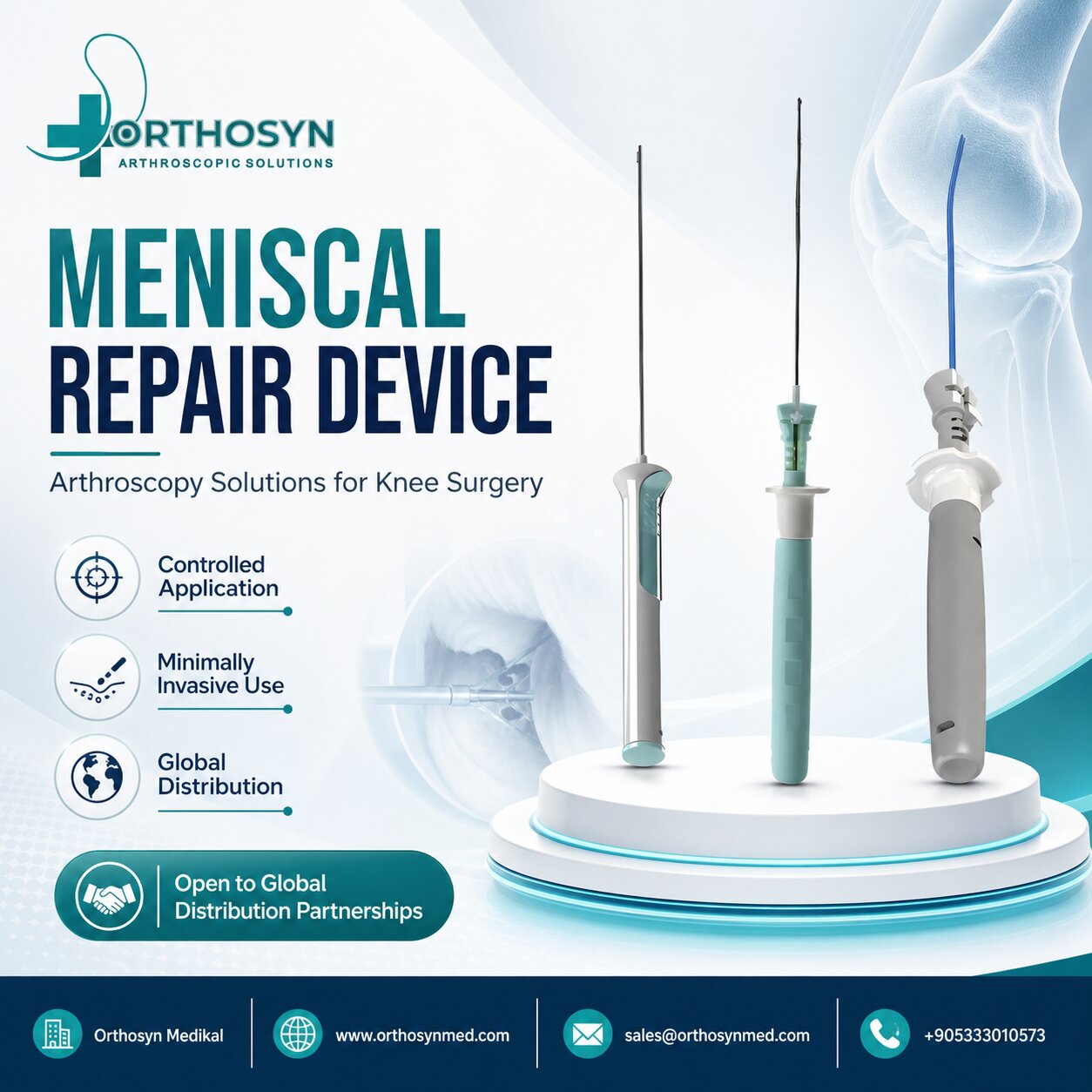
Within the ORTHOSYN arthroscopy portfolio, the VersaFix Meniscal Repair System provides an all-inside fixation concept using two PEEK implants and UHMWPE suture for arthroscopic meniscal repair.
The menisci are fibrocartilaginous structures located between the femur and tibia.
The knee contains two menisci:
They contribute to:
A bucket-handle tear usually represents a longitudinal or vertical longitudinal tear in which the inner portion of the meniscus becomes mobile and can displace centrally.
The displaced segment can resemble the handle of a bucket, which gives the injury its name.
A stable meniscus normally remains positioned between the femoral and tibial surfaces.
With a bucket-handle tear, the elongated torn fragment can move away from its normal position and displace into the joint.
This displaced tissue may mechanically interfere with knee motion.
Patients may therefore experience:
However, symptoms can vary, and clinical assessment together with imaging is required to determine the exact injury pattern.
Bucket-handle tears are often associated with rotational forces acting on a flexed or loaded knee.
Possible mechanisms include:
These tears may occur as isolated injuries or together with other knee injuries, particularly ACL tears.
Diagnosis typically combines clinical examination with imaging.
The clinician may assess:
MRI can help identify the tear configuration and displacement of the meniscal fragment.
Final assessment of tear morphology and tissue quality may also occur during arthroscopy.
Not every bucket-handle tear is suitable for repair.
The decision depends on several factors, including:
When preservation is feasible, modern meniscal surgery generally aims to retain as much functional meniscal tissue as possible.
If the tissue cannot be adequately reduced or repaired, a different surgical strategy may be required.
The procedure begins with arthroscopic evaluation of the knee.
The surgeon identifies the displaced meniscal fragment, evaluates the tear and determines whether the tissue is suitable for repair.
A simplified repair sequence can be described as:
Evaluate Tear → Reduce Displaced Fragment → Prepare Repair Site → Place Sutures/Fixation → Tension Repair → Confirm Stability
The exact technique varies according to the location and characteristics of the tear.
An arthroscope is introduced into the knee through small portals.
The surgeon evaluates:
The tear must be carefully assessed before the fixation strategy is selected.
A defining feature of a bucket-handle tear is displacement of the torn fragment.
Before fixation, the fragment generally needs to be reduced back toward its anatomical position.
The surgeon may use arthroscopic instruments to manipulate the tissue and evaluate whether the meniscus can be restored to an appropriate position.
The concept is:
Displaced Meniscus → Reduction → Anatomical Position → Repair
If the fragment cannot be adequately reduced, the repair strategy may need to be reconsidered.
Once the fragment has been reduced, the repair site may be prepared according to the selected technique.
The purpose is to create appropriate conditions for meniscal healing while preserving viable tissue.
The surgeon also evaluates the edges of the tear and confirms that the reduced meniscus can be stabilized without inappropriate tension.
After reduction and preparation, sutures are placed across the tear to stabilize the meniscus.
The basic concept is:
Meniscal Fragment → Reduction → Suture Fixation → Stable Meniscal Construct
Several fixation points may be required because bucket-handle tears can extend over a relatively long portion of the meniscus.
The number and spacing of fixation points depend on the tear pattern and selected surgical technique.
All-inside meniscus repair is performed using arthroscopic devices that allow fixation to be created from within the joint.
A dedicated delivery system is positioned at the repair site, and the fixation components are deployed to stabilize the tear.
A simplified sequence is:
Position Device → Deploy First Implant → Deploy Second Implant → Tension Suture → Stabilize Meniscus
Because bucket-handle tears may be relatively long, multiple repair constructs can be positioned along the tear when required.
The ORTHOSYN VersaFix Meniscal Repair System is an all-inside meniscal fixation system designed around a compact arthroscopic delivery concept.
The system incorporates:
During an all-inside repair, the implants provide fixation points while the UHMWPE suture connects and stabilizes the repaired meniscal tissue.
The general concept can be represented as:
PEEK Implant → UHMWPE Suture → Meniscal Tissue → UHMWPE Suture → PEEK Implant
The system allows the surgeon to create an all-inside meniscal repair construct through an arthroscopic approach.
Use of VersaFix for a specific tear pattern should follow the product's intended purpose and instructions for use.
Meniscal repair occurs near important anatomical structures around the knee.
Controlling the penetration depth of the delivery system is therefore an important aspect of all-inside repair.
The adjustable depth control of VersaFix allows the penetration setting to be adapted during the repair procedure.
Appropriate depth selection depends on:
The objective is controlled deployment according to the anatomy and selected repair strategy.
The inside-out technique uses long needles to pass sutures from inside the knee through the meniscus and capsule toward the outside of the joint.
The sutures are then retrieved and tied externally.
The general concept is:
Inside Joint → Meniscus → Capsule → External Suture Retrieval → Knot Fixation
Inside-out repair remains an established technique for selected meniscal tears and can provide multiple fixation points along an extensive longitudinal tear.
However, it generally requires an additional posteromedial or posterolateral approach for safe suture retrieval and knot tying.
In an outside-in repair, needles are introduced from outside the joint toward the meniscus.
Sutures are passed through the tear and then secured according to the selected technique.
Outside-in techniques can be particularly relevant for certain tear locations, especially more anterior lesions.
Therefore, the three major approaches can be summarized as:
All-Inside → Fixation from within the joint
Inside-Out → Sutures passed from inside to outside
Outside-In → Sutures introduced from outside toward the joint
Bucket-handle tears are frequently longer than small focal meniscal tears.
A single fixation point may therefore not adequately stabilize the entire tear.
Multiple fixation points can be distributed along the repaired segment to maintain reduction and create a more continuous repair construct.
The concept is:
Anterior Tear Region → Multiple Repair Points → Posterior Tear Region
The exact number of sutures or repair devices depends on tear length, stability, tissue quality and surgical technique.
In a meniscal repair system, the suture is responsible for maintaining the relationship between the fixation points and repaired tissue.
UHMWPE — ultra-high-molecular-weight polyethylene — is used in high-strength orthopedic suture applications.
Within the VersaFix system, UHMWPE suture forms part of the fixation construct connecting the two PEEK implants.
Important considerations in meniscal suturing include:
Excessive tension should be avoided because the goal is to stabilize the reduced meniscus rather than unnecessarily compress or damage the tissue.
Bucket-handle meniscus tears can occur together with anterior cruciate ligament injuries.
When both injuries are present, the surgeon evaluates the entire knee and determines an appropriate treatment strategy.
This can involve:
ACL Injury + Bucket-Handle Meniscus Tear → Ligament Reconstruction + Meniscal Preservation Strategy
Meniscal preservation is particularly relevant because the menisci contribute to load distribution and knee stability.
The relationship between ligament injury and meniscal pathology makes bucket-handle tears an important topic within sports medicine and knee arthroscopy.
Historically, damaged meniscal tissue was more frequently removed.
Modern knee surgery increasingly emphasizes meniscal preservation when repair is feasible because the meniscus has important biomechanical functions.
Preserving functional meniscal tissue can help maintain:
For this reason, determining whether a displaced bucket-handle fragment can be reduced and repaired is an important part of surgical planning.
Bucket-handle tears are particularly relevant in athletes exposed to pivoting, cutting and rotational knee forces.
The informational pathway can be represented as:
Twisting Knee Injury → Locked Knee → Bucket-Handle Meniscus Tear → Knee Arthroscopy → Meniscus Reduction → Meniscal Repair
This creates a natural SEO relationship between procedure-focused searches and terms such as:
Within the ORTHOSYN arthroscopy portfolio, the VersaFix Meniscal Repair System provides an all-inside fixation concept for arthroscopic meniscal repair.
Its design combines:
Two PEEK Implants + UHMWPE Suture + Arthroscopic Delivery + Adjustable Depth Control
For repairable meniscal tears, all-inside technology can provide one method of creating fixation while avoiding the conventional long-needle retrieval pathway associated with inside-out techniques.
However, the appropriate repair strategy depends on the specific tear pattern, location, tissue quality and surgical technique.
Product selection and use should always follow the specific product indications and instructions for use.
A bucket-handle meniscus tear is a longitudinal tear in which a substantial meniscal fragment can become displaced into the knee joint, sometimes producing mechanical locking or restricted motion.
When the tear is considered repairable, treatment generally involves:
Reduction of the Displaced Fragment → Restoration of Meniscal Position → Suture Fixation → Stability Assessment
All-inside, inside-out and outside-in techniques may be considered depending on the characteristics and location of the tear.
Within the ORTHOSYN arthroscopy portfolio, the VersaFix Meniscal Repair System, incorporating two PEEK implants, UHMWPE suture and adjustable depth control, provides an all-inside fixation technology relevant to arthroscopic meniscal repair.