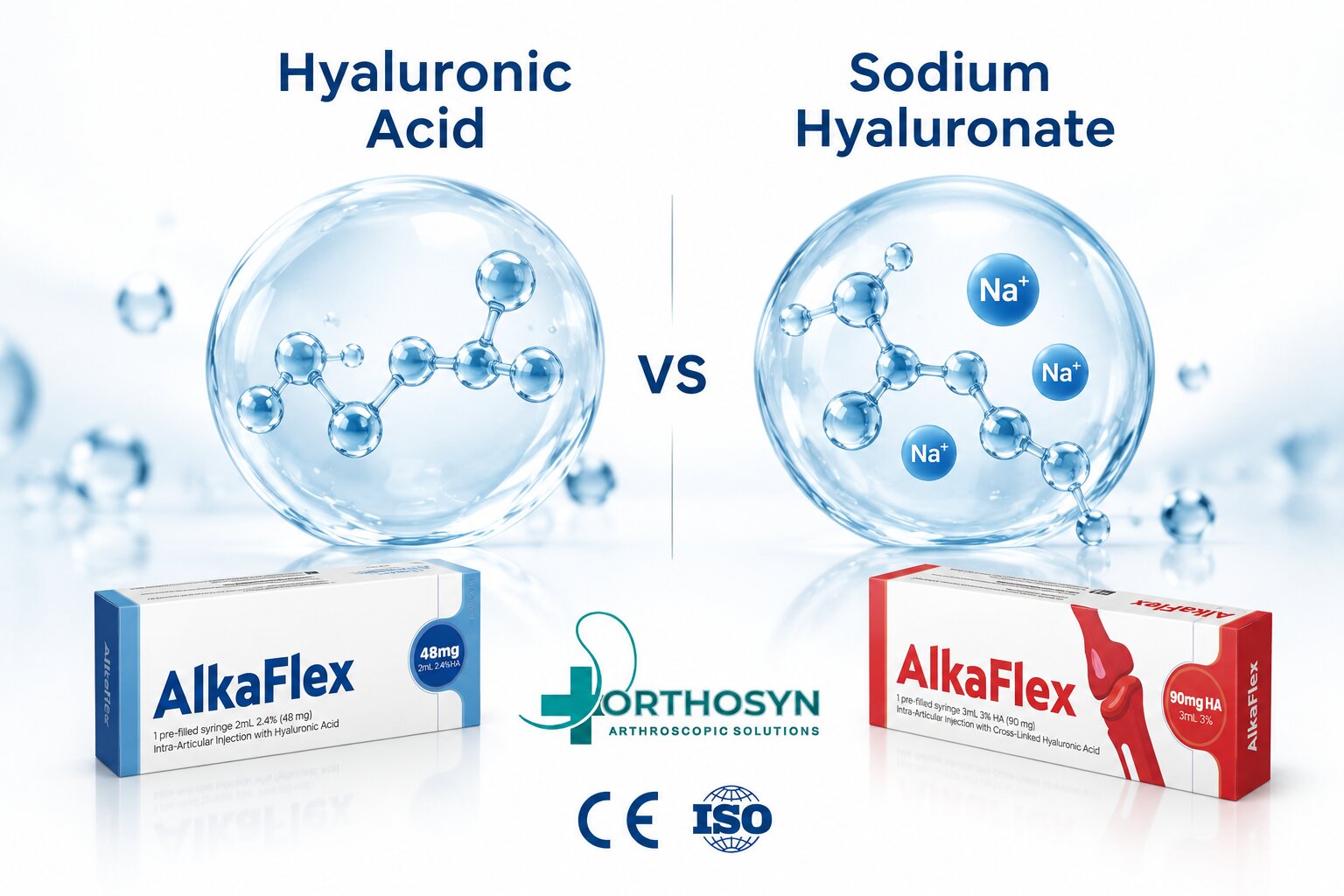
The terms hyaluronic acid and sodium hyaluronate are often used almost interchangeably in medical, cosmetic and pharmaceutical contexts.
They are closely related, but they are not technically identical.
Understanding the difference is important when reading product labels, comparing intra-articular injections and evaluating technical specifications for products such as AlkaFlex.
In simple terms:
Hyaluronic acid is the acid form of the molecule.
Sodium hyaluronate is the sodium salt form of hyaluronic acid.
Both belong to the same hyaluronan family and share very similar biological and physical properties.
Hyaluronic acid is a naturally occurring glycosaminoglycan found throughout the human body.
It is present in tissues such as:
Within synovial joints, hyaluronic acid contributes to:
These properties are especially relevant in discussions about viscosupplementation and intra-articular HA injections.
Sodium hyaluronate is the sodium salt of hyaluronic acid.
Chemically, it is produced when the acidic groups of hyaluronic acid are associated with sodium ions.
In practical product terminology, sodium hyaluronate is commonly used because it is a stable and highly water-compatible form of hyaluronan.
This is why many medical-device and injectable products use the term:
sodium hyaluronate
on their labeling or technical documentation.
They are not exactly the same chemically, but they are closely related forms of the same molecular system.
The key difference is the ionic form.
Hyaluronic acid refers to the protonated acid form.
Sodium hyaluronate refers to the sodium salt form.
In aqueous biological environments, this distinction becomes less dramatic because the molecule exists in ionized forms depending on pH and surrounding ions.
For this reason, the terms are often used broadly and sometimes interchangeably in commercial or educational materials.
Sodium hyaluronate is widely used in injectable and medical-device formulations because it can be formulated in aqueous solutions and hydrogels.
It is commonly found in products designed for:
For intra-articular products, the sodium hyaluronate form is particularly relevant because it can be formulated with specific:
These characteristics are more important clinically and technically than the naming difference alone.
The terms hyaluronic acid and sodium hyaluronate do not automatically indicate different molecular weights.
Molecular weight depends on the length of the polymer chains, not simply on whether the material is described as the acid or sodium salt form.
Therefore, sodium hyaluronate products can be produced in:
When comparing products, molecular weight should always be checked directly in the technical specifications.
The sodium form itself is not enough to determine viscosity.
Viscosity depends on multiple factors, including:
A sodium hyaluronate solution with a high molecular weight and high concentration may have very different rheological properties from another sodium hyaluronate solution with a lower molecular weight or lower concentration.
This is why product comparison should focus on the complete formulation profile.
Linear HA formulations commonly use sodium hyaluronate in a non-cross-linked polymer form.
The technical behavior of the product then depends on parameters such as:
The AlkaFlex Linear Intra-Articular Hyaluronic Acid portfolio represents this type of formulation approach.
Explore AlkaFlex Linear Hyaluronic Acid:
https://orthosynmed.com/product/39/alkaflex-intra-articular-injections-with-hyaluronic-acid---linear-linked
Cross-linked formulations also originate from hyaluronic acid or sodium hyaluronate-based polymer chains.
These chains are chemically connected to create a modified molecular network.
Cross-linking can influence:
The AlkaFlex Cross-Linked Intra-Articular Hyaluronic Acid portfolio represents this second formulation approach.
Explore AlkaFlex Cross-Linked Hyaluronic Acid:
https://orthosynmed.com/product/44/alkaflex-intra-articular-injections-with-cross-linked-hyaluronic-acid
That depends on the context.
For educational and general search purposes, hyaluronic acid is usually the broader and more familiar term.
For technical product documentation, sodium hyaluronate may be the more precise term if that is how the active polymer is identified in the formulation.
This is why both terms are useful in SEO and product communication.
For example:
Hyaluronic acid can capture broad searches such as:
Sodium hyaluronate can capture more technical searches such as:
Not necessarily.
The naming difference alone does not determine whether one product is better than another.
More meaningful technical parameters include:
For this reason, comparing products only by whether the label says “hyaluronic acid” or “sodium hyaluronate” can be misleading.
For intra-articular HA products, terminology can influence how products are searched, compared and understood.
A clinician or distributor may see one product described as:
Hyaluronic Acid Injection
and another as:
Sodium Hyaluronate Injection
even though both belong to the same broader viscosupplementation category.
The important question is not just the name of the molecule, but the full technical profile of the formulation.
AlkaFlex is Orthosyn Medikal’s international brand for intra-articular hyaluronic acid formulations.
Within the AlkaFlex portfolio, the relevant technical parameters include:
These characteristics provide a more meaningful basis for product evaluation than terminology alone.
Hyaluronic acid and sodium hyaluronate are closely related but not chemically identical terms.
Hyaluronic acid refers to the acid form of the molecule, while sodium hyaluronate refers to its sodium salt form.
In practical medical use, both are part of the same hyaluronan family and are closely associated with:
When comparing products, the most important factors are not the names alone, but the complete formulation characteristics, including molecular weight, concentration, total dose and molecular structure.
AlkaFlex Linear Intra-Articular Hyaluronic Acid
https://orthosynmed.com/product/39/alkaflex-intra-articular-injections-with-hyaluronic-acid---linear-linked
AlkaFlex Cross-Linked Intra-Articular Hyaluronic Acid
https://orthosynmed.com/product/44/alkaflex-intra-articular-injections-with-cross-linked-hyaluronic-acid