The triangular fibrocartilage complex (TFCC) is an important stabilizing structure on the ulnar side of the wrist. When the TFCC is torn and the injury produces persistent pain or instability, surgical repair may be considered in selected cases.
In arthroscopic or arthroscopy-assisted TFCC repair, suture anchors can be used to secure repairable TFCC tissue back to its attachment site, particularly when the injury involves a peripheral or foveal attachment.
The fundamental fixation concept is:
Bone → Suture Anchor → High-Strength Suture → TFCC Tissue
Because the wrist contains relatively small anatomical structures and limited working space, anchor dimensions, placement and fixation strategy are particularly important.
Within the ORTHOSYN arthroscopy portfolio, small-diameter Soft Anchors and selected Suture Anchor technologiesprovide fixation concepts relevant to soft tissue-to-bone repair. Product selection and use should follow the specific product indications and instructions for use.
The triangular fibrocartilage complex is located on the ulnar side of the wrist and consists of several interconnected structures.
Rather than functioning as a single ligament, the TFCC acts as a complex stabilizing and load-transmitting structure between the distal radius, ulna and carpal region.
Its functions include:
Damage to this complex can therefore affect both wrist function and stability.
TFCC injuries can occur through acute trauma or degenerative changes.
Common mechanisms include:
Athletes participating in racket sports, gymnastics, weight training and other activities involving repetitive wrist loading may be exposed to mechanisms associated with TFCC injury.
Symptoms vary depending on the location and severity of the injury.
Patients may experience:
However, not every TFCC tear requires surgery.
Treatment decisions depend on factors such as the type of tear, stability, symptoms, tissue quality and response to conservative treatment.
TFCC repair is a surgical procedure intended to restore the damaged TFCC when the tear pattern and tissue quality are considered suitable for repair.
The surgical strategy depends heavily on the location of the lesion.
Some tears may be treated differently because the TFCC does not have uniform healing potential throughout its structure. Peripheral regions generally have a more favorable blood supply than central portions.
For repairable peripheral or foveal lesions, the objective may be to restore the damaged tissue toward its anatomical attachment.
TFCC tears are not all mechanically or biologically identical.
A central lesion differs significantly from a peripheral tear or a lesion involving the deeper foveal attachment.
This distinction influences whether treatment involves:
Therefore, suture anchors are not used for every TFCC tear.
They are relevant when the surgical objective involves fixation of repairable tissue back to bone.
When anchor fixation is selected, a small suture anchor can be positioned at an appropriate bony attachment site.
The sutures connected to the anchor are then passed through the TFCC tissue and tensioned to approximate the tissue toward the bone.
A simplified sequence is:
Identify Tear → Prepare Attachment Site → Position Anchor → Pass Suture → Reduce TFCC → Secure Repair
The objective is to create stable soft tissue-to-bone fixation while preserving the surrounding anatomy.
The foveal attachment is particularly important for the stabilizing function of the TFCC at the distal radioulnar joint.
Certain traumatic TFCC injuries can detach the tissue from this deeper attachment.
When a foveal repair is indicated, the surgeon may restore the TFCC toward its anatomical attachment using a selected fixation technique.
One possible fixation principle is:
Ulnar Fovea → Suture Anchor → Suture → TFCC
This differs from simply closing a superficial tear because the objective is to restore the deeper attachment involved in joint stability.
The wrist provides considerably less bone volume and working space than larger joints such as the shoulder or knee.
For this reason, small-diameter fixation systems can be particularly relevant.
Potential considerations include:
The goal is not simply to use the smallest possible anchor. The implant must be appropriate for the anatomy, tissue, fixation requirement and specific surgical technique.
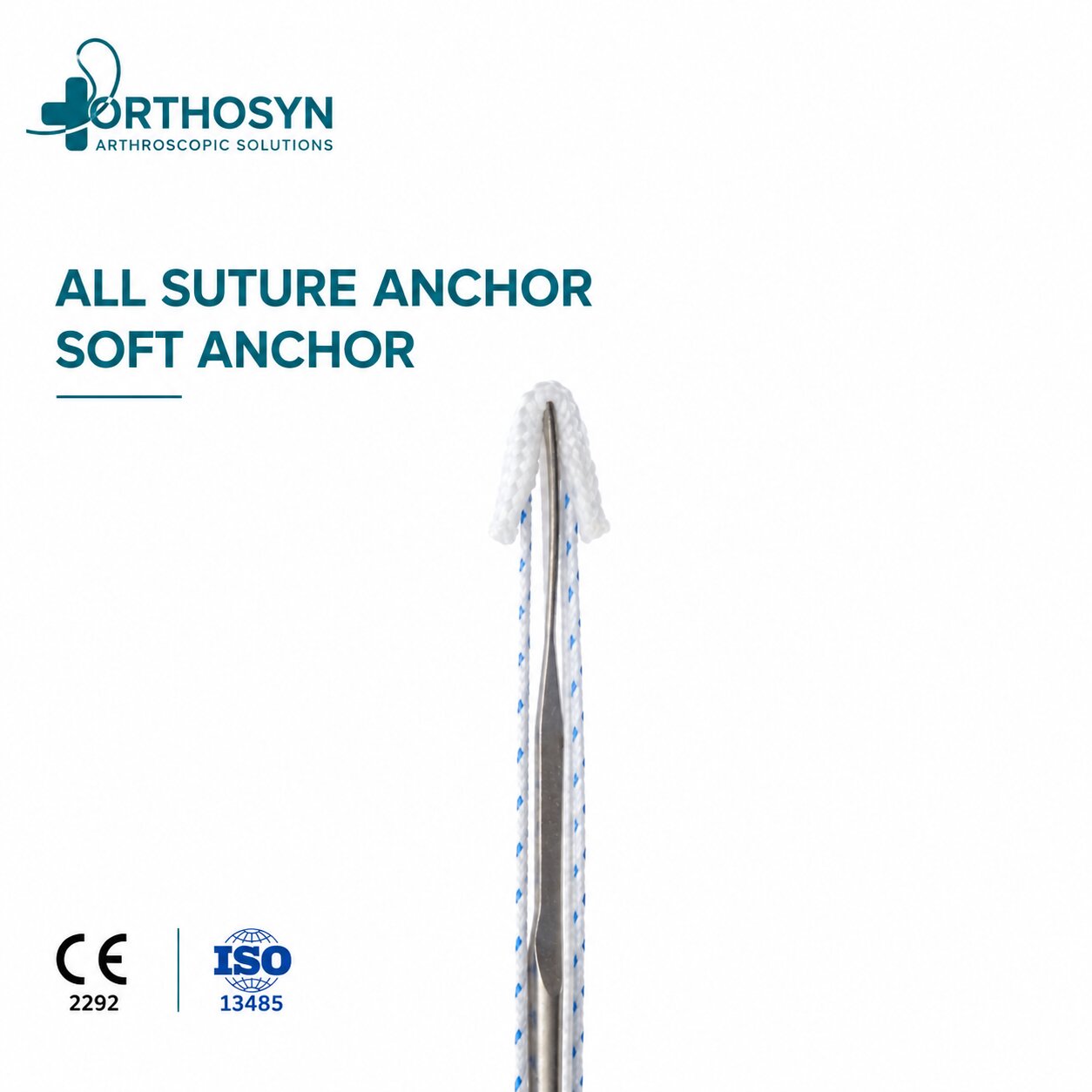
Soft Anchors, also known as all-suture anchors, use a suture-based implant component rather than a conventional rigid screw-shaped anchor body.
One important characteristic of this technology is the ability to create fixation through relatively small bone tunnels.
The ORTHOSYN Soft Anchor portfolio includes small-diameter configurations such as:
These anchors are manufactured using UHMWPE-based suture technology and are available in configurations with and without a needle.
Their small dimensions make Soft Anchor technology particularly relevant when surgeons evaluate fixation strategies for smaller anatomical regions.
Specific use in TFCC repair must follow the intended purpose and instructions for use of the selected product.
Suture anchors can use different implant concepts.
A conventional rigid anchor generally uses a solid implant body manufactured from materials such as titanium or PEEK.
A Soft Anchor instead uses a predominantly suture-based fixation structure.
| Feature | Soft Anchor | Rigid Suture Anchor |
|---|---|---|
| Implant concept | Suture-based | Solid anchor body |
| Bone tunnel | Can be relatively small | Depends on anchor diameter |
| Material concept | UHMWPE-based | PEEK / Titanium depending on product |
| Small-joint relevance | Particularly relevant | Depends on implant size and anatomy |
| Fixation objective | Soft tissue-to-bone | Soft tissue-to-bone |
Neither technology should be considered universally preferable. Implant selection depends on anatomy, fixation requirements, bone quality and surgical technique.
Precise anchor placement is important because the wrist contains multiple structures within a relatively compact anatomical area.
The fixation point must correspond to the intended anatomical repair while avoiding inappropriate implant positioning.
Factors considered during placement can include:
Correct positioning of the anchor and sutures contributes to creating the intended repair construct.
The anchor provides the connection to bone, but the suture creates the connection between the anchor and the repaired tissue.
High-strength sutures therefore form an important part of the overall construct.
The fixation chain can be understood as:
Bone → Anchor → Suture → TFCC
Suture characteristics, passage technique, tissue quality and tensioning all influence the final repair configuration.
ORTHOSYN Soft Anchors use UHMWPE-based suture material, a high-strength material widely associated with orthopedic soft tissue fixation applications.
Wrist arthroscopy allows the surgeon to visualize the internal structures of the wrist through small portals.
During the procedure, arthroscopy can assist with:
Depending on the lesion and selected technique, the repair may be performed arthroscopically or with arthroscopic assistance.
TFCC pathology is particularly relevant to activities that expose the wrist to repeated rotation, loading or impact.
Examples include:
From an educational perspective, this creates a search pathway such as:
Ulnar-Sided Wrist Pain → TFCC Tear → Wrist Arthroscopy → TFCC Repair → Suture Anchor Fixation
This allows informational TFCC content to connect naturally with searches involving small suture anchors, soft anchors and arthroscopic soft tissue fixation.
ORTHOSYN offers different suture anchor technologies for arthroscopic soft tissue-to-bone fixation.
For a procedure involving a relatively small anatomical region such as the wrist, small-diameter Soft Anchor technology is particularly relevant from a fixation-design perspective.
The ORTHOSYN Soft Anchor portfolio includes 1.3 mm, 1.5 mm, 1.9 mm and 3.0 mm configurations, providing different dimensions for soft tissue fixation applications.
ORTHOSYN also offers rigid suture anchor technologies within its broader arthroscopy portfolio.
The appropriate anchor technology, diameter and configuration should always be selected according to the anatomy, surgical technique, bone and tissue quality, as well as the specific product indications and instructions for use.
Suture anchors can be used in selected TFCC repairs to secure repairable tissue back to its bony attachment. This is particularly relevant when the repair strategy requires soft tissue-to-bone fixation, including selected peripheral or foveal lesions.
The basic principle is:
Bone Fixation → Suture Anchor → High-Strength Suture → TFCC Repair
Because TFCC surgery is performed within the compact anatomy of the wrist, anchor diameter, trajectory and placement are important considerations.
Within the ORTHOSYN arthroscopy portfolio, small-diameter Soft Anchors and other Suture Anchor technologiesprovide fixation concepts relevant to soft tissue-to-bone repair, while final product selection should always follow the specific intended use and IFU.