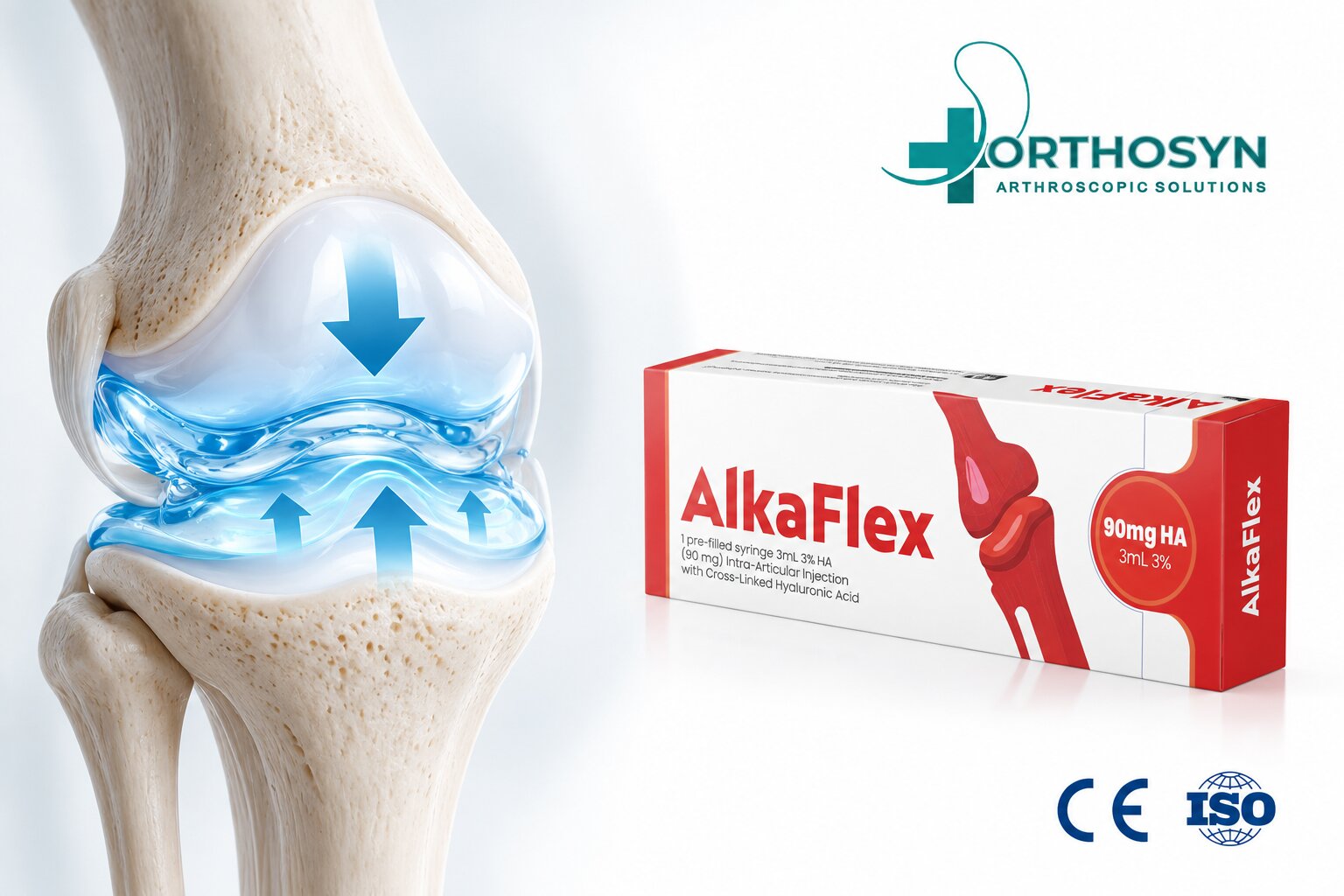
Hyaluronic acid (HA) plays an important role in the mechanical behavior of synovial joints.
Naturally present in synovial fluid, HA contributes to the fluid’s viscosity, elasticity and viscoelasticity. These properties help the joint respond to changing mechanical loads during movement.
Because of this, hyaluronic acid is closely associated with both joint lubrication and the ability of the synovial environment to support cushioning and shock absorption.
Understanding this function also helps explain why parameters such as molecular weight, concentration and molecular structure are important when evaluating intra-articular HA formulations such as AlkaFlex.
A synovial joint is exposed to repeated forces throughout the day.
Activities such as:
all create mechanical loading within the joint.
The joint must manage these forces while allowing smooth movement between the articular surfaces.
Cushioning refers to the way the joint environment helps distribute and respond to these loads.
Synovial fluid, cartilage and other joint structures all contribute to this process.
Hyaluronic acid plays an important role because it affects the physical behavior of synovial fluid.
Synovial fluid is not simply a watery liquid.
It has complex viscoelastic properties.
This means it can respond differently depending on the type and speed of mechanical loading.
During lower-speed movement, its viscous characteristics contribute strongly to lubrication.
During faster movement or increased loading, its elastic characteristics become particularly important.
This ability to adapt its behavior helps the joint environment respond to changing forces.
Hyaluronic acid is one of the key molecules responsible for these properties.
Viscoelasticity describes a material that has both viscous and elastic characteristics.
A viscous material resists flow.
An elastic material can deform when a force is applied and respond to that force.
Synovial fluid combines both behaviors.
This is particularly useful in joints because the mechanical conditions inside the joint are constantly changing.
The same joint may experience:
The viscoelastic behavior of synovial fluid helps the joint adapt to these different conditions.
Hyaluronic acid consists of long polymer chains.
These chains influence the way synovial fluid behaves under mechanical stress.
HA contributes to:
The effectiveness of these physical properties depends partly on the characteristics of the hyaluronic acid itself.
Important parameters include:
The molecular weight of hyaluronic acid refers to the size of the HA polymer chains.
Longer and higher-molecular-weight chains can influence the rheological properties of HA-containing fluids.
Molecular weight may affect:
For this reason, molecular weight is an important consideration when discussing how HA contributes to the mechanical properties of synovial fluid.
However, molecular weight alone does not determine the complete behavior of an HA formulation.
It should be considered together with concentration and molecular structure.
Yes.
HA concentration indicates how much hyaluronic acid is present in a given volume.
A higher concentration can influence viscosity and overall fluid behavior.
However, concentration and molecular weight are different parameters.
For example, two HA formulations can have the same concentration but different molecular weights.
They may therefore show different rheological characteristics.
This is why a more complete evaluation should consider:
molecular weight + concentration + molecular structure + total dose + volume
rather than relying on a single value.
Cross-linking connects hyaluronic acid chains into a modified molecular network.
This can influence important physical characteristics such as:
Cross-linked formulations are therefore often associated with higher viscosity and modified mechanical properties.
These characteristics may influence how the material responds to movement and mechanical loading inside the joint.
The AlkaFlex Cross-Linked Intra-Articular Hyaluronic Acid portfolio represents this formulation approach.
Explore AlkaFlex Cross-Linked Hyaluronic Acid:
https://orthosynmed.com/product/44/alkaflex-intra-articular-injections-with-cross-linked-hyaluronic-acid
Linear hyaluronic acid contains polymer chains without an intentionally created cross-linked network.
Its behavior still depends strongly on:
The AlkaFlex Linear Intra-Articular Hyaluronic Acid portfolio represents the linear formulation approach.
Explore AlkaFlex Linear Hyaluronic Acid:
https://orthosynmed.com/product/39/alkaflex-intra-articular-injections-with-hyaluronic-acid---linear-linked
Linear and cross-linked HA should therefore be viewed as different formulation technologies rather than simply as “weaker” and “stronger” versions of the same material.
In osteoarthritis, the synovial environment can change.
These changes may include alterations in:
When these properties change, the mechanical behavior of synovial fluid may also change.
This provides important context for understanding why intra-articular HA formulations are used within viscosupplementation strategies.
Viscosupplementation refers to the administration of a hyaluronic acid formulation directly into a synovial joint.
The concept is closely related to the physical properties of naturally occurring HA in synovial fluid.
Intra-articular HA formulations are designed with specific characteristics such as:
These characteristics influence the rheological behavior of the formulation.
This is why different viscosupplementation products may behave differently even when they all contain hyaluronic acid.
A higher number of milligrams does not automatically mean greater cushioning or better mechanical properties.
For example, two products may contain the same total HA dose but differ in:
These differences can significantly change how the formulations behave physically.
For this reason, total dose should be considered as one part of a broader technical evaluation.
AlkaFlex is Orthosyn Medikal’s international brand for intra-articular hyaluronic acid formulations.
The AlkaFlex portfolio includes both:
with different technical profiles designed for different intra-articular applications.
These formulations can be evaluated according to the same physical parameters that are important when discussing cushioning and shock absorption in synovial joints:
Hyaluronic acid contributes to joint cushioning and shock absorption by influencing the viscoelastic properties of synovial fluid.
Its long polymer chains affect:
These properties help the joint environment respond to both slow movement and higher mechanical loads.
Because different HA formulations vary in molecular weight, concentration and structure, their physical behavior can also vary.
The AlkaFlex Linear and AlkaFlex Cross-Linked intra-articular hyaluronic acid portfolios represent two different formulation approaches within Orthosyn Medikal’s international HA range.
AlkaFlex Linear Intra-Articular Hyaluronic Acid
https://orthosynmed.com/product/39/alkaflex-intra-articular-injections-with-hyaluronic-acid---linear-linked
AlkaFlex Cross-Linked Intra-Articular Hyaluronic Acid
https://orthosynmed.com/product/44/alkaflex-intra-articular-injections-with-cross-linked-hyaluronic-acid