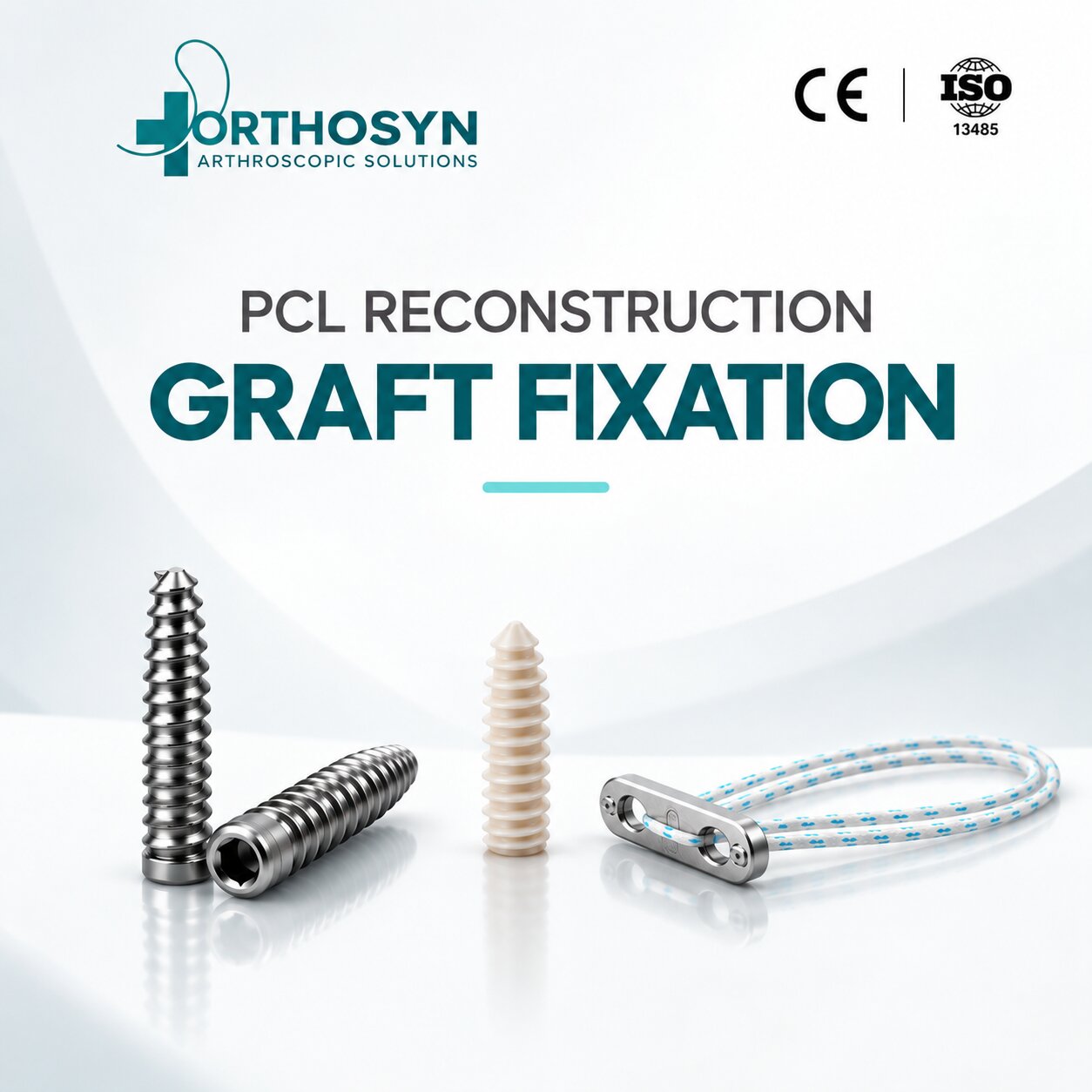
Posterior cruciate ligament (PCL) reconstruction is a surgical procedure used to restore knee stability in selected patients with significant PCL insufficiency. An essential stage of the procedure is PCL graft fixation—securing the reconstruction graft on the femoral and tibial sides after it has been positioned through the prepared bone tunnels or sockets.
Different fixation strategies can be used depending on the surgical technique, graft type, tunnel configuration, bone quality and surgeon preference. Two important fixation concepts used in cruciate ligament reconstruction are interference screw fixation and cortical suspensory fixation with femoral button systems.
Within the ORTHOSYN arthroscopy portfolio, Interference Screws and Femoral Button Systems provide fixation technologies relevant to ACL/PCL reconstruction.
The posterior cruciate ligament (PCL) is one of the major stabilizing ligaments of the knee.
Together with the anterior cruciate ligament (ACL), it contributes to controlling the relationship between the femur and tibia. One of its principal functions is to resist excessive posterior translation of the tibia relative to the femur.
PCL injuries may occur as a result of:
Treatment depends on the severity of the injury, associated ligament damage, degree of instability, patient characteristics and functional requirements.
In PCL reconstruction, a graft is positioned to reproduce the function of the damaged posterior cruciate ligament.
Depending on the selected surgical technique, bone tunnels or sockets are prepared in the femur and tibia. The graft is then passed through the prepared pathway, positioned, tensioned and fixed.
A simplified sequence is:
Graft Preparation → Tunnel Preparation → Graft Passage → Graft Tensioning → Graft Fixation
Fixation is particularly important during the early phase because the graft requires mechanical stability while biological integration develops.
Immediately after reconstruction, the graft has not yet biologically integrated with the surrounding bone.
The fixation system therefore helps maintain the graft in the intended position and under the selected tension during the initial healing period.
The basic concept can be represented as:
Bone → Fixation Device → Graft → Reconstruction Construct
Several factors can influence the fixation strategy:
For this reason, graft fixation is not based on a single implant or universal technique.
Two important concepts relevant to cruciate ligament reconstruction are aperture fixation and suspensory fixation.
With aperture fixation, the graft is secured close to the opening of the bone tunnel. Interference screws are commonly associated with this fixation principle.
With suspensory fixation, the graft construct is connected to a device such as a cortical button, which rests against the cortical surface of the bone.
The two methods therefore use different mechanical concepts:
Interference Screw → Graft Compression Inside the Tunnel
Femoral Button → Cortical Suspensory Fixation
An interference screw is positioned between the graft and the wall of the prepared bone tunnel.
As the screw is inserted, it creates interference between the graft and tunnel wall, helping secure the graft within the tunnel.
The fixation concept is:
Bone Tunnel → Graft + Interference Screw → Graft Fixation
This allows fixation to occur close to the tunnel aperture.
Interference screws used in ligament reconstruction can be manufactured from different materials, including titanium, PEEK and bioabsorbable materials.
Titanium Interference Screws provide a rigid metallic fixation option.
During graft fixation, the screw is positioned alongside the graft within the prepared tunnel.
The basic fixation pathway is:
Tunnel Wall → Titanium Interference Screw → Graft
Titanium therefore represents one material option for interference fixation in cruciate ligament reconstruction.
PEEK (polyether ether ketone) is a non-metallic polymer used in orthopedic implant applications.
PEEK Interference Screws provide a rigid, non-metallic alternative to titanium interference screws.
Characteristics associated with PEEK technology include:
Within the ORTHOSYN portfolio, PEEK Interference Screws form part of the fixation solutions available for cruciate ligament reconstruction.
Bioabsorbable interference screws represent another material concept for graft fixation.
Bioabsorbable technologies can provide an alternative to permanent metallic or PEEK implants in selected ligament reconstruction procedures.
Material selection should always correspond to the specific surgical procedure, fixation requirements and the indications and instructions for use of the selected product.
A Femoral Button System provides a different fixation principle.
Instead of securing the graft through direct interference inside the tunnel, a button is positioned against the outer cortical surface of the femur.
The graft is connected to the button through a loop or high-strength suture construct.
The concept can be simplified as:
PCL Graft → Loop/Suture Construct → Femoral Tunnel → Cortical Button
Once the button has passed through the prepared tunnel, it is positioned against the femoral cortex to create a suspensory fixation point.
Although both technologies can contribute to graft fixation, their mechanical principles are different.
| Feature | Interference Screw | Femoral Button System |
|---|---|---|
| Fixation concept | Aperture fixation | Suspensory fixation |
| Mechanism | Graft secured within tunnel | Graft suspended from cortical fixation |
| Implant | Screw | Cortical button + loop/suture |
| Position | Within bone tunnel | Against cortical surface |
| ORTHOSYN category | Interference Screws | Femoral Button Systems |
They should therefore be understood as different fixation strategies rather than different versions of the same implant.
In selected PCL reconstruction techniques, a femoral cortical button can provide suspensory fixation on the femoral side.
The graft construct is connected to the button through a loop or suture system. After passage through the femoral tunnel, the button is positioned against the cortical surface.
The fixation pathway becomes:
PCL Graft → Adjustable or Fixed Loop → Femoral Button → Femoral Cortex
Depending on the system and surgical technique, adjustable loop technology can also support graft positioning and tensioning.
Within the ORTHOSYN arthroscopy portfolio, Femoral Lift Systems provide cortical button technology for cruciate ligament graft fixation.
The portfolio includes adjustable femoral fixation concepts designed for graft positioning and fixation.
Together with the ORTHOSYN Interference Screw range, this creates two complementary fixation categories:
ORTHOSYN Interference Screws → Tunnel / Aperture Fixation
ORTHOSYN Femoral Button Systems → Cortical Suspensory Fixation
The appropriate system depends on the reconstruction technique and the specific indications and instructions for use of the selected product.
The same fixation principle does not necessarily need to be used at both ends of a cruciate ligament graft.
Depending on the selected reconstruction technique, different fixation concepts may be used on the femoral and tibial sides.
For example, a reconstruction strategy may involve:
Femoral Side → Cortical Button Fixation
Tibial Side → Interference Screw Fixation
This combination illustrates why both suspensory fixation systems and interference screws are important components of a broader ACL/PCL reconstruction portfolio.
The actual configuration should be determined according to the surgical technique, graft characteristics and applicable product instructions.
Fixation is only one component of PCL reconstruction.
Before final fixation, the graft must be positioned and tensioned according to the selected surgical technique.
This is particularly important in PCL reconstruction because the reconstructed ligament is intended to contribute to controlling posterior tibial translation.
The complete process therefore involves:
Tunnel Position → Graft Passage → Graft Positioning → Tensioning → Fixation → Final Assessment
Implant selection should consequently be considered within the entire reconstruction strategy rather than in isolation.
PCL reconstruction can also be performed using different graft configurations.
The native PCL is commonly described as having functional components including the anterolateral and posteromedial bundles.
A single-bundle reconstruction generally reconstructs one principal functional component, whereas double-bundle techniques use separate graft components and fixation points.
This can affect:
The fixation strategy must therefore correspond to the overall reconstruction technique.
PCL injuries can occur in athletes as well as in patients who experience traumatic knee injuries.
Contact sports and high-energy mechanisms may produce isolated PCL injuries or more complex multiligament injuries.
From an educational perspective, the patient and clinical research pathway can be summarized as:
PCL Injury → Knee Instability → PCL Reconstruction → PCL Graft Fixation → Interference Screw / Femoral Button
This makes graft fixation an important topic connecting procedural searches with ACL/PCL fixation technologies.
The ORTHOSYN arthroscopy portfolio includes different technologies relevant to cruciate ligament graft fixation.
Interference Screw technologies provide fixation within the prepared bone tunnel and offer different material concepts for ligament reconstruction.
Femoral Button Systems provide a cortical suspensory fixation concept for selected cruciate ligament reconstruction techniques.
Together, these technologies represent two important principles:
Aperture Fixation + Suspensory Fixation
This allows the ORTHOSYN ACL/PCL portfolio to address different graft fixation strategies rather than relying on a single fixation concept.
Product type, dimensions and configuration should always be selected according to the surgical technique, anatomy, graft characteristics and the specific product indications and instructions for use.
PCL graft fixation is an essential stage of posterior cruciate ligament reconstruction. The graft requires mechanical fixation to maintain its intended position while biological integration progresses.
Two important fixation strategies are Interference Screw fixation and Femoral Button fixation.
Interference screws secure the graft within the bone tunnel through an aperture fixation concept, while femoral button systems provide cortical suspensory fixation.
Within the ORTHOSYN ACL/PCL fixation portfolio, Interference Screws and Femoral Button Systems provide complementary technologies relevant to these reconstruction strategies.