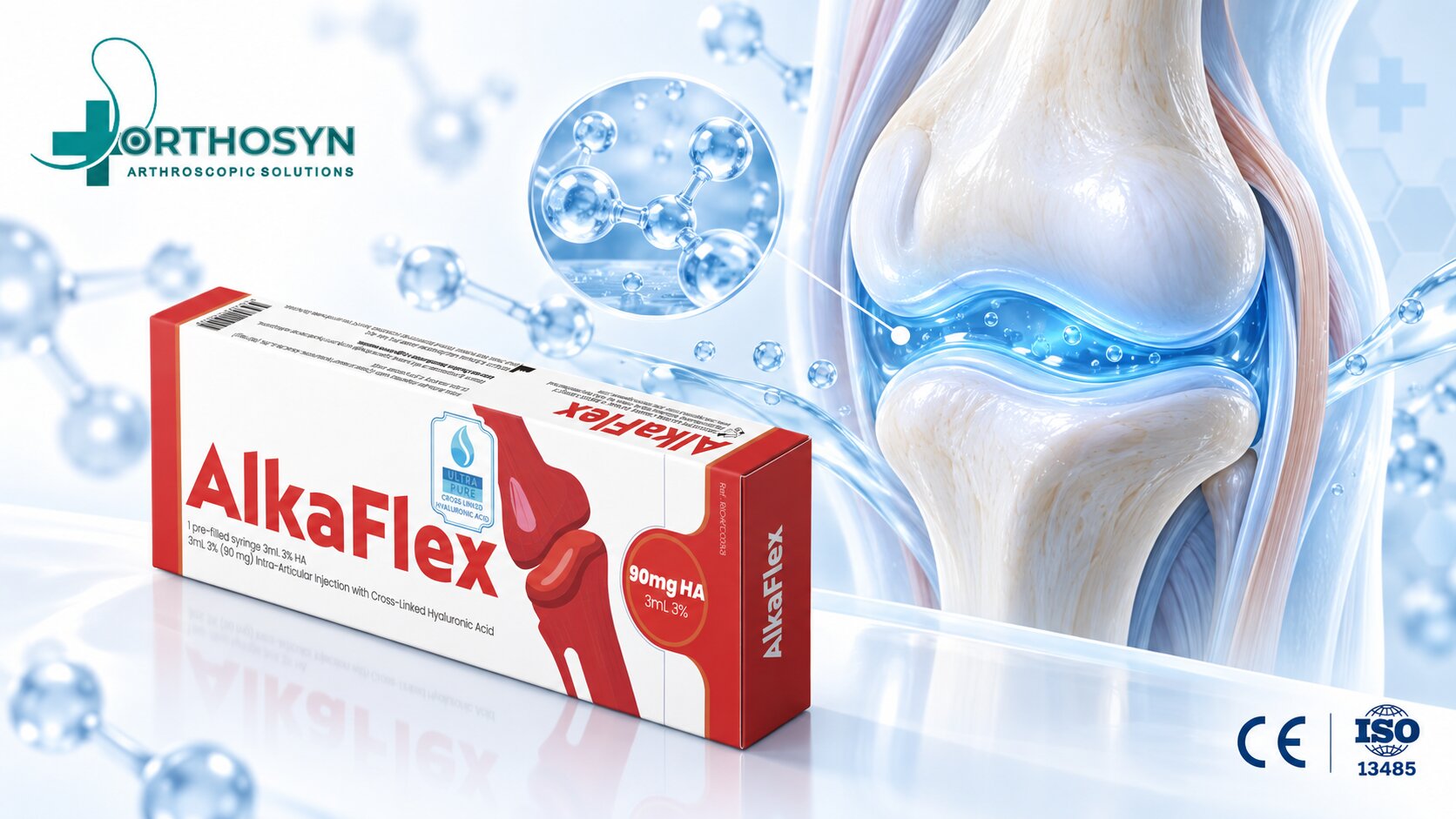
Hyaluronic acid (HA) plays an important role in the lubrication and viscoelastic behavior of synovial joints.
It is naturally present in synovial fluid, where it helps create a low-friction environment between articular surfaces and contributes to smooth joint movement.
Because of this function, hyaluronic acid is closely associated with concepts such as joint lubrication, synovial fluid, viscosupplementation and intra-articular HA injections.
Understanding how HA supports lubrication also helps explain why technical parameters such as molecular weight and concentration are important when evaluating intra-articular formulations such as AlkaFlex Linear Hyaluronic Acid.
Joint lubrication refers to the mechanisms that help reduce friction between moving articular surfaces.
Synovial joints such as the knee, hip, shoulder and ankle are exposed to repeated motion and mechanical loading.
To allow these surfaces to move efficiently, the joint depends on several complementary lubrication mechanisms.
Synovial fluid is one of the most important parts of this system.
It helps create a fluid environment between articular surfaces and contributes to smooth movement.
Hyaluronic acid is a major macromolecular component of synovial fluid.
It consists of long polymer chains that influence the fluid’s:
The combination of these properties contributes to the viscoelastic behavior of synovial fluid.
This is one of the main reasons why HA is so closely associated with normal joint mechanics.
The surfaces of a synovial joint move against each other many times throughout the day.
Hyaluronic acid contributes to the rheological characteristics of synovial fluid, helping maintain a fluid environment between these moving surfaces.
This supports lubrication by helping synovial fluid:
HA is therefore part of a broader lubrication system rather than functioning as a simple mechanical coating.
Viscosity describes a fluid’s resistance to flow.
Synovial fluid is more viscous than water, partly because of the presence of hyaluronic acid and other macromolecules.
The viscosity of synovial fluid helps it remain within the joint environment and contributes to its lubricating characteristics.
However, viscosity alone does not fully describe synovial fluid.
Its elastic properties are also important.
Together, viscosity and elasticity create the fluid’s viscoelastic behavior.
A viscoelastic material behaves partly like a fluid and partly like an elastic material.
This is useful in a joint because mechanical conditions change constantly.
During slower movement, the viscous characteristics of synovial fluid contribute to lubrication.
During faster movement or increased loading, its elastic characteristics help the joint environment respond to mechanical stress.
Hyaluronic acid contributes significantly to both behaviors.
This is why the molecular characteristics of HA are important when discussing joint lubrication.
The molecular weight of hyaluronic acid refers to the size of its polymer chains.
Molecular weight can influence:
For this reason, molecular weight is an important technical parameter in both natural synovial fluid and intra-articular HA formulations.
However, molecular weight should not be evaluated alone.
The behavior of an HA formulation also depends on factors such as:
HA concentration describes how much hyaluronic acid is present in each milliliter of a formulation.
The concentration can influence how the material behaves physically.
For example:
This is why concentration and molecular weight should be evaluated together.
A formulation cannot be fully understood by looking at only one specification.
In osteoarthritis, the synovial environment can change.
Changes in naturally occurring hyaluronic acid may include alterations in:
As a result, synovial fluid may not exhibit the same mechanical behavior as in a healthy joint.
This altered joint environment is one of the concepts behind viscosupplementation.
Viscosupplementation refers to the administration of a hyaluronic acid formulation directly into a synovial joint.
The concept is closely related to the natural function of HA in synovial fluid.
Intra-articular HA products are designed with defined characteristics such as:
These technical parameters influence the physical behavior of the formulation after administration.
Linear hyaluronic acid consists of HA polymer chains without an intentionally created cross-linked molecular network.
This structure is closely related to the naturally occurring polymeric form of HA found in synovial fluid.
For this reason, linear HA is particularly relevant when discussing the relationship between hyaluronic acid and joint lubrication.
The AlkaFlex Linear Intra-Articular Hyaluronic Acid portfolio includes formulations developed for intra-articular application.
Explore AlkaFlex Linear Hyaluronic Acid:
https://orthosynmed.com/product/39/alkaflex-intra-articular-injections-with-hyaluronic-acid---linear-linked
When evaluating a linear hyaluronic acid formulation, several technical parameters are important.
These include:
The size of the HA polymer chains influences rheological behavior.
The amount of HA per milliliter affects the physical properties of the formulation.
The total quantity of HA delivered should be considered separately from concentration.
Different syringe volumes may contain different concentrations and total doses.
The origin and production method of the HA can also be relevant when reviewing a product specification.
Evaluating these parameters together provides a more complete understanding of the formulation.
Not necessarily.
A highly viscous formulation is not automatically superior simply because it has greater resistance to flow.
Joint lubrication is influenced by multiple physical properties, including:
For this reason, HA products should be compared according to their complete technical profile rather than a single measurement.
AlkaFlex is Orthosyn Medikal’s international brand for intra-articular hyaluronic acid formulations.
The AlkaFlex Linear portfolio focuses on linear HA formulations designed for intra-articular use.
Its technical positioning is closely associated with important concepts related to joint lubrication, including:
This makes joint lubrication an important foundational topic within the AlkaFlex HA content strategy.
Hyaluronic acid supports joint lubrication by contributing to the physical and rheological properties of synovial fluid.
Its long polymer chains help influence:
These characteristics help synovial fluid support smooth movement and reduce friction between articular surfaces.
Because the behavior of HA depends on factors such as molecular weight, concentration and molecular structure, these parameters should be considered together when evaluating intra-articular formulations.
The AlkaFlex Linear Intra-Articular Hyaluronic Acid portfolio represents Orthosyn Medikal’s linear HA approach within its international joint injection range.
AlkaFlex Linear Intra-Articular Hyaluronic Acid
https://orthosynmed.com/product/39/alkaflex-intra-articular-injections-with-hyaluronic-acid---linear-linked