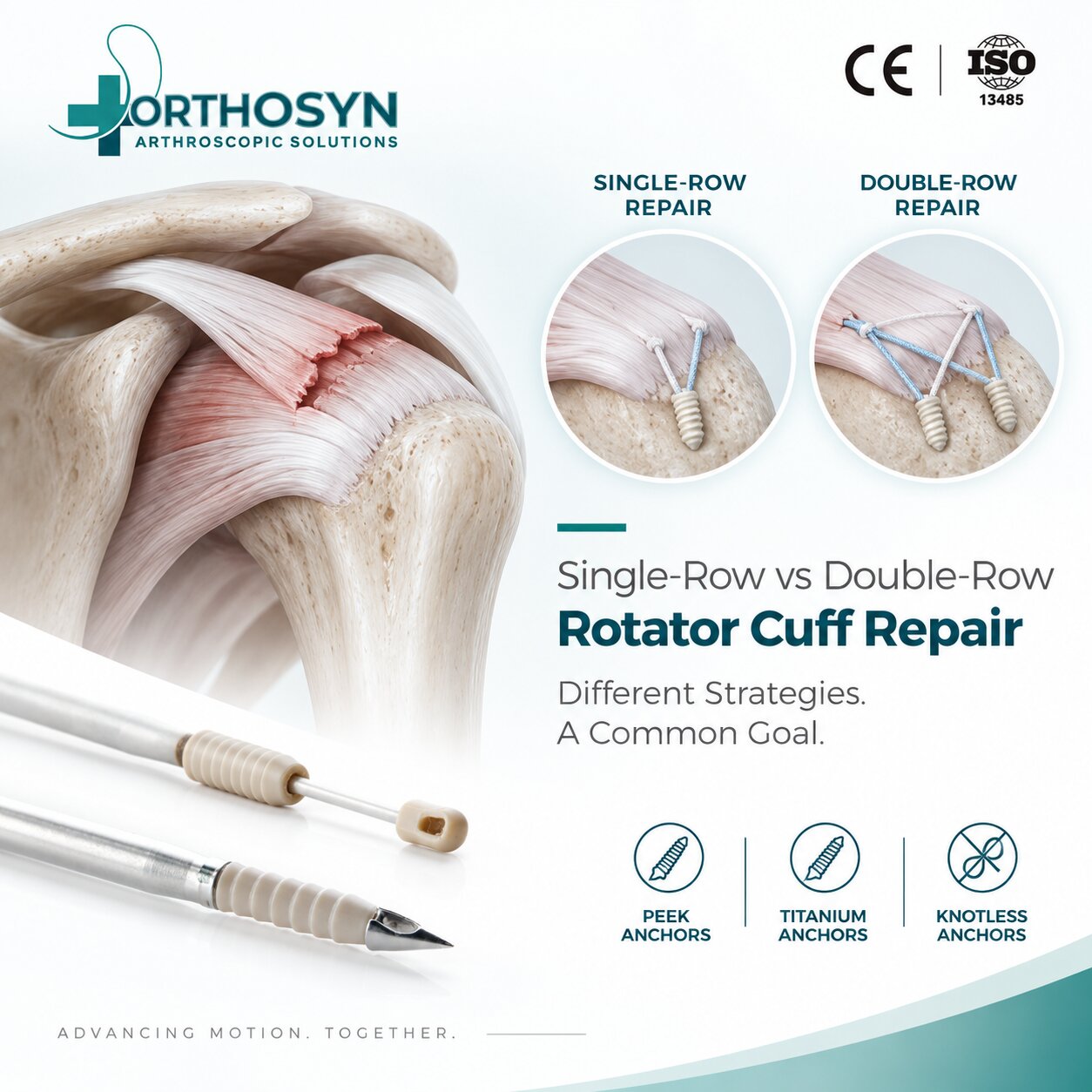
Rotator cuff repair is one of the most common procedures performed in shoulder arthroscopy. When a torn rotator cuff tendon is considered repairable, suture anchors can be used to reattach the tendon to its anatomical insertion on the humeral head.
Two commonly discussed fixation configurations are single-row and double-row rotator cuff repair.
Both techniques aim to restore tendon-to-bone contact and provide stable fixation during healing. However, they differ in the number and arrangement of anchor rows, the resulting repair construct, footprint coverage, technical complexity, and number of implants that may be required.
Within the ORTHOSYN arthroscopy portfolio, PEEK Suture Anchors, Titanium Suture Anchors and Knotless Anchors provide different fixation technologies relevant to arthroscopic rotator cuff repair.
The rotator cuff consists of four muscles and their associated tendons:
These structures contribute to shoulder movement, dynamic stabilization and control of the humeral head.
A rotator cuff tear occurs when one or more of these tendons become partially or completely disrupted.
Rotator cuff tears may be associated with:
The appropriate treatment depends on factors such as tear size, tear configuration, tendon quality, symptoms, patient characteristics and functional requirements.
Arthroscopic rotator cuff repair is a minimally invasive surgical procedure performed through small portals around the shoulder.
The surgeon uses an arthroscope to visualize the joint and subacromial space and specialized instruments to prepare and repair the damaged tendon.
A simplified repair sequence may include:
One of the major decisions during this process is how the anchors will be arranged.
In a single-row rotator cuff repair, suture anchors are positioned in a single line along the greater tuberosity of the humerus.
The sutures connected to these anchors are passed through the torn tendon and secured to approximate the tendon toward its insertion site.
The basic concept is:
Humerus → Single Anchor Row → Sutures → Rotator Cuff Tendon
Depending on the tear and technique, multiple anchors can still be used. The term single-row refers to their arrangement in one row, not necessarily to the use of only one anchor.
A double-row rotator cuff repair uses two anchor rows to create a broader fixation construct.
These are generally described as:
Medial Row → Rotator Cuff Tendon → Lateral Row
The medial anchors are positioned closer to the articular side of the tendon footprint, while lateral fixation is created farther laterally on the greater tuberosity.
This arrangement is intended to increase tendon contact with the prepared footprint.
Modern double-row techniques can include different configurations, including transosseous-equivalent or suture-bridge constructs.
The principal difference is the configuration of tendon fixation to the humerus.
| Feature | Single-Row Repair | Double-Row Repair |
|---|---|---|
| Anchor arrangement | One row | Medial + lateral rows |
| Tendon fixation | Single-row construct | Two-row construct |
| Footprint coverage | More limited | Generally broader |
| Number of anchors | Generally fewer | Generally more |
| Technical complexity | Usually lower | Usually higher |
| Knotless fixation | Can be used depending on technique | Frequently relevant to lateral-row constructs |
| ORTHOSYN relevance | PEEK / Titanium Anchors | PEEK / Titanium / Knotless Anchors |
The choice is not based simply on which technique uses more anchors. Tear characteristics, tendon mobility, tissue quality, footprint anatomy and the surgeon's repair strategy all influence construct selection.
The rotator cuff footprint is the area where the tendon normally attaches to the humeral head.
During rotator cuff repair, the objective is not simply to place sutures through the tendon. The tendon must be brought into appropriate contact with the prepared bone surface.
This creates the fundamental repair concept:
Bone → Suture Anchor → Suture → Tendon → Tendon-to-Bone Contact
One reason double-row repair techniques were developed was to increase the area of tendon contact across the anatomical footprint.
Single-row repair provides a relatively straightforward fixation configuration.
Potential procedural characteristics include:
Simpler construct: Anchors are positioned along a single row.
Fewer fixation points: Depending on the tear, fewer anchors may be required compared with a double-row construct.
Reduced technical complexity: The repair may involve fewer fixation steps.
Established technique: Single-row fixation has been widely used in arthroscopic rotator cuff surgery.
For some tears, a single-row construct may provide the fixation strategy selected by the surgeon.
Double-row repair was developed to create broader tendon-to-bone contact across the rotator cuff footprint.
Potential characteristics include:
Greater footprint coverage: The tendon can be compressed across a broader area of the prepared humeral footprint.
Multiple fixation points: Medial and lateral fixation points create a broader repair construct.
Suture-bridge possibilities: Double-row techniques can be configured to create transosseous-equivalent or suture-bridge constructs.
Knotless lateral fixation: Knotless anchors can be particularly relevant when creating certain lateral-row constructs.
However, a more complex construct does not automatically mean it is preferable for every rotator cuff tear.
There is no universal answer for every tear and every patient.
Biomechanical studies have generally demonstrated advantages of double-row constructs in areas such as footprint restoration and tendon-to-bone contact.
Clinical research, however, is more nuanced. Studies and systematic reviews have reported improvements after both techniques, while differences between single-row and double-row repair may depend on factors such as:
Some evidence suggests that double-row repair may offer particular structural advantages in larger tears, but the choice of repair should be individualized rather than treating one configuration as universally superior.
A suture-bridge repair is a form of double-row or transosseous-equivalent fixation.
A simplified configuration is:
Medial Anchor → Suture Across Tendon → Lateral Knotless Anchor
Sutures from the medial fixation points cross over the repaired tendon and are secured laterally.
This creates compression of the tendon against the prepared footprint.
Because the lateral anchor can capture and tension sutures without requiring a conventional knot at the lateral fixation point, knotless anchors are particularly relevant to this type of construct.
PEEK — polyether ether ketone — is a polymer used in orthopedic implant technology.
PEEK suture anchors provide a rigid, non-metallic fixation option for soft tissue-to-bone repair.
Within rotator cuff surgery, a PEEK anchor can serve as a fixation point for high-strength sutures used to secure the tendon.
Characteristics associated with PEEK anchor technology include:
Within the ORTHOSYN portfolio, PEEK anchor technology provides one option for arthroscopic soft tissue fixation.
Titanium Suture Anchors represent a conventional metallic fixation approach.
The anchor is inserted into the prepared humeral bone, while the associated sutures are passed through the rotator cuff tendon.
The basic fixation principle is:
Humeral Bone → Titanium Anchor → High-Strength Suture → Rotator Cuff Tendon
Titanium anchors therefore provide another rigid fixation option within the ORTHOSYN anchor portfolio.
Knotless anchors are particularly relevant to modern rotator cuff repair constructs because they allow sutures to be captured, tensioned and secured without conventional arthroscopic knot tying at that fixation point.
In a double-row suture-bridge configuration, sutures originating from the medial row can be secured laterally using knotless anchors.
The concept becomes:
Medial Fixation → Suture Bridge → Lateral Knotless Fixation
ORTHOSYN offers Knotless PEEK+PEEK and Knotless PEEK+Titanium anchor technologies in the arthroscopy portfolio, including 3.5 mm and 5.0 mm configurations.
These technologies provide different material and fixation concepts for arthroscopic soft tissue repair.
Rotator cuff tears vary considerably in size and morphology.
They may be described as:
A repair configuration suitable for a small tear may not necessarily be appropriate for a larger or more complex lesion.
Surgeons therefore consider factors such as:
This is why the comparison between single-row and double-row repair should be understood as a comparison of repair strategies, rather than a simple competition between two techniques.
Rotator cuff pathology is particularly relevant in activities involving repetitive overhead movement.
This includes athletes participating in sports such as:
Rotator cuff tears also occur outside sports and may result from degeneration, occupational loading or traumatic injuries.
From an informational and SEO perspective, this creates a broad pathway:
Shoulder Pain → Rotator Cuff Tear → Shoulder Arthroscopy → Rotator Cuff Repair → Single-Row vs Double-Row → Suture Anchor Selection
The ORTHOSYN arthroscopy portfolio includes several anchor technologies relevant to arthroscopic soft tissue-to-bone fixation.
For the single-row vs double-row rotator cuff repair topic, the principal product categories are:
Rigid, non-metallic PEEK anchor technology for suture-based soft tissue fixation.
Rigid metallic anchors providing a conventional titanium fixation concept.
Knotless fixation technologies available in PEEK+PEEK and PEEK+Titanium configurations, particularly relevant to repair strategies where sutures need to be tensioned and secured without conventional knot tying at the fixation point.
Together, these technologies allow the ORTHOSYN anchor portfolio to support different fixation concepts used across arthroscopic shoulder procedures.
Anchor type, size and configuration should always be selected according to the surgical technique, anatomy, tissue and bone quality, as well as the specific product indications and instructions for use.
Single-row and double-row rotator cuff repair are two arthroscopic strategies for reattaching a torn rotator cuff tendon to the humerus.
Single-row repair positions anchors in one row along the tendon insertion area, while double-row repair creates medial and lateral fixation points to establish a broader tendon-to-bone construct.
Neither configuration should be considered universally appropriate for every rotator cuff tear. The repair strategy depends on the tear size, tendon quality, mobility, anatomy, bone quality and surgeon's selected technique.
Suture anchors are central to both approaches. Within the ORTHOSYN arthroscopy portfolio, PEEK Suture Anchors, Titanium Suture Anchors and Knotless Anchors provide different technologies relevant to these fixation strategies.
This creates a strong connection between the ORTHOSYN anchor portfolio and searches involving rotator cuff tears, shoulder arthroscopy, single-row repair, double-row repair and suture-bridge fixation.