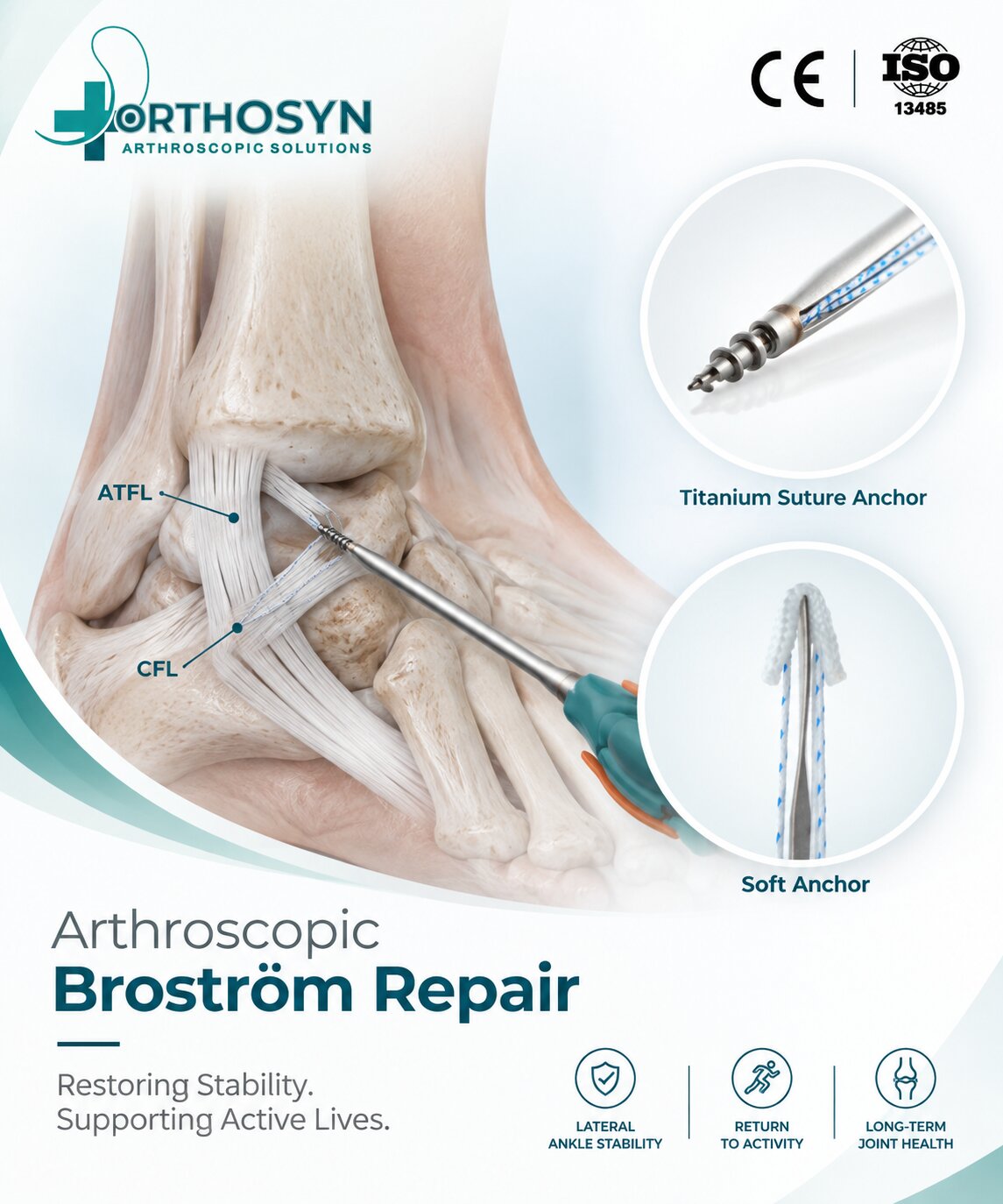
Arthroscopic Broström repair is a minimally invasive surgical technique used to treat selected cases of chronic lateral ankle instability by repairing and tightening damaged lateral ankle ligaments.
The procedure is based on the principles of the traditional Broström repair but is performed arthroscopically through small portals. Suture anchors can be placed into the fibula to provide fixation points for repairing the lateral ligament complex.
Within the ORTHOSYN arthroscopy portfolio, Soft Anchors and Titanium Suture Anchors provide anchor technologies relevant to soft tissue-to-bone fixation procedures such as arthroscopic lateral ankle ligament repair.
The ankle can become unstable after one or multiple lateral ankle sprains.
The lateral ligament complex includes several structures, with the anterior talofibular ligament (ATFL) and calcaneofibular ligament (CFL) playing important roles in lateral ankle stability.
The ATFL is particularly vulnerable during inversion injuries.
In some patients, the injured ligaments do not regain sufficient mechanical stability after conservative treatment. This can lead to chronic lateral ankle instability, which may be associated with:
When symptoms and instability persist despite appropriate non-operative treatment, surgical stabilization may be considered.
The Broström procedure is an anatomical ligament repair technique designed to restore stability by repairing the patient's existing lateral ankle ligaments.
Rather than replacing the ligament with a graft in every case, the procedure generally aims to restore the native ligament structures when their condition allows repair.
The procedure commonly focuses on the ATFL, with the CFL also addressed when indicated.
The fundamental objective is:
Damaged Lateral Ligament → Anatomical Repair → Restoration of Lateral Ankle Stability
Traditional Broström repair is performed through an open surgical approach.
An arthroscopic Broström repair applies similar anatomical repair principles using ankle arthroscopy.
Through small arthroscopic portals, the surgeon can evaluate the joint, identify relevant pathology and perform lateral ligament repair using specialized instruments and fixation devices.
A simplified surgical sequence may include:
The exact technique can vary according to the patient's anatomy, ligament condition and surgeon preference.
Suture anchors provide a method for attaching the damaged ligament tissue back to bone.
During anchor-based Broström repair, the anchor is typically positioned at the appropriate fibular attachment site.
The suture connected to the anchor is passed through the ligament tissue. The repair construct is then tensioned to approximate the ligament toward its anatomical attachment.
The basic fixation concept can be represented as:
Fibula → Suture Anchor → High-Strength Suture → Lateral Ankle Ligament
Depending on the repair technique and extent of the injury, more than one anchor may be used.
The fibula provides a limited anatomical area for ligament fixation.
Anchor positioning therefore requires consideration of:
Proper trajectory is particularly important because anchor placement must provide fixation while avoiding unwanted penetration into surrounding structures.
Soft anchors, also known as all-suture anchors, provide a fixation concept in which the implanted anchor component is predominantly based on high-strength suture material rather than a conventional rigid anchor body.
A major characteristic of this technology is the possibility of using small-diameter bone tunnels.
This can be relevant in ankle ligament repair because the available bone area for anchor placement may be limited and more than one fixation point can be required.
ORTHOSYN offers Soft Anchors manufactured from UHMWPE in several diameters, including:
Configurations with and without a needle are available within the ORTHOSYN Soft Anchor portfolio.
Titanium suture anchors provide a rigid metallic alternative for soft tissue-to-bone fixation.
The titanium anchor is inserted into a prepared bone site, while the attached high-strength suture is used to secure the ligament tissue.
In Broström-type repairs, this fixation concept can be used to reattach lateral ligament tissue to its fibular attachment.
Titanium anchors offer a different fixation approach from Soft Anchors:
Soft Anchor → Predominantly suture-based implant structure
Titanium Anchor → Rigid metallic anchor structure
The appropriate anchor type and size depend on the surgical technique, anatomy, bone quality and surgeon preference.
The anterior talofibular ligament (ATFL) is one of the primary structures addressed during many Broström repairs.
The ATFL extends between the fibula and talus and contributes to lateral ankle stability.
Following repeated ankle sprains, the ligament may become attenuated, damaged or insufficient.
During an anchor-based repair, sutures can be used to approximate the ligament toward its fibular attachment.
This creates an important clinical relationship:
Chronic Ankle Instability → ATFL Injury → Broström Repair → Suture Anchor Fixation
For SEO purposes, this also connects broader patient and surgeon searches for ankle instability with the anchor technologies used during surgical stabilization.
The calcaneofibular ligament (CFL) is another component of the lateral ankle ligament complex.
Not every Broström procedure requires the same treatment of the CFL. The surgical strategy depends on the injury pattern and the degree of instability identified during clinical and surgical assessment.
When necessary, the lateral ligament repair strategy may address both the ATFL and CFL components.
This is one reason the term lateral ankle ligament repair is useful alongside the more specific term Broström repair.
Both open and arthroscopic approaches are used for lateral ankle ligament stabilization.
The open technique provides direct surgical exposure of the lateral ligament structures.
The arthroscopic approach uses small portals and allows intra-articular assessment during the same procedure.
Published systematic reviews and meta-analyses generally report improvement in clinical outcomes with both approaches. Differences have been reported in individual outcomes and complication profiles, but current evidence does not establish that one approach is universally preferable for every patient.
The selection of technique therefore depends on factors such as:
Chronic ankle instability can coexist with other intra-articular abnormalities.
An arthroscopic approach allows the surgeon to inspect the ankle joint and identify associated pathology while performing the stabilization procedure.
This can include evaluation of structures such as:
This ability to combine joint assessment with ligament stabilization is one of the reasons ankle arthroscopy is relevant in the treatment pathway for chronic lateral ankle instability.
Lateral ankle sprains are common in sports involving running, jumping, rapid direction changes and landing.
Recurrent instability can therefore be particularly relevant in athletes participating in:
This creates a natural informational pathway:
Ankle Sprain → Recurrent Ankle Instability → Chronic Lateral Ankle Instability → Broström Repair → Suture Anchor Fixation
For ORTHOSYN, educational content around Broström repair helps connect searches for ankle pathology and surgical techniques with the broader suture anchor portfolio.
The ORTHOSYN arthroscopy portfolio includes different anchor technologies for arthroscopic soft tissue fixation.
For the Broström repair topic, the most relevant product categories are:
UHMWPE-based Soft Anchors available in multiple small-diameter configurations, providing a soft-anchor approach to soft tissue-to-bone fixation.
Rigid titanium anchors combined with high-strength sutures, providing a conventional metallic fixation concept for ligament and soft tissue repair.
These two technologies allow the ORTHOSYN portfolio to address different anchor preferences and fixation concepts within arthroscopic surgery.
The final selection of anchor type, diameter and configuration should be based on the specific procedure, anatomy and the product's intended use and instructions for use.
Arthroscopic Broström repair is a minimally invasive approach to anatomical lateral ankle ligament stabilization in selected patients with chronic lateral ankle instability.
The procedure commonly focuses on repairing the ATFL, with additional lateral ligament structures addressed when clinically indicated.
Suture anchors provide fixation points in the fibula, allowing sutures to secure the damaged ligament tissue toward its anatomical attachment.
Soft Anchors and Titanium Suture Anchors represent two different fixation concepts relevant to this type of arthroscopic soft tissue-to-bone repair. The ORTHOSYN portfolio includes both technologies, creating a natural connection between ankle arthroscopy, Broström repair, ATFL repair and suture anchor fixation.