Synovial fluid is the clear, viscous fluid found inside synovial joints such as the knee, shoulder, hip and ankle.
It plays an essential role in normal joint function by helping reduce friction between articular surfaces, supporting smooth movement and contributing to the mechanical environment of the joint.
One of the key components of synovial fluid is hyaluronic acid (HA). Hyaluronic acid contributes significantly to the viscosity and viscoelasticity of synovial fluid, which is why it is closely associated with joint lubrication and intra-articular HA applications.
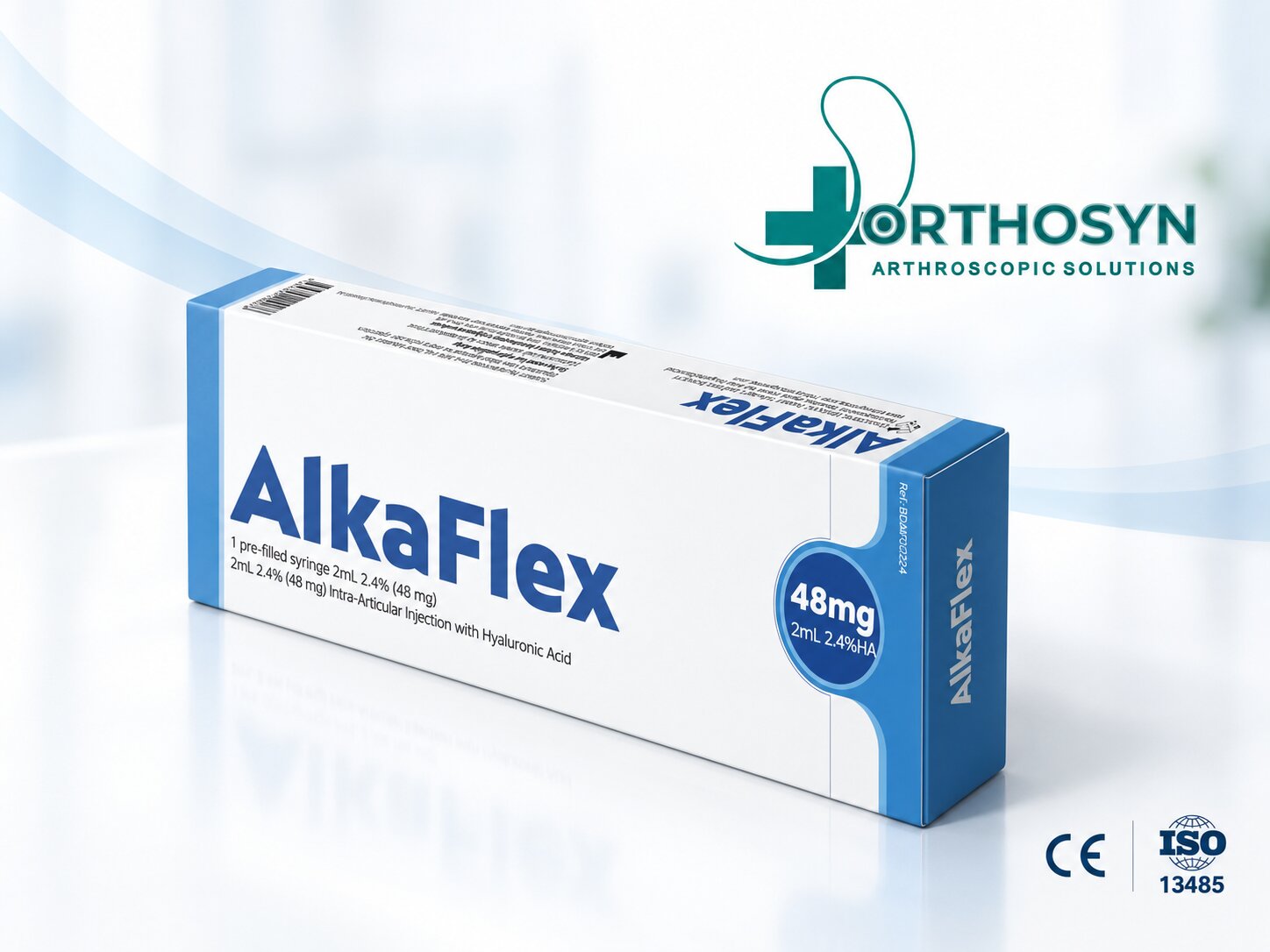
Understanding synovial fluid also helps explain the role of products such as AlkaFlex Linear Intra-Articular Hyaluronic Acid.
Synovial fluid is located inside synovial joints.
These joints include many of the body’s major movable joints, such as:
The joint cavity is lined by the synovial membrane, which contributes to the production and maintenance of synovial fluid.
The fluid occupies the space between the articular surfaces and forms part of the joint’s internal mechanical environment.
Synovial fluid contains a combination of water, proteins, electrolytes and other biological molecules.
One of its most important macromolecular components is hyaluronic acid.
HA influences important physical properties of synovial fluid, including:
These characteristics help synovial fluid perform its mechanical functions during movement and loading.
Articular surfaces move against each other repeatedly throughout the day.
Without an effective lubrication system, friction between these surfaces would increase.
Synovial fluid helps create a low-friction environment within the joint.
Hyaluronic acid contributes to this process by influencing the fluid’s viscosity and rheological behavior.
This helps support smooth movement between joint surfaces.
Hyaluronic acid is one of the most important molecules affecting the physical characteristics of synovial fluid.
Its role is associated with:
HA consists of long polymer chains.
The size and concentration of these molecules influence the overall properties of synovial fluid.
This is one reason why molecular weight and concentration are important when discussing intra-articular hyaluronic acid products.
Synovial fluid does not behave simply like water.
It has both viscous and elastic characteristics.
This combination is called viscoelasticity.
Viscosity describes resistance to flow.
Elasticity refers to the ability of a material to deform and respond to mechanical forces.
Because synovial fluid combines these properties, it can behave differently depending on the type of movement and loading placed on the joint.
During slower movement, viscosity contributes to lubrication.
During higher mechanical loading, elastic characteristics help the joint environment respond to force.
Hyaluronic acid is an important contributor to this viscoelastic behavior.
Synovial fluid forms part of the mechanical environment that helps joints respond to changing loads.
During activities such as:
the joint is exposed to repeated forces.
The viscoelastic characteristics of synovial fluid contribute to its ability to respond to these changes.
For this reason, synovial fluid and hyaluronic acid are frequently discussed in relation to cushioning and shock absorption.
Articular cartilage does not have the same direct blood supply as many other tissues.
The synovial environment therefore plays an important role in the movement of nutrients and metabolic products around the articular surfaces.
Synovial fluid also helps maintain the mechanical environment in which cartilage functions.
Its role should therefore not be viewed only as lubrication.
It forms part of a broader biological and mechanical system within the joint.
In osteoarthritis, both the structure of the joint and the composition of the synovial environment can change.
Changes may include alterations in:
These changes can cause synovial fluid to behave differently compared with fluid in a healthy joint.
This is one of the concepts behind the use of intra-articular hyaluronic acid in viscosupplementation.
The molecular weight of hyaluronic acid refers to the size of its polymer chains.
Molecular weight can influence:
However, molecular weight is not the only factor that determines the characteristics of an HA formulation.
Other important parameters include:
Linear hyaluronic acid consists of HA polymer chains without an intentionally created cross-linked molecular network.
This structure represents one of the established approaches used in intra-articular HA formulations.
The AlkaFlex Linear Intra-Articular Hyaluronic Acid portfolio includes linear HA formulations designed for intra-articular use.
Explore AlkaFlex Linear Hyaluronic Acid:
https://orthosynmed.com/product/39/alkaflex-intra-articular-injections-with-hyaluronic-acid---linear-linked
Because linear HA is closely related to the naturally occurring polymer structure of hyaluronic acid, it is particularly relevant when discussing the role of HA within synovial fluid.
Viscosupplementation involves administering a hyaluronic acid formulation directly into a synovial joint.
The concept is closely related to the role of naturally occurring HA in synovial fluid.
However, commercial HA formulations should not be considered identical to endogenous synovial fluid.
Instead, they are specifically formulated intra-articular products with defined characteristics such as:
Understanding normal synovial fluid provides useful context for understanding these products.
When evaluating an intra-articular HA formulation, it is useful to understand which technical characteristics influence fluid behavior.
These include:
Molecular weight
Influences polymer behavior and rheological properties.
Concentration
Determines how much HA is present per milliliter.
Total dose
Defines the total quantity of HA delivered.
Molecular structure
HA may be linear or cross-linked.
Viscosity and elasticity
Describe important physical characteristics of the formulation.
Evaluating these factors together provides a more complete understanding of an HA product.
AlkaFlex is Orthosyn Medikal’s international brand for intra-articular hyaluronic acid formulations.
The AlkaFlex Linear portfolio provides linear HA formulations designed for intra-articular application.
Its positioning within the HA category is directly related to key concepts surrounding synovial fluid, including:
This makes synovial fluid an important foundational topic for understanding intra-articular HA technology.
Synovial fluid is essential for normal joint function.
It contributes to:
Hyaluronic acid is one of the key molecules responsible for the viscosity and viscoelastic characteristics of synovial fluid.
Understanding the relationship between synovial fluid and hyaluronic acid provides important context for understanding intra-articular HA formulations and viscosupplementation.
The AlkaFlex Linear Intra-Articular Hyaluronic Acid portfolio represents Orthosyn Medikal’s linear HA approach within its international intra-articular product range.
AlkaFlex Linear Intra-Articular Hyaluronic Acid
https://orthosynmed.com/product/39/alkaflex-intra-articular-injections-with-hyaluronic-acid---linear-linked