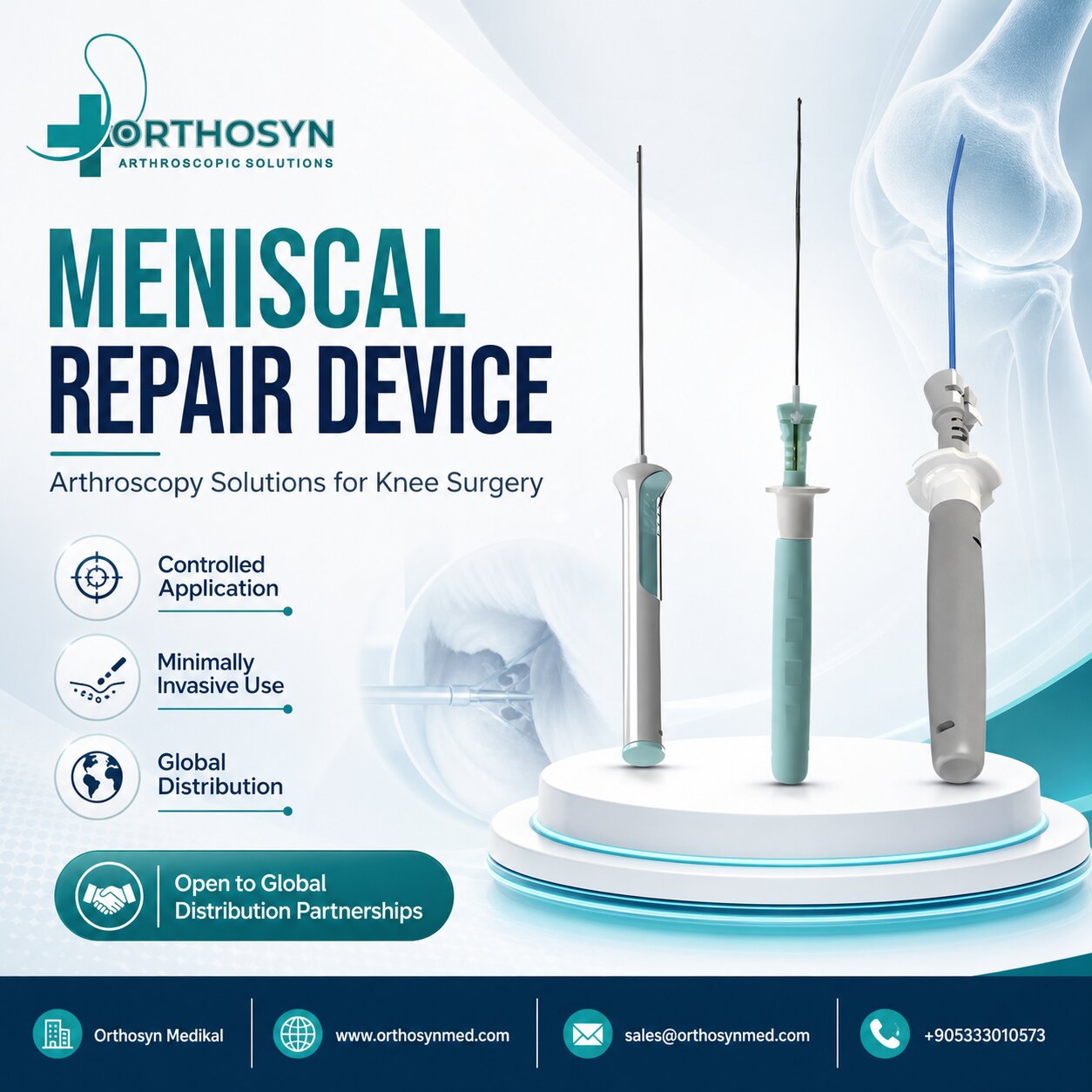
Meniscal preservation has become an important principle in modern knee surgery. When a meniscal tear is considered repairable, the objective is to restore the damaged tissue while preserving as much functional meniscus as possible.
Two commonly used arthroscopic repair approaches are all-inside meniscus repair and inside-out meniscus repair.
Both techniques aim to stabilize the meniscal tear and support healing, but they differ significantly in how the sutures or fixation implants are introduced, how the repair is secured, and what additional surgical access is required.
For the ORTHOSYN arthroscopy portfolio, this topic is particularly relevant because the VersaFix Meniscal Repair System provides an all-inside meniscal repair solution using PEEK implants and UHMWPE suture, while high-strength sutures are also relevant to conventional meniscal suturing techniques.
The medial and lateral menisci are fibrocartilaginous structures located between the femur and tibia.
They contribute to:
When possible and clinically appropriate, repairing a damaged meniscus can preserve meniscal tissue instead of removing the torn portion.
Whether a tear is suitable for repair depends on factors including the tear pattern, location, tissue quality, vascularity, chronicity and associated knee injuries.
All-inside meniscus repair is performed arthroscopically with the fixation construct deployed from within the joint.
Modern all-inside systems typically use a delivery device that allows fixation components to be positioned across the meniscal tear without requiring the long needles and additional posteromedial or posterolateral access commonly associated with inside-out repair.
The basic concept is:
Arthroscopic Portal → Meniscal Repair Device → Fixation Implant → Suture Construct → Meniscus
This approach has become widely used because the repair can be performed through standard arthroscopic portals.
Systematic reviews have found that all-inside repair can reduce operative time compared with inside-out repair, although outcomes depend heavily on tear type, patient characteristics and the device or technique being used.
In an all-inside repair, the surgeon advances the delivery system arthroscopically toward the meniscal tear.
Depending on the device design, fixation elements are deployed around or beyond the meniscal tissue. The connected suture construct is then tensioned to approximate and stabilize the tear.
A simplified sequence is:
Identify Tear → Position Device → Deploy Fixation → Tension Suture → Stabilize Meniscus
This enables the repair construct to be created without retrieving long suture needles through an additional posterior incision.
The VersaFix Meniscal Repair System is the relevant ORTHOSYN solution for the all-inside technique.
The system incorporates:
The depth limiter can be adjusted according to the surgical requirement, helping control penetration during deployment.
The two fixation implants and connecting suture create an all-inside fixation construct across the meniscal tear.
This makes VersaFix directly relevant to searches for:
all-inside meniscus repair, arthroscopic meniscus repair, meniscal repair device and meniscal fixation system.
Inside-out meniscus repair uses sutures passed from inside the knee joint through the meniscus and joint capsule toward the outside of the knee.
Long needles carrying sutures are introduced arthroscopically and passed through the meniscal tissue.
The needles exit through the capsule and are retrieved through an additional incision. The sutures are then tied externally over the capsule.
The basic concept is:
Inside the Joint → Meniscus → Capsule → Outside the Joint → Suture Fixation
This technique allows the surgeon to create multiple sutures along the meniscal tear and remains an established method of meniscal repair.
One of the principal differences between the techniques is how the sutures are managed.
With inside-out repair, needles must pass from the intra-articular space through the capsule and be retrieved externally.
This generally requires an additional posteromedial or posterolateral surgical approach, depending on the location of the repair.
Careful protection of the surrounding neurovascular structures is therefore important.
By comparison, modern all-inside systems are designed to complete the fixation from within the arthroscopic working environment without the same needle-retrieval process.
A 2021 systematic review found a lower incidence of nerve injury with all-inside repair and shorter operative time, while finding no significant difference in meniscal healing rates between the two groups.
The fundamental difference is therefore not the objective of the procedure. Both techniques attempt to stabilize the torn meniscus and preserve meniscal tissue.
The difference lies primarily in how fixation is created.
| Feature | All-Inside Repair | Inside-Out Repair |
|---|---|---|
| Arthroscopic technique | Yes | Yes |
| Fixation | Dedicated implant/suture construct | Suture-based |
| Additional posterior incision | Generally not required for fixation | Typically required |
| Needle passage | Controlled through delivery system | From inside joint to outside capsule |
| External knot tying | Generally avoided | Typically required |
| ORTHOSYN relevance | VersaFix Meniscal Repair System | UHMWPE suture technology |
The exact technique selected depends on the tear pattern, tear location, anatomy, surgeon preference and available fixation system.
There is no simple universal answer.
Published evidence does not establish one technique as superior for every meniscal tear or patient population.
A 2023 systematic review of 39 studies involving 1,848 patients found no significant differences between all-inside and inside-out techniques in several patient-reported outcomes or overall failure and reoperation rates, although differences were reported for reinjury and return-to-play measures.
More recent evidence illustrates why the comparison remains nuanced. A 2025 meta-analysis found broadly comparable clinical success but reported a higher pooled failure rate for all-inside repair in its comparative studies; the authors also noted that this result was influenced by an elite-athlete cohort.
Long-term evidence likewise shows similar failure rates between modern all-inside and inside-out repairs in some analyses, while emphasizing that outcomes can depend on factors such as meniscal side, tear characteristics and the generation of the repair device.
Therefore, the clinically relevant question is usually not simply:
“Which technique is better?”
but rather:
“Which repair technique is appropriate for this particular meniscal tear?”
Modern all-inside repair offers several procedural characteristics:
Arthroscopic workflow: Fixation can be performed through standard arthroscopic portals.
No conventional inside-out needle retrieval: The technique avoids passing long repair needles through the capsule for external retrieval.
Reduced additional access: An additional posterior incision used for conventional inside-out suture retrieval can generally be avoided.
Controlled delivery: Dedicated systems allow the surgeon to position and deploy fixation components arthroscopically.
Potentially shorter operative time: Comparative evidence has reported reduced operating time with all-inside techniques.
These characteristics help explain the development and widespread use of modern all-inside meniscal repair devices.
Inside-out repair remains an important meniscal suturing technique.
It allows multiple sutures to be placed across a tear and gives surgeons flexibility in configuring the repair according to the tear pattern.
The technique has a substantial clinical history and continues to be used for a variety of repairable meniscal lesions.
However, it requires suture passage through the capsule and external retrieval, making the surgical approach and protection of surrounding structures important parts of the technique.
The choice between all-inside and inside-out repair cannot be separated from the characteristics of the meniscal tear.
Examples include:
Different tear configurations create different mechanical requirements.
For example, a 2024 systematic review focusing specifically on bucket-handle meniscus tears found improvement in patient-reported outcomes with both all-inside and inside-out techniques, while reporting broad and overlapping ranges of failure rates.
Evidence for radial tears also demonstrates that results can differ from those seen in other tear patterns, reinforcing the importance of evaluating the specific pathology rather than assuming that one repair method is universally preferable.
A meniscal repair construct must maintain tissue approximation while biological healing progresses.
For this reason, the properties of the suture are an important component of the fixation system.
UHMWPE — Ultra-High-Molecular-Weight Polyethylene — is widely used in high-strength orthopedic sutures.
In the VersaFix Meniscal Repair System, UHMWPE suture connects the fixation components and contributes to stabilization of the meniscal repair construct.
The ORTHOSYN portfolio also includes Enhanced UHMWPE Sutures, connecting the company's broader high-strength suture technology with arthroscopic soft tissue repair.
Meniscal injuries are common within sports medicine, particularly in activities involving pivoting, rotation, sudden changes of direction and substantial loading of the knee.
Meniscal tears may also occur together with ligament injuries such as an ACL tear.
Preservation of meniscal tissue is particularly relevant in active patients because the meniscus contributes to normal load distribution and joint mechanics.
This creates an important informational search pathway:
Sports Injury → Knee Pain → Meniscus Tear → Meniscus Repair → All-Inside vs Inside-Out Repair → Meniscal Repair System
For ORTHOSYN, this allows the VersaFix system to be introduced naturally within clinically relevant educational content rather than relying exclusively on direct product searches.
For this topic, the primary ORTHOSYN product connection is the VersaFix Meniscal Repair System.
VersaFix represents the all-inside side of the comparison, combining PEEK fixation implants with UHMWPE suture in an arthroscopic delivery system.
This creates a clear separation between SEO objectives.
The product page can target commercial terms such as:
meniscal repair system, all-inside meniscal repair device, meniscus repair device, VersaFix
while this educational article targets:
all-inside vs inside-out meniscus repair, meniscus repair techniques, arthroscopic meniscus repair and meniscal tear repair.
This approach strengthens the relationship between procedure-based searches and the ORTHOSYN meniscal repair portfolio without making the blog compete directly with the product page.
All-inside and inside-out meniscus repair share the same fundamental objective: stabilizing a repairable meniscal tear while preserving meniscal tissue.
The main difference lies in the method used to create the fixation.
Inside-out repair passes sutures from within the joint through the capsule for external retrieval and fixation. All-inside repair uses a dedicated arthroscopic system to create the repair construct without the same conventional external needle-retrieval process.
Current evidence does not demonstrate that one technique is universally superior. Outcomes vary according to factors such as tear pattern, meniscal location, patient characteristics, associated injuries and repair technology.
Within the ORTHOSYN portfolio, the VersaFix Meniscal Repair System, incorporating PEEK implants and UHMWPE suture, provides the direct product connection to modern all-inside meniscal repair.