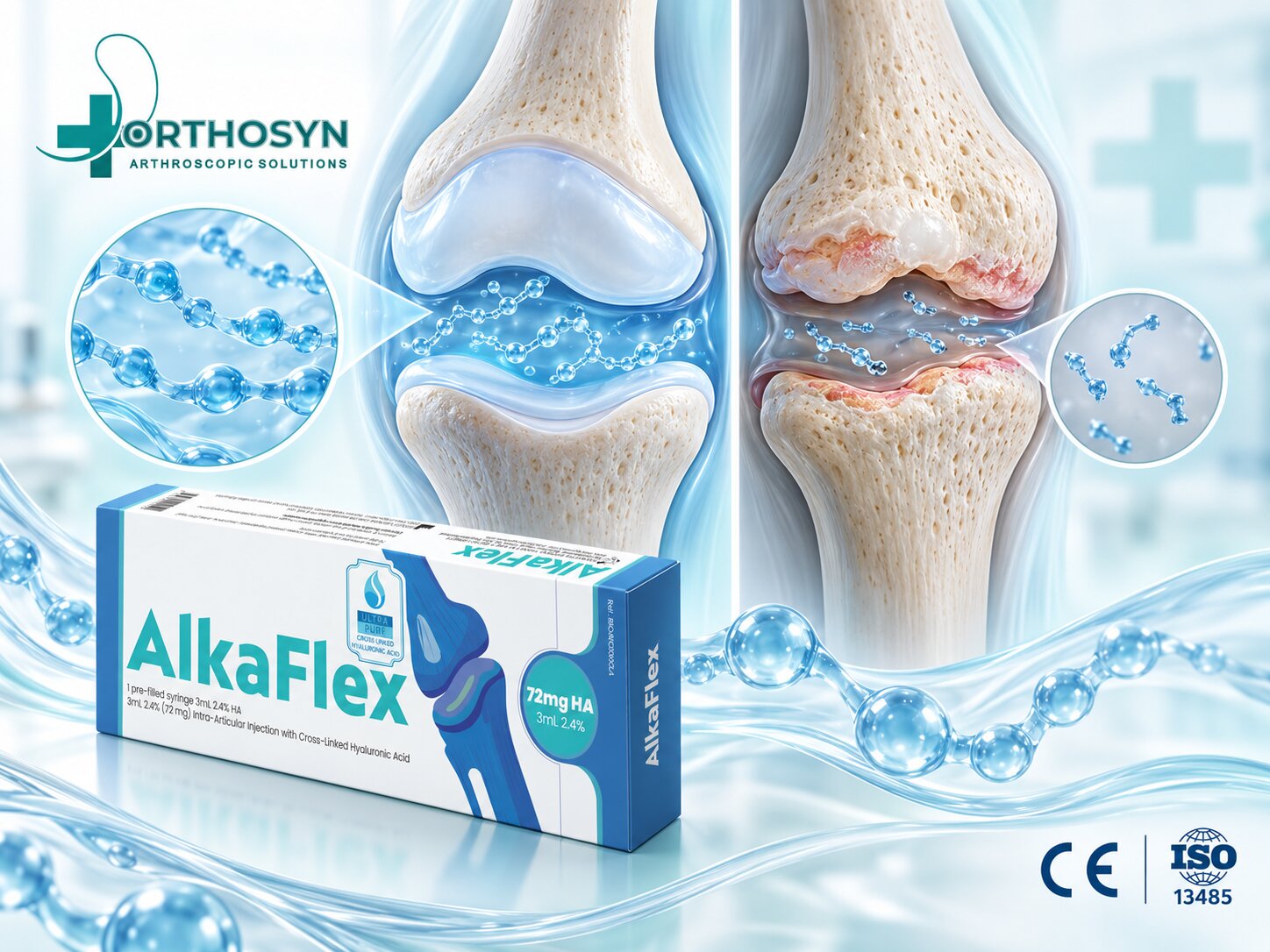
Hyaluronic acid (HA) is a natural component of synovial fluid and plays an important role in joint lubrication, viscoelasticity and mechanical function.
In osteoarthritis, the environment inside the joint changes. These changes can affect the naturally occurring hyaluronic acid in the synovial fluid, including its molecular weight, concentration and rheological behavior.
Understanding what happens to hyaluronic acid in osteoarthritis helps explain why intra-articular HA formulations are used within viscosupplementation strategies.
In a healthy synovial joint, hyaluronic acid contributes to the physical properties of synovial fluid.
Its functions are associated with:
These properties help the joint respond to changing mechanical loads during everyday movement.
Osteoarthritis is associated with structural and biochemical changes within the joint.
These may involve:
Hyaluronic acid is one of the molecules affected by this altered joint environment.
One of the most important changes discussed in osteoarthritis is a shift in the molecular-weight profile of endogenous hyaluronic acid.
In a healthy joint, synovial HA typically includes high-molecular-weight polymer chains.
In osteoarthritis, degradation and altered metabolism can contribute to a greater proportion of lower-molecular-weight HA fragments.
This can affect the physical behavior of synovial fluid.
Lower effective molecular weight may be associated with changes in:
This is why molecular weight is such an important parameter when evaluating intra-articular hyaluronic acid products.
The concentration of endogenous HA in synovial fluid can also be altered in osteoarthritis.
Changes in concentration can influence the viscosity and flow characteristics of synovial fluid.
However, concentration should not be considered separately from molecular weight.
The behavior of HA depends on multiple factors working together, including:
molecular weight + concentration + molecular structure + joint environment
This is also why two HA products with the same concentration may still behave differently if their molecular weights or molecular structures are not the same.
Because hyaluronic acid is an important contributor to synovial fluid rheology, changes in HA can alter the mechanical properties of the fluid.
In osteoarthritis, synovial fluid may become less viscous and show altered elastic behavior compared with a healthy joint.
This can affect its ability to perform mechanical functions associated with:
The concept of viscosupplementation is closely related to these changes.
Viscoelasticity refers to a material having both viscous and elastic characteristics.
Synovial fluid uses both behaviors depending on the type of movement and mechanical load.
At slower movement, viscosity supports lubrication.
During faster movement or greater loading, elastic behavior helps the fluid respond to mechanical forces.
When the molecular weight or concentration of hyaluronic acid changes, the viscoelastic profile of synovial fluid may also change.
No.
Hyaluronic acid is often discussed because of its mechanical contribution to synovial fluid, but it also interacts with cells and molecules within the joint environment.
Its biological effects can vary depending on factors such as:
For this reason, high- and low-molecular-weight HA may not behave identically at the biological level.
However, when evaluating a commercial intra-articular HA formulation, it is important to assess the complete product profile rather than attributing clinical performance to molecular weight alone.
Intra-articular hyaluronic acid formulations are administered directly into the joint space.
They are used within viscosupplementation approaches to introduce exogenous HA into the synovial environment.
Different formulations may vary according to:
This is important because osteoarthritis affects the joint environment in multiple ways, while HA products themselves also have different technical characteristics.
Linear hyaluronic acid consists of polymer chains without an intentionally created cross-linked network.
The AlkaFlex Linear Intra-Articular Hyaluronic Acid portfolio includes linear HA formulations designed for intra-articular use.
Explore AlkaFlex Linear Hyaluronic Acid:
https://orthosynmed.com/product/39/alkaflex-intra-articular-injections-with-hyaluronic-acid---linear-linked
Linear HA represents one formulation approach within the broader viscosupplementation category.
Cross-linked HA contains a modified molecular network created by connecting hyaluronic acid chains.
Cross-linking can influence technical characteristics such as:
The AlkaFlex Cross-Linked Intra-Articular Hyaluronic Acid portfolio represents this formulation approach.
Explore AlkaFlex Cross-Linked Hyaluronic Acid:
https://orthosynmed.com/product/44/alkaflex-intra-articular-injections-with-cross-linked-hyaluronic-acid
A common mistake is to focus on only one specification.
For example, a higher HA concentration does not automatically mean a higher molecular weight.
Likewise, a high molecular weight does not by itself describe the full rheological behavior of a product.
When comparing HA formulations, it is more useful to examine:
Together, these parameters provide a more complete technical profile.
When evaluating an intra-articular HA formulation, useful questions include:
These questions are more informative than comparing products only by brand name or milligram value.
AlkaFlex is Orthosyn Medikal’s international brand for intra-articular hyaluronic acid formulations.
The portfolio includes:
This allows AlkaFlex products to be evaluated according to the same technical characteristics that are relevant when discussing changes in hyaluronic acid within osteoarthritic joints.
In osteoarthritis, naturally occurring hyaluronic acid in the joint may undergo important changes in:
These changes can alter the mechanical characteristics of synovial fluid.
This is one of the key concepts behind the use of intra-articular HA formulations in viscosupplementation.
Because HA products vary considerably, it is important to evaluate their full technical profile, including molecular weight, concentration, total dose and molecular structure.
AlkaFlex offers both Linear and Cross-Linked intra-articular hyaluronic acid formulations within Orthosyn Medikal’s international HA portfolio.
AlkaFlex Linear Intra-Articular Hyaluronic Acid
https://orthosynmed.com/product/39/alkaflex-intra-articular-injections-with-hyaluronic-acid---linear-linked
AlkaFlex Cross-Linked Intra-Articular Hyaluronic Acid
https://orthosynmed.com/product/44/alkaflex-intra-articular-injections-with-cross-linked-hyaluronic-acid
SEO Title: What Happens to Hyaluronic Acid in Osteoarthritis? | AlkaFlex
Meta Description: Learn how osteoarthritis can affect hyaluronic acid molecular weight, concentration, viscosity and viscoelasticity inside the joint, and explore AlkaFlex HA formulations.
Keywords: hyaluronic acid osteoarthritis, hyaluronic acid in osteoarthritis, osteoarthritis synovial fluid, hyaluronic acid molecular weight, hyaluronic acid concentration, synovial fluid viscosity, viscosupplementation, intra-articular hyaluronic acid, linear hyaluronic acid, cross-linked hyaluronic acid, knee osteoarthritis, AlkaFlex, Orthosyn Medikal