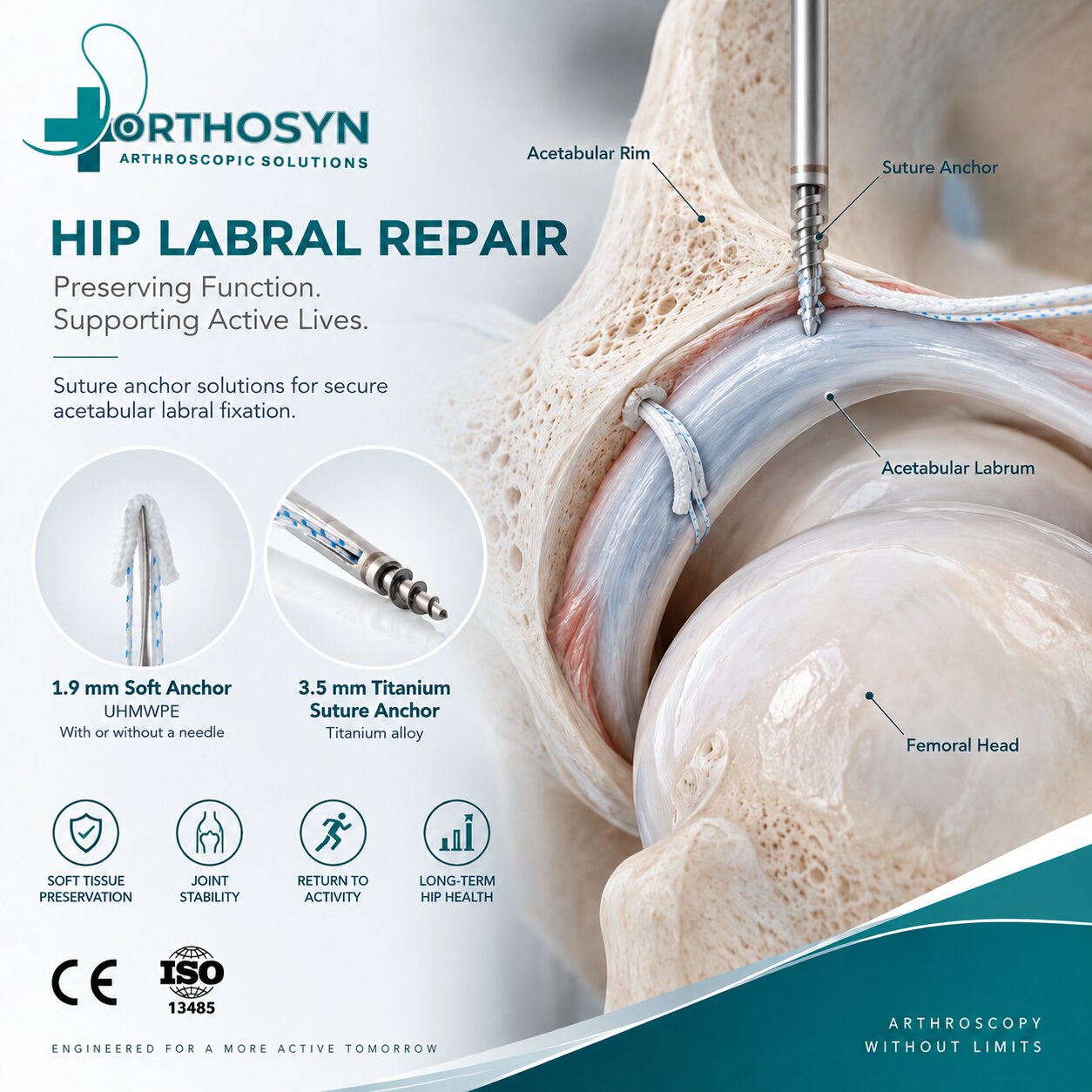
The acetabular labrum is an important fibrocartilaginous structure surrounding the rim of the hip socket. When the labrum becomes torn or detached from the acetabular rim, arthroscopic hip labral repair may be performed in selected patients to restore the attachment of the damaged tissue.
One of the key fixation methods used during this procedure is the suture anchor. Anchors are placed into the acetabular rim and provide fixation points for sutures that secure the labrum back to the bone.
For this type of fixation, the ORTHOSYN arthroscopy portfolio includes the 1.9 mm Soft Anchor and 3.5 mm Titanium Suture Anchor, providing soft and rigid anchor options for hip labral repair.
The acetabular labrum is a ring of fibrocartilaginous tissue located around the outer rim of the acetabulum.
It contributes to important functions of the hip joint, including:
Damage to the labrum may disrupt these functions and can be associated with hip pain, clicking, catching or other mechanical symptoms.
A hip labral tear occurs when the acetabular labrum is damaged, separated or detached from its attachment to the acetabular rim.
Hip labral tears can be associated with conditions and activities such as:
The characteristics of the tear, condition of the labral tissue and underlying hip anatomy influence the treatment approach.
Not every hip labral tear requires surgery. However, when arthroscopic repair is indicated, the objective is generally to preserve the labral tissue and restore its attachment to the acetabular rim.
Arthroscopic hip labral repair is a minimally invasive surgical procedure in which the damaged labrum is repaired through small arthroscopic portals.
A typical repair may involve:
The number and position of the anchors depend on the location and extent of the tear as well as the selected surgical technique.
During hip labral repair, a suture anchor is positioned in the acetabular rim adjacent to the damaged labrum.
The associated suture is then passed through or around the labral tissue. When the suture construct is secured, the labrum is brought back toward its intended attachment on the acetabulum.
The fundamental fixation concept is:
Acetabular Rim → Suture Anchor → High-Strength Suture → Acetabular Labrum
When a longer section of the labrum requires repair, multiple anchors can be positioned sequentially along the acetabular rim to create multiple fixation points.
The acetabular rim provides a relatively specific anatomical area for anchor placement. Surgeons must consider both the fixation requirement and the surrounding anatomy when preparing anchor sites.
Anchor selection can therefore involve factors such as:
Smaller-diameter anchors can be particularly relevant when multiple fixation points are required because they require smaller bone tunnels.
At the same time, conventional rigid anchors provide another established approach to soft tissue-to-bone fixation.
For this reason, the ORTHOSYN portfolio provides two relevant concepts for hip labral repair: the 1.9 mm Soft Anchorand the 3.5 mm Titanium Suture Anchor.
The ORTHOSYN 1.9 mm Soft Anchor provides a small-diameter fixation option for arthroscopic hip labral repair.
Unlike a conventional rigid anchor body, the Soft Anchor uses a predominantly suture-based implant structure manufactured from UHMWPE.
The 1.9 mm diameter is particularly relevant for acetabular labral fixation because hip labral repair may require multiple anchor positions along the acetabular rim.
A smaller anchor diameter allows a smaller bone tunnel to be created at each fixation point, helping preserve bone stock when multiple anchors are required.
The ORTHOSYN 1.9 mm Soft Anchor is available in configurations with and without a needle.
Within the ORTHOSYN portfolio:
1.9 mm Soft Anchor → Small-diameter UHMWPE-based fixation for hip labral repair
The ORTHOSYN 3.5 mm Titanium Suture Anchor provides a rigid metallic anchor option for hip labral repair.
The titanium anchor is inserted into the prepared bone site to establish a fixation point at the acetabular rim. The associated high-strength suture can then be used to secure the labral tissue.
This represents a more conventional rigid anchor concept compared with the predominantly suture-based construction of a Soft Anchor.
Within the ORTHOSYN portfolio:
3.5 mm Titanium Suture Anchor → Rigid metallic fixation for hip labral repair
The 1.9 mm Soft Anchor and 3.5 mm Titanium Suture Anchor therefore provide two different fixation approaches within the ORTHOSYN arthroscopy portfolio.
The two ORTHOSYN anchor options differ primarily in their construction and fixation concept.
| Feature | ORTHOSYN 1.9 mm Soft Anchor | ORTHOSYN 3.5 mm Titanium Suture Anchor |
|---|---|---|
| Anchor Type | Soft / All-Suture | Rigid Suture Anchor |
| Diameter | 1.9 mm | 3.5 mm |
| Material | UHMWPE | Titanium |
| Fixation Concept | Small-diameter soft anchor | Rigid metallic anchor |
| Application | Hip labral repair | Hip labral repair |
The selection between the two depends on the surgical technique, anatomy, bone quality and surgeon preference.
A labral tear may extend across a section of the acetabular rim rather than being limited to a single point.
In these situations, a surgeon may create several fixation points along the tear.
Each anchor can secure a portion of the labrum, creating a sequential repair construct along the acetabular rim.
The general concept becomes:
Anchor → Labral Fixation → Anchor → Labral Fixation → Anchor
The number of anchors required depends on the characteristics and extent of the lesion rather than a fixed number for every procedure.
Femoroacetabular impingement (FAI) is commonly associated with acetabular labral pathology.
FAI occurs when abnormal contact develops between the femoral head-neck region and the acetabular rim during certain hip movements.
Repeated contact can contribute to damage of the labrum and adjacent structures.
When hip arthroscopy is performed in a patient with both FAI and a repairable labral tear, the surgical strategy may involve addressing the underlying bony morphology in addition to repairing the labrum.
This creates an important clinical and SEO relationship:
Femoroacetabular Impingement → Hip Labral Tear → Hip Arthroscopy → Hip Labral Repair → Suture Anchor Fixation
Hip labral injuries are also relevant within sports medicine, particularly in activities involving repetitive hip flexion, rotation or substantial loading of the hip joint.
Labral pathology may therefore be encountered in athletes participating in sports such as football, soccer, hockey, martial arts, gymnastics and dance.
This expands the search pathway beyond the implant itself:
Hip Pain → Sports Injury → Hip Labral Tear → Hip Arthroscopy → Labral Repair → Suture Anchors
For ORTHOSYN, this is important because users searching initially for a condition such as a hip labral tear or a procedure such as hip labral repair can subsequently encounter the fixation technologies used during the procedure.
Hip labral repair is fundamentally a soft tissue-to-bone fixation procedure.
The labrum represents the soft tissue component, while the acetabular rim provides the bone fixation site.
The suture anchor creates the connection between these structures:
Bone → Anchor → Suture → Labrum
This same general fixation principle is used across different arthroscopic procedures, although the anatomy, anchor positioning and surgical technique vary according to the joint and pathology.
Within the ORTHOSYN arthroscopy portfolio, two anchor configurations are suitable for hip labral repair:
A small-diameter, UHMWPE-based Soft Anchor providing a compact fixation option where smaller bone tunnels and multiple fixation points may be relevant.
A rigid titanium anchor providing a conventional metallic fixation option for securing labral tissue to the acetabular rim.
Together, these products allow ORTHOSYN to provide both soft-anchor and rigid-anchor fixation concepts for arthroscopic hip labral repair.
From an SEO perspective, this also allows the article to target procedure-focused searches without competing directly with ORTHOSYN product pages.
Product pages can primarily target:
soft anchor, 1.9 mm soft anchor, titanium suture anchor, 3.5 mm titanium anchor
while this article targets:
hip labral repair, hip labral tear, acetabular labral repair, hip arthroscopy and suture anchors in hip labral repair.
Arthroscopic hip labral repair is used in selected patients to restore the attachment of a damaged acetabular labrum to the acetabular rim.
Suture anchors provide fixation points in the acetabulum, allowing high-strength sutures to secure the labral tissue back to the bone.
Within the ORTHOSYN arthroscopy portfolio, the 1.9 mm Soft Anchor and 3.5 mm Titanium Suture Anchor provide two different fixation options suitable for hip labral repair.
The 1.9 mm Soft Anchor provides a small-diameter UHMWPE-based fixation concept, while the 3.5 mm Titanium Suture Anchor provides a rigid metallic fixation option.
This makes hip labral repair an important connection between the ORTHOSYN anchor portfolio and broader searches involving hip arthroscopy, acetabular labral tears, femoroacetabular impingement and sports medicine.