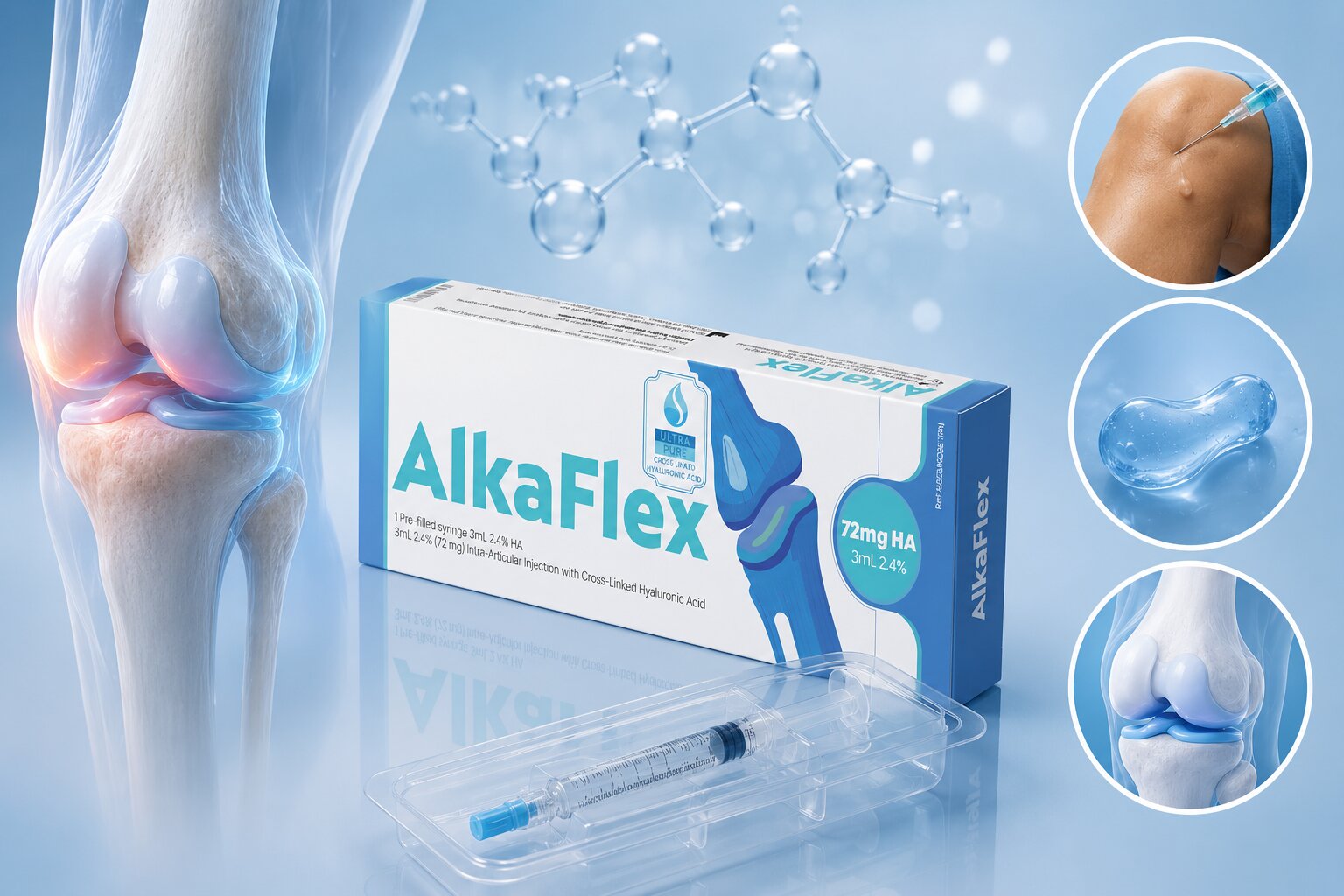
Hyaluronic acid is a naturally occurring molecule that plays an important role inside the knee joint, particularly within the synovial fluid.
In a healthy knee, synovial fluid helps the joint surfaces move smoothly against each other. Hyaluronic acid contributes to the fluid’s viscosity, elasticity and lubricating properties, helping support normal joint mechanics.
For this reason, hyaluronic acid is closely associated with intra-articular injections and viscosupplementation.
Understanding what HA does inside the knee helps explain why different formulation characteristics such as molecular weight, concentration and cross-linking are important.
Hyaluronic acid is naturally present in the synovial fluid that fills the knee joint.
It is also associated with the extracellular environment surrounding articular cartilage and other joint tissues.
Within the joint, HA contributes to the physical properties of synovial fluid.
These properties are important because the knee is constantly exposed to:
The behavior of synovial fluid helps the joint respond to these mechanical demands.
One of the best-known functions of hyaluronic acid is its contribution to joint lubrication.
The surfaces inside the knee need to move against each other with as little friction as possible.
Synovial fluid helps create a lubricating environment between these surfaces.
Hyaluronic acid contributes to this function by influencing the viscosity and flow behavior of the fluid.
This is particularly important during repeated joint movement.
Hyaluronic acid gives synovial fluid both viscous and elastic characteristics.
This is known as viscoelasticity.
A viscous material resists flow.
An elastic material can deform and recover its shape.
Synovial fluid combines both behaviors.
At slower movements, its viscous properties help with lubrication.
At faster movement or higher loading, its elastic characteristics help support mechanical cushioning.
This viscoelastic behavior is one of the key reasons why hyaluronic acid is important for joint mechanics.
The knee experiences repeated impact during daily activities such as:
Hyaluronic acid contributes to the mechanical behavior of synovial fluid and therefore supports the joint’s ability to manage loading.
Its viscoelastic characteristics help the synovial environment respond to changes in force.
This is why HA is frequently described in relation to cushioning and shock absorption.
In osteoarthritis, the joint environment changes.
These changes can include alterations in the naturally occurring hyaluronic acid found in synovial fluid.
Important changes may involve:
As a result, synovial fluid may not behave in the same way as in a healthy joint.
This is one of the reasons why intra-articular hyaluronic acid is used in viscosupplementation strategies.
The molecular weight of hyaluronic acid refers to the size of its polymer chains.
This parameter can influence:
Different HA products may use different molecular-weight profiles.
For this reason, molecular weight is one of the key technical parameters used when evaluating an intra-articular hyaluronic acid formulation.
However, molecular weight should not be considered alone.
It should be evaluated together with:
concentration + total dose + molecular structure + injection volume + protocol
Concentration describes how much hyaluronic acid is present in each milliliter of solution.
For example:
Higher concentration can affect the physical properties of the formulation.
But concentration is only one part of the full product profile.
Two formulations with the same concentration may still behave differently if their molecular weight or structure is different.
Not all injected HA has the same molecular structure.
Linear hyaluronic acid contains polymer chains without an intentionally created cross-linked network.
The AlkaFlex Linear Intra-Articular Hyaluronic Acid portfolio represents this formulation approach.
Explore AlkaFlex Linear Hyaluronic Acid:
https://orthosynmed.com/product/39/alkaflex-intra-articular-injections-with-hyaluronic-acid---linear-linked
Cross-linked hyaluronic acid contains a modified molecular network created by connecting HA chains.
This can influence:
The AlkaFlex Cross-Linked Intra-Articular Hyaluronic Acid portfolio represents this formulation approach.
Explore AlkaFlex Cross-Linked Hyaluronic Acid:
https://orthosynmed.com/product/44/alkaflex-intra-articular-injections-with-cross-linked-hyaluronic-acid
Intra-articular HA injections are designed to deliver hyaluronic acid directly into the joint space.
This places the formulation directly into the synovial environment.
The exact performance of the product depends on its formulation characteristics.
Important factors include:
This is why different HA products should be evaluated according to their full technical profile rather than only their brand name or total milligrams.
AlkaFlex is Orthosyn Medikal’s international brand for intra-articular hyaluronic acid formulations.
The AlkaFlex portfolio includes:
This allows AlkaFlex products to be evaluated according to the same technical parameters that define how hyaluronic acid behaves inside the joint.
Hyaluronic acid plays an important role inside the knee joint by contributing to the viscosity, elasticity, lubrication and mechanical behavior of synovial fluid.
Its properties are closely related to:
These characteristics help explain why intra-articular hyaluronic acid formulations can differ significantly from one another.
AlkaFlex offers both Linear and Cross-Linked HA formulations within Orthosyn Medikal’s international intra-articular injection portfolio.
AlkaFlex Linear Intra-Articular Hyaluronic Acid
https://orthosynmed.com/product/39/alkaflex-intra-articular-injections-with-hyaluronic-acid---linear-linked
AlkaFlex Cross-Linked Intra-Articular Hyaluronic Acid
https://orthosynmed.com/product/44/alkaflex-intra-articular-injections-with-cross-linked-hyaluronic-acid