A SLAP tear is an injury involving the superior portion of the glenoid labrum, where the long head of the biceps tendon attaches to the shoulder. The term SLAP stands for Superior Labrum Anterior to Posterior, describing a lesion that extends across the superior labrum from anterior to posterior.
Depending on the type of SLAP lesion, symptoms, patient characteristics and clinical findings, surgical treatment may include arthroscopic SLAP repair. In selected repair procedures, suture anchors are used to secure the detached superior labrum back to the glenoid.
SLAP repair therefore connects several important areas of shoulder arthroscopy, labral repair, suture anchor fixation and sports medicine.
The glenoid labrum is a fibrocartilaginous structure surrounding the rim of the glenoid.
It contributes to shoulder stability and provides an attachment area for several capsuloligamentous structures.
The superior region of the labrum is particularly important because it is associated with the attachment of the long head of the biceps tendon.
Damage in this region can involve the labral tissue, the biceps-labral complex or both.
A SLAP tear affects the superior labrum and extends from anterior to posterior around the superior glenoid.
SLAP lesions may be associated with:
Different patterns of SLAP lesions have been described, and not every SLAP lesion requires surgical repair.
Treatment depends on the lesion pattern, symptoms, patient age, activity level and other associated shoulder pathology.
Arthroscopic SLAP repair is a surgical technique used in selected cases to reattach an unstable or detached superior labrum to the glenoid.
The general procedure may involve:
The exact technique varies according to the lesion and surgical approach.
A suture anchor provides a fixation point within the glenoid bone.
The sutures associated with the anchor are used to capture the labral tissue and secure it toward the prepared glenoid rim.
The basic fixation concept can be represented as:
Glenoid Bone → Suture Anchor → High-Strength Suture → Superior Labrum
This allows the anchor to function as the bone-side component of the soft tissue-to-bone repair.
Depending on the lesion configuration, one or more fixation points may be required.
Both SLAP repair and Bankart repair involve the glenoid labrum, but they address different anatomical regions and instability patterns.
A Bankart lesion typically involves the anterior-inferior labrum and is commonly associated with anterior shoulder instability.
A SLAP lesion involves the superior labrum and the region associated with the long head of the biceps tendon.
Therefore:
Bankart Repair → Anterior-Inferior Labrum
SLAP Repair → Superior Labrum / Biceps-Labral Complex
Both procedures may use suture anchors, but the location, pathology and surgical objectives are different.
Different anchor technologies can be used for arthroscopic soft tissue fixation depending on the selected technique.
These include:
Each anchor category has different material and fixation characteristics.
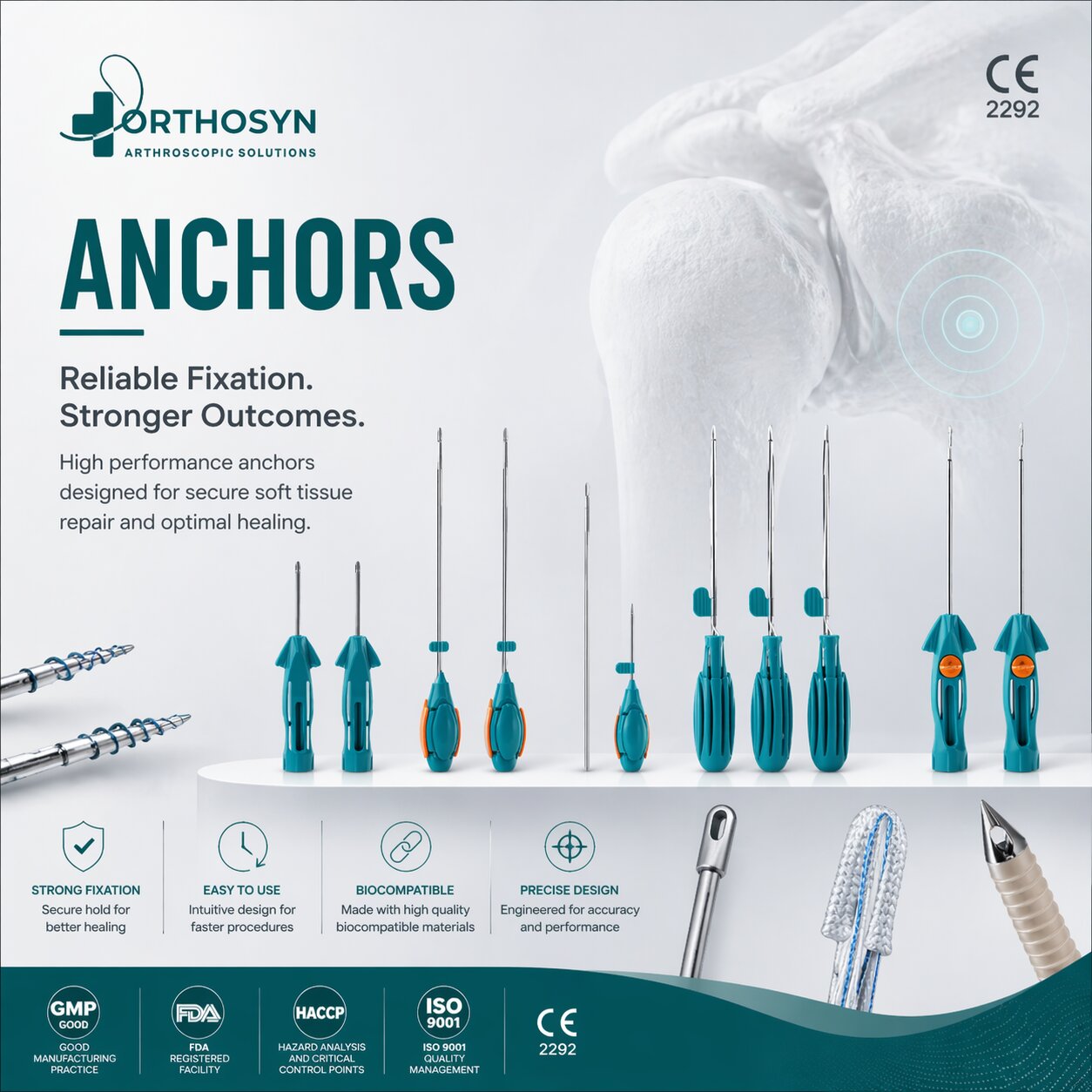
This makes SLAP repair another procedure-oriented topic that can naturally connect with the ORTHOSYN Suture Anchor portfolio without making the product name itself the primary subject of the article.
Soft Anchors, also called all-suture anchors, use a predominantly suture-based implant structure.
Their small diameter can be relevant in arthroscopic procedures where multiple fixation points may be required along the glenoid.
ORTHOSYN Soft Anchors are manufactured from UHMWPE and are available in:
Options are available with and without a needle.
This provides different configurations for arthroscopic soft tissue fixation requirements.
ORTHOSYN also provides conventional rigid anchor options.
PEEK Suture Anchors provide a non-metallic fixation option. PEEK is radiolucent compared with metallic implant materials and is widely used in orthopedic applications.
Titanium Suture Anchors provide a metallic fixation option and use titanium alloy as the anchor material.
These different materials allow the ORTHOSYN anchor portfolio to address different arthroscopic fixation requirements.
Knotless anchors use an anchor-based locking mechanism instead of relying on conventional arthroscopic knot tying for final suture fixation.
This provides another fixation concept for selected arthroscopic soft tissue repairs.
The ORTHOSYN portfolio includes:
Available configurations include 3.5 mm and 5.0 mm options.
The appropriate anchor and repair technique depend on the anatomy, lesion and surgeon's selected approach.
SLAP lesions are particularly relevant to sports medicine because the superior labrum and biceps-labral complex can be exposed to significant forces during repetitive overhead activity.
This is especially relevant in sports involving repeated throwing or overhead shoulder motion.
From an SEO perspective, this creates a broader search pathway:
Sports Medicine → Shoulder Pain → Overhead Athlete → SLAP Tear → Superior Labral Tear → Arthroscopic SLAP Repair → Suture Anchor Fixation
This allows ORTHOSYN to reach users researching a shoulder condition or surgical procedure before they begin searching for a specific implant.
The ORTHOSYN arthroscopy portfolio includes multiple fixation technologies relevant to arthroscopic soft tissue repair:
The product pages can continue targeting commercial terms such as suture anchor, PEEK anchor, soft anchor and knotless suture anchor.
This blog article instead targets procedure and pathology searches such as SLAP tear, SLAP repair, superior labral tear and shoulder labral repair.
This separation supports the SEO structure we are building between product pages and procedure-focused blog content.
A SLAP tear affects the superior portion of the glenoid labrum and may involve the biceps-labral complex.
In selected cases, arthroscopic SLAP repair can use suture anchors positioned in the glenoid to create fixation points for reattaching the superior labrum.
Different anchor technologies—including titanium, PEEK, soft and knotless anchors—can provide different approaches to arthroscopic soft tissue fixation.
For ORTHOSYN, SLAP repair connects the suture anchor portfolio with broader searches involving superior labral tears, shoulder arthroscopy, overhead sports injuries, labral repair and sports medicine.