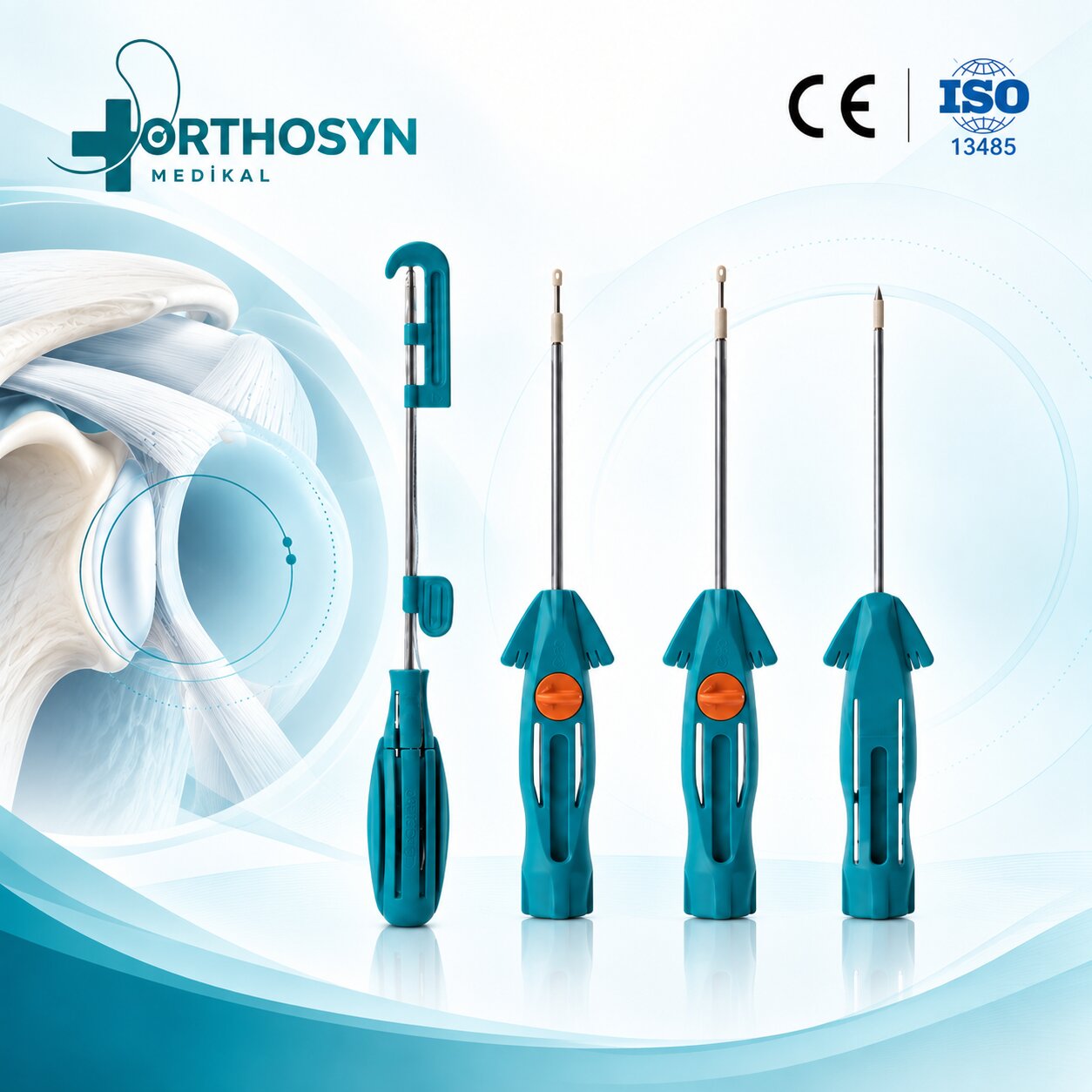
A Bankart lesion is an injury involving the anteroinferior labrum of the shoulder, commonly associated with anterior shoulder dislocation and recurrent shoulder instability. When surgical treatment is indicated, arthroscopic Bankart repair can be performed to restore the damaged capsulolabral structures and improve shoulder stability.
One of the key implant technologies used during this procedure is the suture anchor. Suture anchors provide fixation to the glenoid bone and allow the detached or damaged labral tissue to be secured back to its intended anatomical position.
Bankart repair therefore represents an important connection between shoulder arthroscopy, shoulder instability, labral repair, suture anchors and sports medicine.
The glenoid labrum is a fibrocartilaginous structure surrounding the rim of the glenoid. It contributes to shoulder stability by increasing the effective depth of the glenoid and supporting the capsuloligamentous structures.
During an anterior shoulder dislocation, the anterior-inferior portion of the labrum may become detached from the glenoid rim.
This injury is commonly referred to as a Bankart lesion.
It may be associated with:
Arthroscopic Bankart repair is a minimally invasive surgical procedure designed to repair the detached anterior-inferior labrum and associated capsular structures.
The procedure is performed using an arthroscope and specialized shoulder arthroscopy instruments.
The general surgical concept involves:
The objective is to restore the capsulolabral complex and improve stability of the shoulder.
During a Bankart repair, the detached labrum must be reattached to the glenoid.
A suture anchor creates a fixation point within the glenoid bone. Sutures connected to the anchor can then be passed through the labral and capsular tissue.
When the sutures are secured, the tissue is brought back toward the prepared glenoid rim.
The basic fixation concept is:
Glenoid Bone → Suture Anchor → High-Strength Suture → Capsulolabral Tissue
Multiple anchors may be positioned along the glenoid rim depending on the lesion and surgical technique.
In arthroscopic Bankart repair, anchors are generally positioned along the anterior-inferior glenoid rim according to the anatomy of the lesion and the surgeon's repair strategy.
Anchor positioning is important because the objective is not simply to close a tear but to reconstruct the capsulolabral attachment along the glenoid.
For this reason, Bankart repair requires appropriate:
The exact number and position of anchors depend on the individual lesion and selected surgical technique.
Different types of anchors are available for arthroscopic shoulder stabilization.
Common categories include:
Each design uses a different fixation concept or material configuration.
This makes Bankart repair particularly relevant to the ORTHOSYN Suture Anchor portfolio, which includes multiple anchor technologies for arthroscopic soft tissue fixation.
Titanium suture anchors use a metallic anchor body positioned within the bone.
Titanium alloys are widely used in orthopedic implants because of their mechanical properties and biocompatibility.
In shoulder arthroscopy, titanium anchors can provide a bone fixation point for sutures used to repair soft tissue structures such as the labrum.
ORTHOSYN offers titanium suture anchors in multiple diameters for different arthroscopic fixation requirements.
PEEK (Polyetheretherketone) suture anchors provide a non-metallic implant option for soft tissue-to-bone fixation.
PEEK is radiolucent compared with metallic implant materials and is commonly used in orthopedic implant applications.
The ORTHOSYN PEEK Anchor portfolio provides different diameter options for arthroscopic repair procedures, including applications involving shoulder soft tissue fixation.
A soft anchor, also known as an all-suture anchor, uses a predominantly suture-based fixation structure rather than a conventional rigid anchor body.
The smaller bone tunnel associated with soft anchor systems can be particularly relevant in areas where multiple fixation points may be required.
ORTHOSYN Soft Anchors are manufactured from UHMWPE and are available in:
Options are available with and without a needle.
This range provides different diameter options for arthroscopic soft tissue fixation requirements.
Some Bankart repair techniques use knotless suture anchors.
Instead of securing the repair using conventional arthroscopic knot tying, the suture is locked through the anchor's fixation mechanism.
This can simplify certain aspects of suture management during arthroscopic repair.
The ORTHOSYN portfolio includes:
These systems are available in 3.5 mm and 5.0 mm configurations, with product variants designed for different suture requirements.
Shoulder instability is particularly relevant in athletes participating in contact, collision and overhead sports.
A traumatic anterior shoulder dislocation may damage the labrum and create a Bankart lesion. Recurrent instability can subsequently interfere with athletic activity and shoulder function.
This creates an important search pathway:
Sports Injury → Shoulder Dislocation → Bankart Lesion → Shoulder Instability → Arthroscopic Bankart Repair → Suture Anchor Fixation
For ORTHOSYN's SEO strategy, this allows the website to reach users researching the condition and surgical procedure, rather than relying exclusively on searches for specific implant names.
The ORTHOSYN arthroscopy portfolio includes several suture anchor technologies relevant to arthroscopic soft tissue fixation:
Together, these product groups allow ORTHOSYN to address different fixation concepts used across shoulder arthroscopy and sports medicine procedures.
Importantly, the individual product pages can target commercial product searches such as PEEK suture anchor, soft anchor and knotless suture anchor, while this blog article targets procedure-oriented searches such as Bankart repair, Bankart lesion and shoulder instability surgery.
This separation helps avoid making the blog and product pages compete for exactly the same primary SEO keyword.
A Bankart lesion commonly involves detachment of the anterior-inferior labrum following anterior shoulder instability or dislocation.
During arthroscopic Bankart repair, suture anchors can be positioned in the glenoid to provide fixation points for sutures used to reattach and tension the capsulolabral tissue.
Different anchor technologies—including titanium, PEEK, soft and knotless anchors—provide different approaches to arthroscopic soft tissue fixation.
For ORTHOSYN, Bankart repair is therefore an important topic connecting the company's suture anchor portfolio with broader searches involving shoulder instability, shoulder dislocation, labral repair, shoulder arthroscopy and sports medicine.