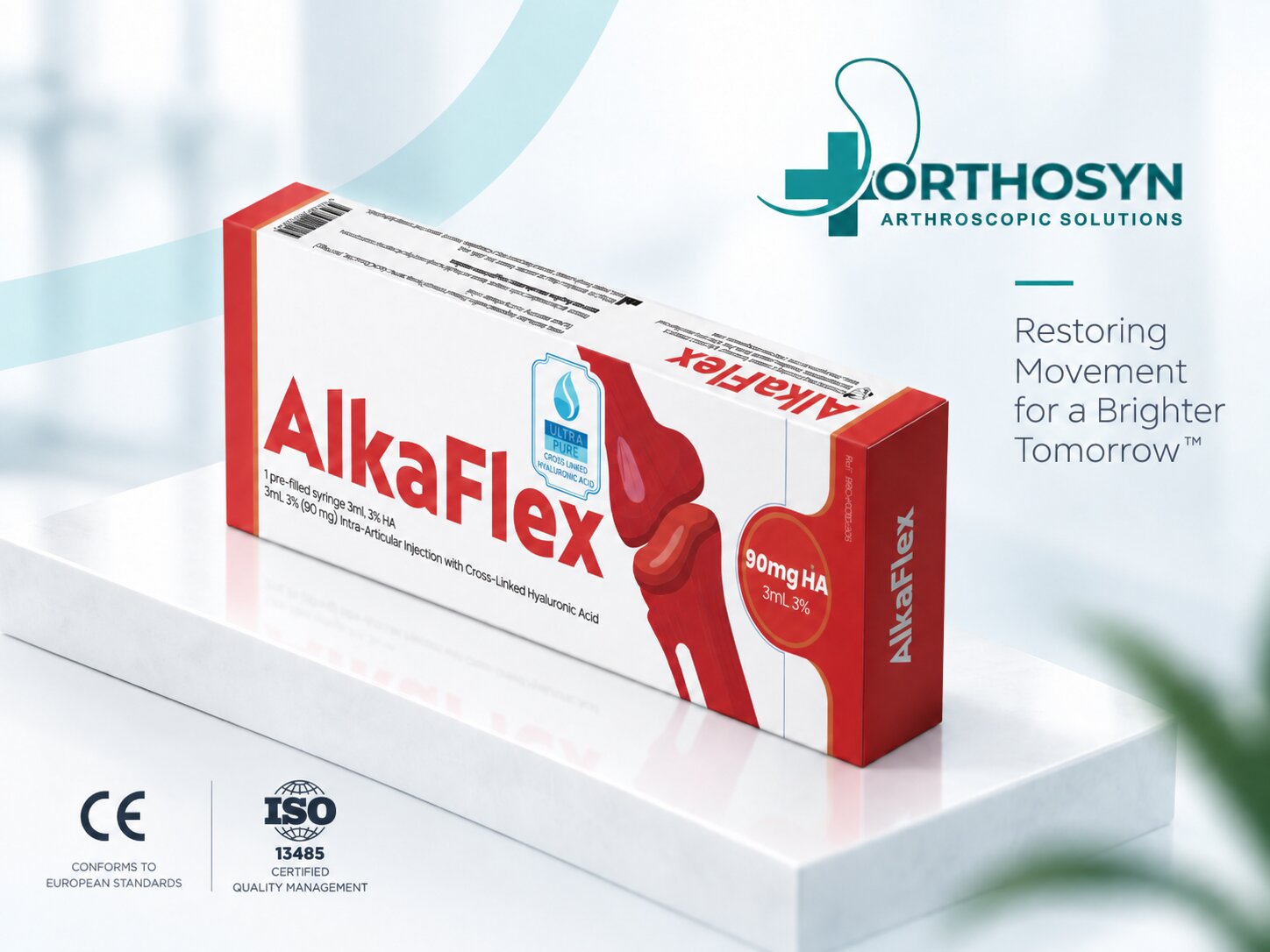
A hyaluronic acid knee injection is an intra-articular injection designed to deliver hyaluronic acid directly into the knee joint.
Hyaluronic acid, often abbreviated as HA, is naturally present in synovial fluid and contributes to the lubrication and viscoelastic properties of the joint environment.
In clinical practice, intra-articular HA injections are commonly associated with viscosupplementation, particularly in patients with knee osteoarthritis.
However, not all hyaluronic acid knee injections are the same. Differences in molecular weight, concentration, total dose, molecular structure and injection protocol can significantly affect how individual products are designed and compared.
The knee is a synovial joint.
Inside the joint, synovial fluid helps reduce friction between articulating surfaces and supports smooth movement.
Hyaluronic acid is one of the key components responsible for the viscoelastic characteristics of synovial fluid.
Its physical properties contribute to:
For this reason, hyaluronic acid is an important molecule when discussing knee joint function.
Knee osteoarthritis is associated with structural and biochemical changes within the joint.
The quality and rheological properties of synovial fluid may also change.
Changes in endogenous hyaluronic acid can involve parameters such as:
These changes are one of the reasons why intra-articular HA formulations are used in viscosupplementation strategies.
The aim is to introduce exogenous hyaluronic acid directly into the joint space.
A hyaluronic acid knee injection is administered directly into the intra-articular space of the knee.
Because this is an intra-articular medical procedure, it should be performed by a qualified healthcare professional.
The exact injection technique can vary depending on:
Some clinicians may also use imaging guidance depending on the clinical setting.
The number of injections required depends on the specific HA formulation.
Some products are designed for multiple injections, while other formulations are developed for a single-injection protocol.
The term viscosupplementation refers to the administration of hyaluronic acid into a synovial joint.
The concept is related to the natural role of HA in synovial fluid.
Instead of viewing all HA injections as identical, it is more accurate to evaluate their formulation characteristics individually.
These may include:
No.
Two products may both be described as hyaluronic acid knee injections but have very different technical characteristics.
For example, one formulation may contain linear HA, while another may contain cross-linked HA.
They may also differ in:
Molecular weight
The size of the hyaluronic acid molecules can vary significantly.
Concentration
Products may contain different amounts of HA per milliliter.
Total dose
A syringe may contain different total quantities of hyaluronic acid.
Volume
Injection volumes can vary.
Molecular structure
HA may be linear or cross-linked.
Protocol
Some products are administered as a series of injections, while others are designed for one injection.
These differences are important when comparing HA products.
Linear hyaluronic acid consists of HA polymer chains without an intentionally created cross-linked network.
Linear formulations can be designed in different concentrations and total doses.
The AlkaFlex Linear Intra-Articular Hyaluronic Acid range includes formulations developed for intra-articular application.
Explore AlkaFlex Linear Hyaluronic Acid:
Linear HA represents one formulation approach within the broader viscosupplementation category.
Cross-linked HA contains a modified molecular network created by connecting hyaluronic acid chains.
Cross-linking can influence physical properties such as:
These properties are especially relevant in formulations developed for high-viscosity or single-injection use.
The AlkaFlex Cross-Linked Intra-Articular Hyaluronic Acid range represents this formulation approach.
Explore AlkaFlex Cross-Linked Hyaluronic Acid:
Molecular weight refers to the average size of the hyaluronic acid polymer chains.
It is one of the most important technical parameters used to describe HA formulations.
Higher molecular weight can influence:
However, molecular weight should not be considered alone.
When evaluating a hyaluronic acid knee injection, it is more meaningful to consider:
molecular weight + concentration + total dose + cross-linking + injection volume + protocol
together.
HA concentration usually refers to how much hyaluronic acid is present in each milliliter of solution.
For example:
However, concentration is different from total dose.
A 3 mL syringe containing 30 mg/mL provides a total of 90 mg of hyaluronic acid.
This distinction is important when comparing knee injection products.
One of the most common differences between HA products is the number of injections included in the treatment protocol.
Some formulations are designed as a series of injections.
Others are designed as single-injection hyaluronic acid products.
Single-injection formulations are often associated with higher total doses or modified HA structures, including cross-linked formulations.
However, the number of injections alone does not determine product performance.
The complete formulation should always be evaluated.
When comparing different hyaluronic acid knee injection products, important questions include:
These factors provide a more complete picture than simply comparing brand names or total milligrams.
AlkaFlex is Orthosyn Medikal's international hyaluronic acid brand for intra-articular joint applications.
The AlkaFlex portfolio includes both:
with different technical specifications designed for different product requirements and application protocols.
This allows physicians and international distributors to evaluate HA products according to multiple formulation parameters instead of relying on a single characteristic.
A hyaluronic acid knee injection is an intra-articular HA formulation administered directly into the knee joint.
These products are commonly associated with viscosupplementation, but their technical characteristics can vary significantly.
Important differences include:
Understanding these characteristics helps healthcare professionals and distributors compare different HA products more accurately.
AlkaFlex offers both Linear and Cross-Linked intra-articular hyaluronic acid formulations as part of Orthosyn Medikal's international HA portfolio.
AlkaFlex Linear Intra-Articular Hyaluronic Acid
https://orthosynmed.com/product/39/alkaflex-intra-articular-injections-with-hyaluronic-acid---linear-linked
AlkaFlex Cross-Linked Intra-Articular Hyaluronic Acid
https://orthosynmed.com/product/44/alkaflex-intra-articular-injections-with-cross-linked-hyaluronic-acid