Acromioclavicular (AC) joint injuries occur at the junction between the clavicle and the acromion of the scapula. While some AC joint injuries can be managed conservatively, selected unstable or severe injuries may require surgical stabilization or reconstruction.
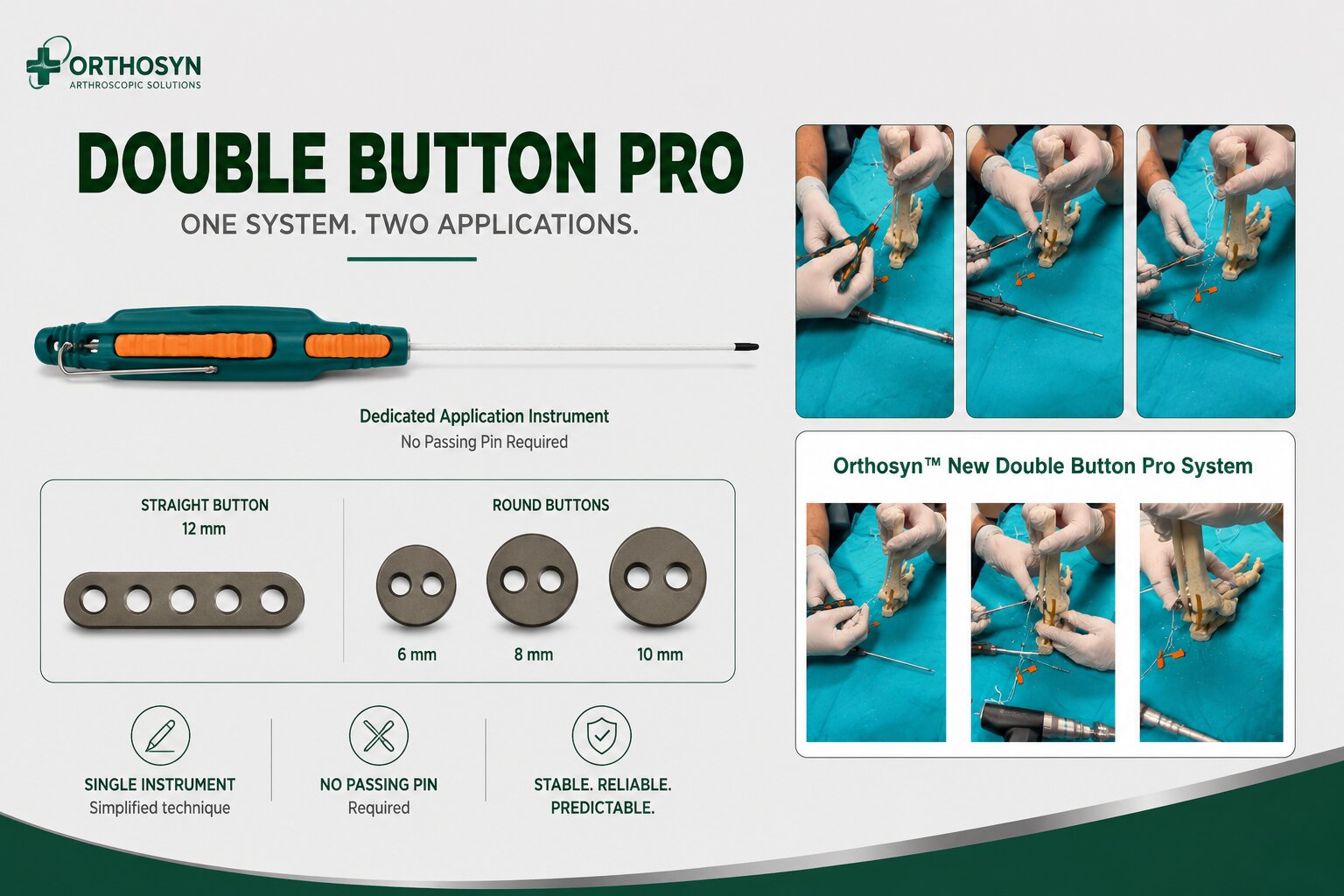
One surgical concept used for AC joint stabilization is double button fixation. This technique uses cortical buttons connected by high-strength sutures to create a fixation construct between the clavicle and coracoid region, supporting reduction and stabilization of the injured AC joint.
Understanding how AC joint reconstruction works also helps explain the role of fixation systems such as the ORTHOSYN Double Button Lift System in shoulder surgery.
The acromioclavicular joint, commonly called the AC joint, is located where the lateral end of the clavicle meets the acromion.
Stability of this region depends on several structures, particularly the acromioclavicular and coracoclavicular ligaments.
Trauma to the shoulder can damage these stabilizing structures and lead to displacement of the clavicle relative to the acromion.
The severity of the injury and degree of instability influence the treatment strategy.
AC joint reconstruction aims to restore and maintain the anatomical relationship between the clavicle and the scapular complex following an unstable AC joint injury.
Depending on the surgical technique and characteristics of the injury, reconstruction or stabilization may involve:
The objective is to create a stable fixation construct while the injured or reconstructed soft tissues recover.
A double button fixation system uses two cortical buttons connected by a high-strength suture construct.
In an AC joint application, a channel is prepared according to the selected surgical technique. The fixation system is passed through the prepared pathway so that the buttons can provide support on opposite cortical surfaces.
The suture construct connecting the buttons is then tensioned to support reduction of the clavicle toward its intended anatomical relationship with the coracoid and acromion.
The basic concept can be understood as:
Cortical Button → High-Strength Suture Construct → Cortical Button
Rather than relying on a conventional screw positioned across the AC joint itself, the double button construct provides a suture-button fixation mechanism.
The buttons act as cortical fixation points for the connecting suture construct.
When appropriately positioned, they allow the forces generated by the tensioned sutures to be distributed over the cortical surfaces.
This creates a fixation construct designed to maintain reduction between the relevant anatomical structures.
The system therefore combines:
The suture component is fundamental to a double button fixation construct.
High-strength sutures connect the buttons and transmit the tension required to maintain the reduction.
The ORTHOSYN Double Button Lift System uses UHMWPE sutures, a material commonly associated with high-strength orthopedic suture applications.
Suture management and controlled tensioning are therefore important stages of the fixation procedure.
The ORTHOSYN system uses Ti-6Al-4V ELI titanium alloy buttons.
The buttons provide the cortical contact points of the fixation construct. Their role differs from that of a conventional interference screw or suture anchor because they work as part of a suspensory suture-button system.
This distinction is important when understanding different orthopedic fixation mechanisms.
A suture anchor primarily provides a fixation point for soft tissue-to-bone repair, whereas a double button construct connects cortical fixation points through a high-strength suture system.
Although both technologies are used in shoulder surgery, their functions should not be confused.
Suture anchors are commonly associated with procedures such as:
A double button AC fixation system, on the other hand, is designed to support stabilization between anatomical structures through a cortical button and suture construct.
This is why selecting the fixation system depends on the anatomy being treated and the objective of the surgical procedure.
The ORTHOSYN Double Button Lift System provides a fixation solution for applications including AC joint stabilization.
The system combines:
The same general double button fixation concept can also be adapted to other orthopedic applications where controlled stabilization between bone structures is required.
ORTHOSYN Double Button Lift solutions include applications for AC joint fixation, syndesmosis fixation and Hallux Valgus fixation, depending on the intended system configuration and surgical technique.
AC joint injuries are particularly relevant in sports medicine, especially in activities involving direct shoulder impact.
Cycling, contact sports and other athletic activities can produce trauma to the lateral shoulder and damage the AC and coracoclavicular stabilizing structures.
For this reason, AC joint injuries represent an important intersection between shoulder surgery, arthroscopy, orthopedic fixation and sports medicine.
This also makes AC joint reconstruction an important topic beyond conventional searches for individual implants. Surgeons and distributors may search for solutions using terms such as AC joint fixation, AC joint reconstruction, coracoclavicular fixation, suture button fixation and double button fixation.
AC joint reconstruction and stabilization are used to address selected unstable acromioclavicular joint injuries. One fixation concept involves using two cortical buttons connected by high-strength sutures to support reduction and stabilization between the clavicle and coracoid region.
The ORTHOSYN Double Button Lift System combines titanium cortical buttons with UHMWPE sutures to provide a double button fixation solution for AC joint applications.
Understanding the mechanism of double button fixation also demonstrates how different arthroscopic and orthopedic implants serve different purposes: suture anchors provide soft tissue-to-bone fixation, while double button systems provide cortical suture-button fixation between anatomical structures.