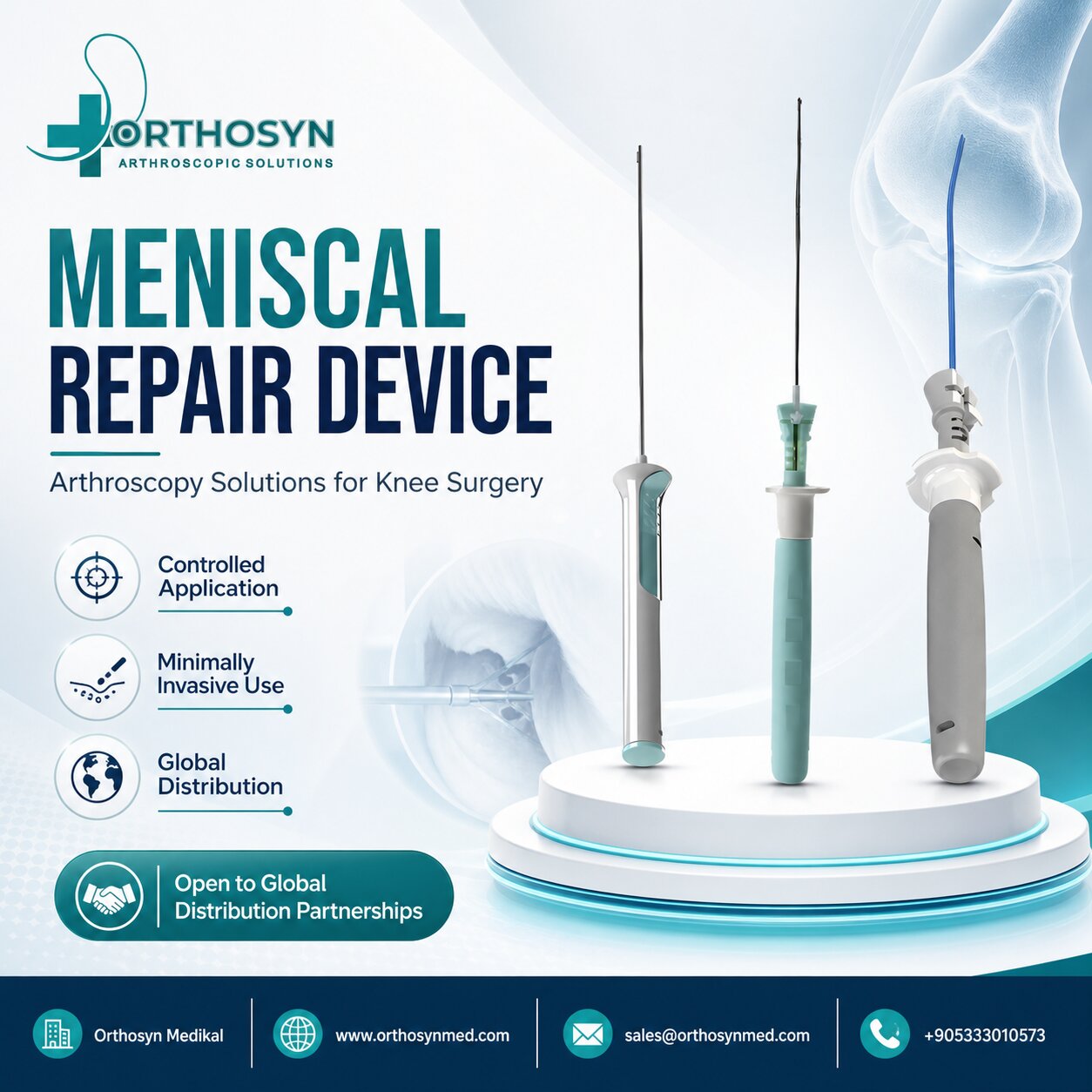
A meniscal tear is one of the common injuries treated during knee arthroscopy. When the location, pattern and biological condition of the tear are suitable for repair, preserving the meniscus may be considered instead of removing the damaged tissue.
One technique used for this purpose is all-inside meniscal repair. Unlike techniques that require sutures to pass through additional incisions outside the joint, an all-inside system allows the fixation construct to be delivered from within the arthroscopic working space.
Understanding how these systems work helps explain the role of devices such as the ORTHOSYN VersaFix Meniscal Repair System in arthroscopic meniscus repair.
All-inside meniscal repair is an arthroscopic technique in which the fixation components are introduced and deployed through the joint using a dedicated delivery device.
The objective is to approximate the torn meniscal tissue and create stable fixation while keeping the procedure primarily within the joint.
An all-inside system typically combines:
These components work together to deploy the fixation construct and approximate the meniscal tear.
The basic concept involves placing fixation implants across the meniscal tear and using the connecting suture to bring the torn tissue together.
With the ORTHOSYN VersaFix Meniscal Repair System, two small PEEK implants are pre-loaded within the device and connected by a suture construct.
During the procedure, the first implant is deployed at the selected fixation point. The device is then repositioned for deployment of the second implant.
After both implants have been positioned, the connecting suture is tensioned to approximate and stabilize the torn meniscal tissue.
This creates an internal fixation construct without requiring conventional external knot tying.
Accurate implant positioning is an important part of meniscal repair.
The surgeon must consider:
The fixation points should support approximation of the tear while respecting the surrounding anatomy.
Different tear patterns may therefore require different implant orientations or multiple fixation constructs.
One important consideration during all-inside meniscal repair is controlling how far the delivery needle advances beyond the meniscus.
The VersaFix Meniscal Repair System incorporates a depth limiter designed to control needle penetration according to the selected application.
Depth control is particularly relevant because the meniscus is located close to the joint capsule and surrounding anatomical structures.
A controlled delivery mechanism therefore supports more predictable implant placement during the procedure.
VersaFix uses two small PEEK fixation implants.
PEEK, or polyetheretherketone, is a polymer material used in various orthopedic implants. In an all-inside meniscal repair construct, the implants act as fixation components while the connecting suture provides the tension required to approximate the meniscal tissue.
The small implant configuration allows the fixation system to be delivered through the dedicated arthroscopic device.
Not every meniscal tear is treated in the same way.
The decision to repair a meniscus depends on several factors, including the tear pattern, location, vascularity, tissue quality, patient characteristics and associated injuries.
Repair techniques may be considered for selected:
The final treatment strategy depends on clinical evaluation and the selected surgical technique.
There are several techniques for repairing a meniscus.
In an inside-out repair, sutures are passed from inside the joint toward the outside and are typically secured through an additional approach.
In an all-inside repair, the fixation construct is deployed arthroscopically using a dedicated device, reducing the need for additional suture passage outside the joint.
Both techniques have established roles in meniscal surgery. The appropriate approach depends on the tear characteristics, anatomical location and surgeon's preferred technique.
The ORTHOSYN VersaFix Meniscal Repair System is designed for arthroscopic all-inside meniscal repair.
Its principal features include:
The system is designed to combine implant delivery, fixation and suture management within a dedicated arthroscopic device.
All-inside meniscal repair provides a method of stabilizing selected meniscal tears using implants and sutures delivered from within the joint.
The procedure depends not only on the fixation device but also on appropriate tear selection, implant positioning, penetration depth and controlled suture tensioning.
Systems such as ORTHOSYN VersaFix combine these functions in a dedicated device designed to support efficient and controlled arthroscopic meniscal repair.