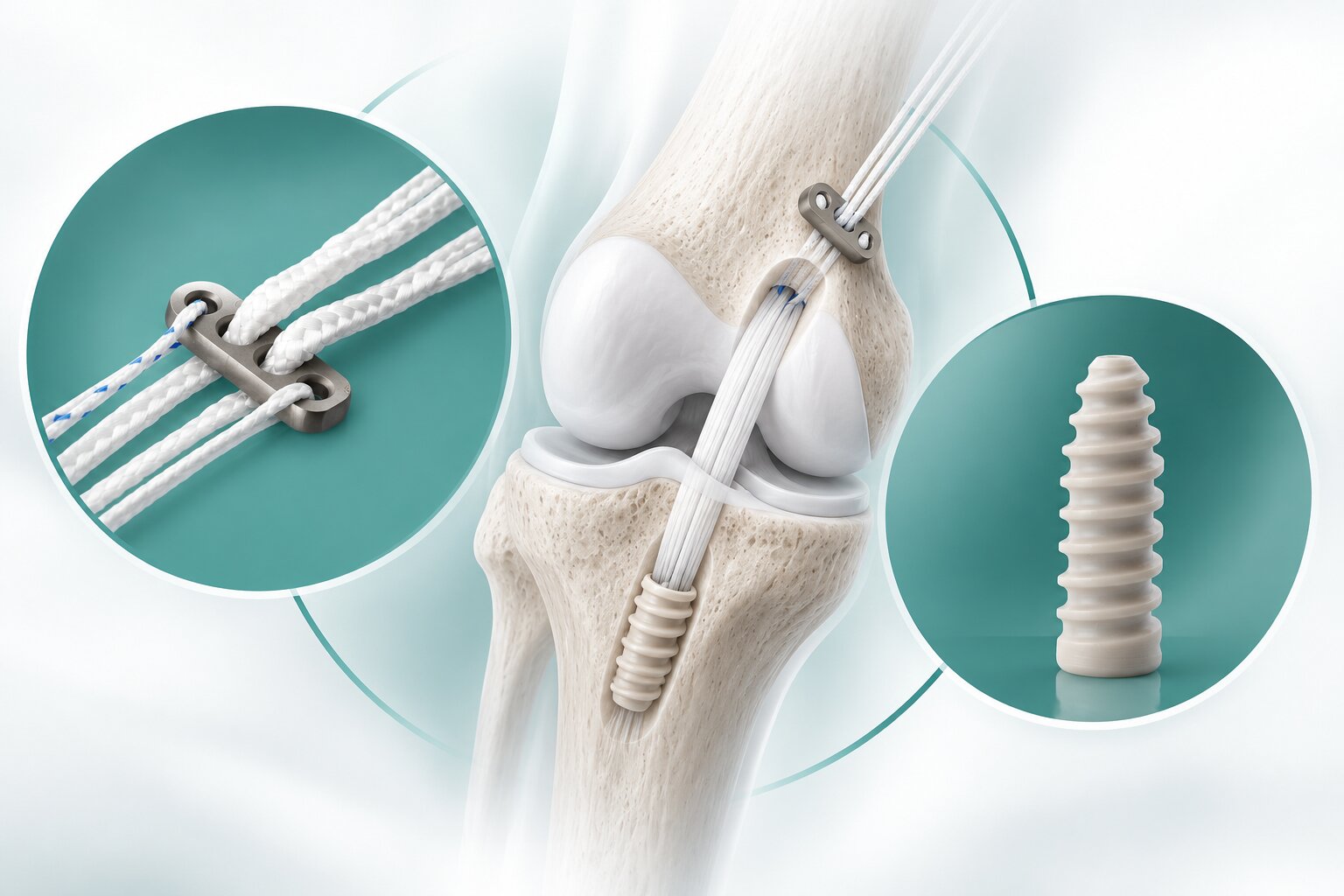
Anterior cruciate ligament (ACL) reconstruction is a surgical procedure in which the damaged ACL is replaced with a graft. Once the femoral and tibial tunnels or sockets have been prepared and the graft has been positioned, one of the key stages of the procedure is graft fixation.
The fixation method is designed to maintain the graft in its intended position while biological integration takes place. Different fixation concepts can be used on the femoral and tibial sides, depending on the graft type, surgical technique and fixation strategy.
During ACL reconstruction, the graft passes through or into prepared bone tunnels or sockets in the femur and tibia.
Fixation systems are then used to secure the graft at these locations. Two commonly used fixation concepts are:
These approaches use different mechanisms to secure the graft and may also be used on different sides of the reconstruction.
A femoral cortical button provides suspensory fixation on the outer cortex of the femur.
After the graft and fixation construct are passed through the prepared femoral tunnel, the button is positioned against the cortical surface. The graft is suspended through the loop connected to the button.
Femoral button systems may use either a fixed loop or an adjustable loop.
In a fixed-loop system, the loop has a predetermined length. Different loop lengths can be selected according to the tunnel and graft fixation requirements.
An adjustable-loop system allows the loop length to be adjusted during the fixation process. This provides another approach to positioning and tensioning the graft within the prepared socket or tunnel.
ORTHOSYN provides both Fixed Loop Femoral Button Systems and Adjustable Femoral Lift Systems for ligament reconstruction fixation.
An interference screw secures the graft by positioning the screw between the graft and the wall of the prepared bone tunnel.
As the screw is inserted, the graft is compressed against the tunnel wall, creating aperture fixation close to the tunnel opening.
Interference screws are commonly associated with tibial fixation in ACL reconstruction, although their use depends on the graft and surgical technique.
ORTHOSYN provides PEEK and Titanium Interference Screws in multiple diameters and lengths for ligament reconstruction procedures.
The fundamental difference is where and how the graft is secured.
Suspensory fixation uses a cortical button and loop construct to suspend the graft from the cortical bone.
Aperture fixation positions the fixation closer to the tunnel aperture, commonly using an interference screw to secure the graft against the tunnel wall.
These are not necessarily competing concepts in every reconstruction. A surgical construct may use different fixation mechanisms on the femoral and tibial sides.
ACL reconstruction also requires instruments that assist with tunnel preparation, graft passage and implant placement.
Passing pins can assist with the passage of sutures or graft-related constructs through prepared tunnels.
Nitinol guide wires can provide guidance during procedures such as interference screw placement.
These instruments do not provide the final graft fixation themselves but support different stages of the reconstruction workflow.
ORTHOSYN provides several products associated with ligament reconstruction and graft fixation, including:
Together, these product groups provide different options for femoral fixation, tibial fixation, graft passage and ligament reconstruction procedures.
Graft fixation is a fundamental stage of ACL reconstruction. Depending on the surgical technique, fixation may involve femoral cortical buttons, adjustable or fixed loops, interference screws and other fixation components.
Understanding the difference between suspensory cortical fixation and aperture fixation also helps explain why different fixation devices are used during different stages of ACL reconstruction.