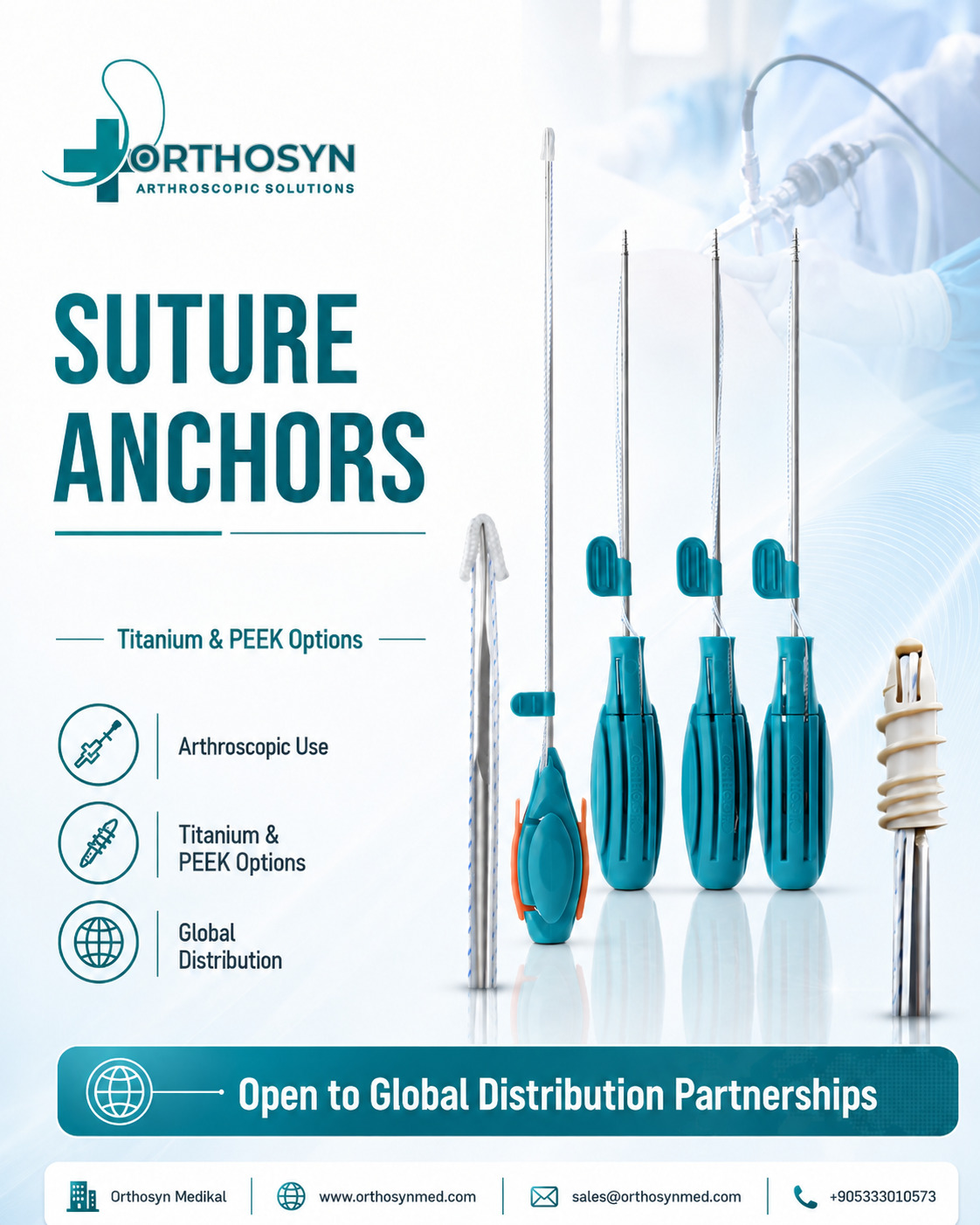
Suture anchors are commonly used in arthroscopic rotator cuff repair to establish fixation between the torn tendon and bone. The anchor creates a fixation point within the bone, while sutures are passed through the tendon to position the tissue at the intended repair site.
The complete repair construct therefore involves more than the anchor itself. Anchor placement, suture configuration, tissue quality and surgical technique all contribute to the fixation strategy.
During rotator cuff repair, the objective is to reattach the affected tendon to its intended attachment area on the humerus.
A suture anchor is placed into the prepared bone to establish a fixation point. The associated sutures can then be passed through the tendon and secured according to the selected repair technique.
In simplified terms, the construct consists of:
These components function together as a complete soft tissue-to-bone fixation construct.
The position of a suture anchor influences the location from which the tendon is secured.
Depending on the repair configuration, surgeons may use one or multiple anchors to create the required fixation pattern.
When several anchors are required, factors such as anchor diameter, spacing and available bone stock become relevant to surgical planning.
This is also why arthroscopic anchor systems are available in different sizes and designs.
After anchor placement, sutures are passed through the rotator cuff tissue according to the selected repair technique.
The suture configuration determines how the tendon is connected to the fixation points created by the anchors.
Depending on the anchor system, fixation may involve conventional arthroscopic knot tying or a knotless fixation mechanism.
Therefore, anchor design and suture management should be considered as parts of the same repair construct.
Different suture anchor technologies are available for arthroscopic soft tissue repair.
Titanium anchors provide a rigid metallic fixation option and are available in different diameters and suture configurations.
PEEK anchors provide a non-metallic polymer-based option with radiolucent material characteristics.
Soft or all-suture anchors use a predominantly suture-based implant structure and can be placed through relatively small bone tunnels.
Knotless anchors are designed to secure the suture without conventional arthroscopic knot tying.
The appropriate anchor technology depends on factors including anatomy, bone quality, repair configuration and surgical technique.
Anchor diameter determines, among other factors, the size of the bone tunnel required for implantation.
Smaller-diameter anchors generally require smaller bone tunnels, while larger solid-body anchors require different bone preparation.
When multiple fixation points are planned, surgeons must also consider the available bone stock and spacing between anchors.
Anchor diameter should therefore be evaluated together with the overall repair strategy rather than as an isolated characteristic.
Orthosyn Medikal provides different suture anchor technologies for arthroscopic soft tissue-to-bone fixation.
The Orthosyn anchor portfolio includes:
Different materials, diameters and fixation mechanisms provide options for different arthroscopic repair requirements.
Explore the complete portfolio:
Suture anchors provide the bone fixation points required to connect soft tissue to bone during arthroscopic rotator cuff repair.
However, successful fixation depends on the complete repair construct, including anchor placement, anchor diameter, suture passage, fixation configuration, tissue condition and surgical technique.
Understanding how these components interact helps explain why different suture anchor designs and fixation technologies are available for arthroscopic shoulder repair.