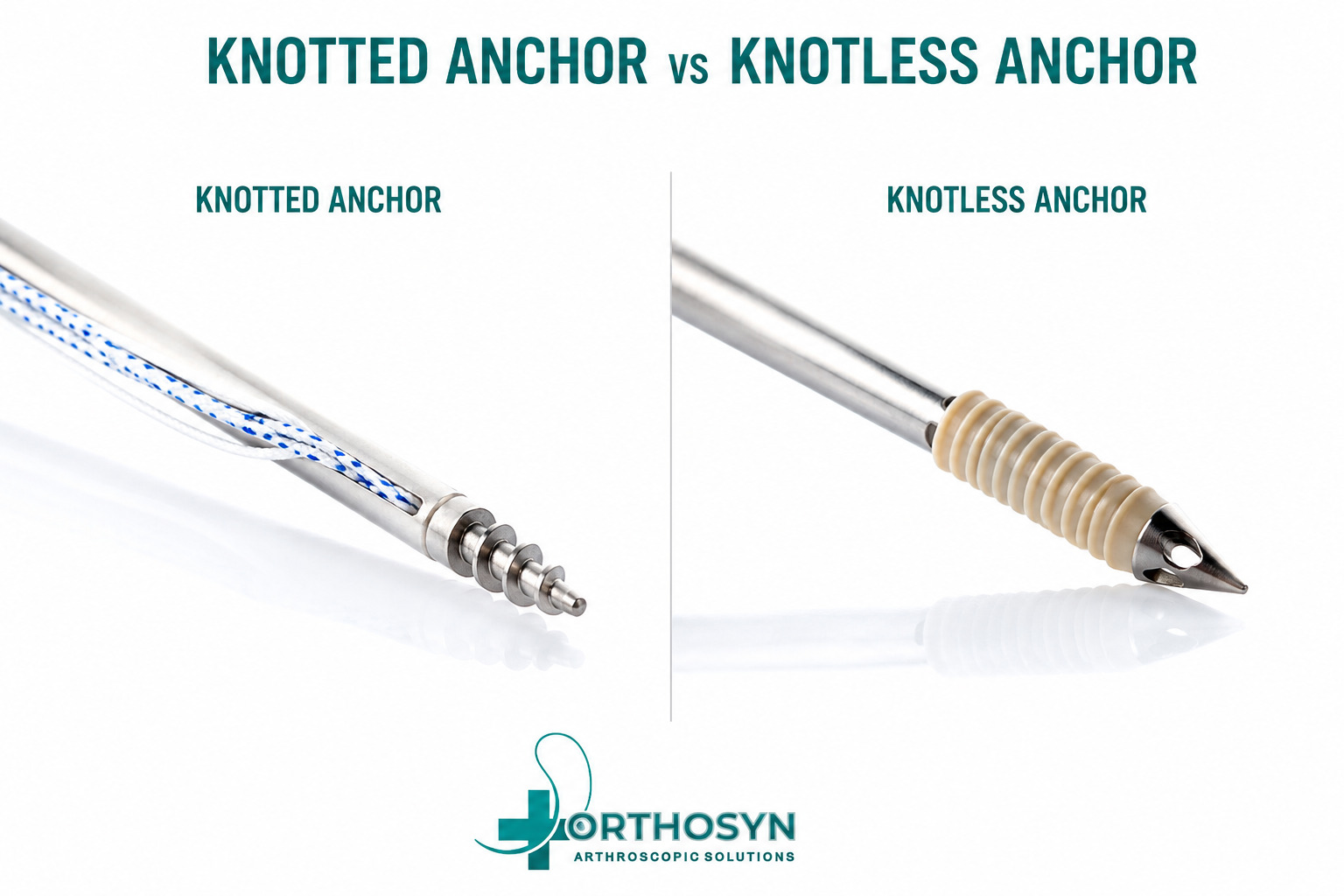
Suture anchors are widely used in arthroscopic procedures to support soft tissue-to-bone fixation. Depending on the implant design and surgical technique, fixation can generally be performed using either a knotted or knotless approach.
Although both approaches serve the same fundamental purpose, the way the suture is secured differs.
In a conventional knotted technique, the anchor is inserted into the bone and the attached sutures are passed through the target tissue.
The surgeon then creates arthroscopic knots to secure the tissue in the intended position.
This approach allows the surgeon to manage the suture configuration and knot placement according to the repair technique.
A knotless anchor is designed to secure the suture without requiring a conventional arthroscopic knot.
After the suture is passed through the tissue, it is incorporated into the knotless fixation mechanism and secured through the anchor construct.
This can simplify the final fixation stage and eliminates the need to leave an arthroscopic knot stack within the repair construct.
The main difference is how the suture is secured.
Knotted fixation:
Knotless fixation:
Neither approach should automatically be considered appropriate for every procedure. Selection depends on anatomy, tissue condition, repair technique, anchor positioning and surgeon preference.
In both techniques, appropriate management of suture tension is an important part of positioning the tissue at the intended fixation site.
With knotless systems in particular, the fixation sequence and tension applied before final anchor seating form part of the surgical technique.
Therefore, implant design and surgical technique should always be considered together.
Orthosyn Medikal provides different solutions for arthroscopic soft tissue fixation, including:
This portfolio provides different implant material and fixation options for various arthroscopic repair strategies.
Explore Orthosyn arthroscopy products:
The primary distinction between knotted and knotless suture anchors is the method used to secure the suture.
Knotted systems rely on arthroscopic knot tying, while knotless systems incorporate the suture into the anchor fixation mechanism.
Understanding this difference can help surgeons evaluate the most appropriate fixation approach according to the requirements of the arthroscopic procedure.