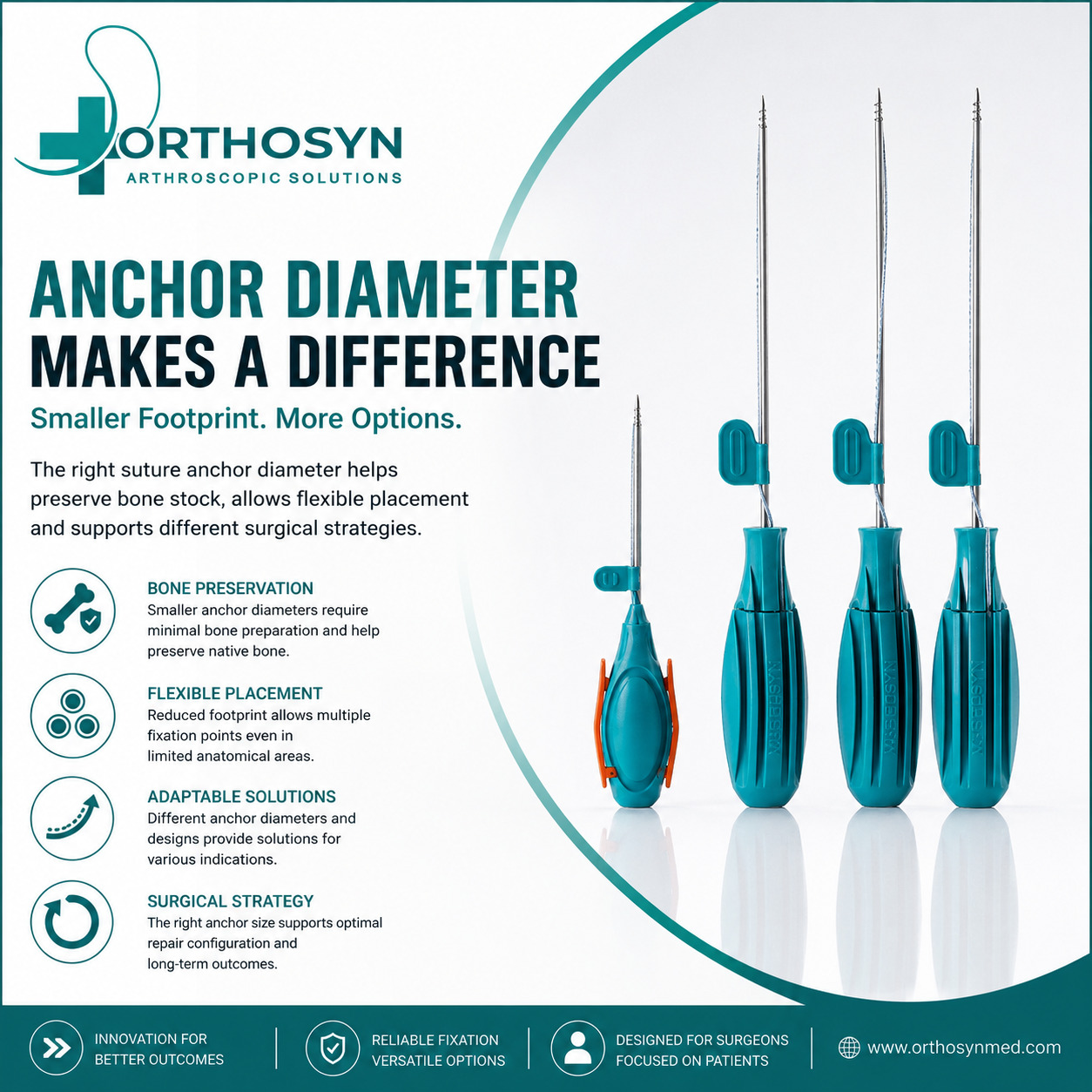
Suture anchor selection in arthroscopic surgery involves more than choosing an implant material. Anchor diameter is another important consideration, particularly when surgeons need to balance fixation requirements with preservation of the surrounding bone.
Different arthroscopic procedures may require different anchor sizes depending on the anatomical location, bone quality, available bone stock, tissue characteristics, and repair configuration.
For this reason, modern arthroscopic fixation systems are available in a range of diameters, from small Soft / All-Suture Anchors to larger PEEK and titanium anchors.
Before inserting a suture anchor, a bone socket or pilot hole is generally prepared according to the implant and surgical technique.
The dimensions of this preparation are directly related to the anchor system being used. Therefore, anchor diameter can influence the amount of bone involved in the fixation procedure.
This becomes particularly important when:
One of the main reasons for using smaller-diameter anchors is the possibility of reducing the size of the required bone preparation.
Soft / All-Suture Anchors are especially relevant in this context because their predominantly suture-based construction allows them to be used with relatively small bone tunnels.
After insertion, the soft anchor deploys within the prepared bone tunnel to establish fixation.
This approach can help preserve more native bone compared with fixation systems requiring larger bone preparation.
A reduced implant footprint may provide additional flexibility when planning the repair.
Some procedures require several anchors to be positioned along a relatively small anatomical area.
Smaller anchor dimensions can provide more flexibility when planning the spacing between fixation points.
Reducing bone removal can be particularly relevant in areas where available bone stock is limited.
Preserving native bone during the initial procedure may also be beneficial if additional fixation is required in the future.
Not necessarily.
Anchor diameter is only one component of fixation performance.
The overall stability of a repair can also depend on:
Therefore, the smallest available anchor should not automatically be considered the best option.
The objective is to select an implant whose dimensions and design are appropriate for the specific repair.
Modern arthroscopic surgery offers several anchor technologies.
Designed around a predominantly suture-based implant structure and generally associated with a smaller bone footprint.
Rigid polymer anchors that combine mechanical stability with radiolucent material characteristics.
Metallic fixation systems offering rigid implant construction and clear radiographic visibility.
Designed to secure sutures without requiring traditional arthroscopic knot tying and available in different material configurations.
Each system provides different characteristics that can be selected according to the surgical strategy.
Orthosyn Medikal offers multiple anchor technologies and dimensions for arthroscopic soft tissue fixation.
The Orthosyn arthroscopy portfolio includes:
This range provides surgeons with different options when considering implant footprint, material, fixation technique, and anatomical requirements.
Explore Orthosyn arthroscopy solutions and suture anchor systems:
Anchor diameter is an important consideration in arthroscopic soft tissue repair because implant dimensions can influence bone preparation, anchor positioning, available bone stock, and overall repair strategy.
Smaller-diameter anchors can be particularly useful when bone preservation or multiple fixation points are priorities. However, implant selection should always consider the complete anchor design rather than diameter alone.
The appropriate anchor should ultimately be selected according to the anatomical location, bone quality, tissue characteristics, fixation requirements, and preferred surgical technique.