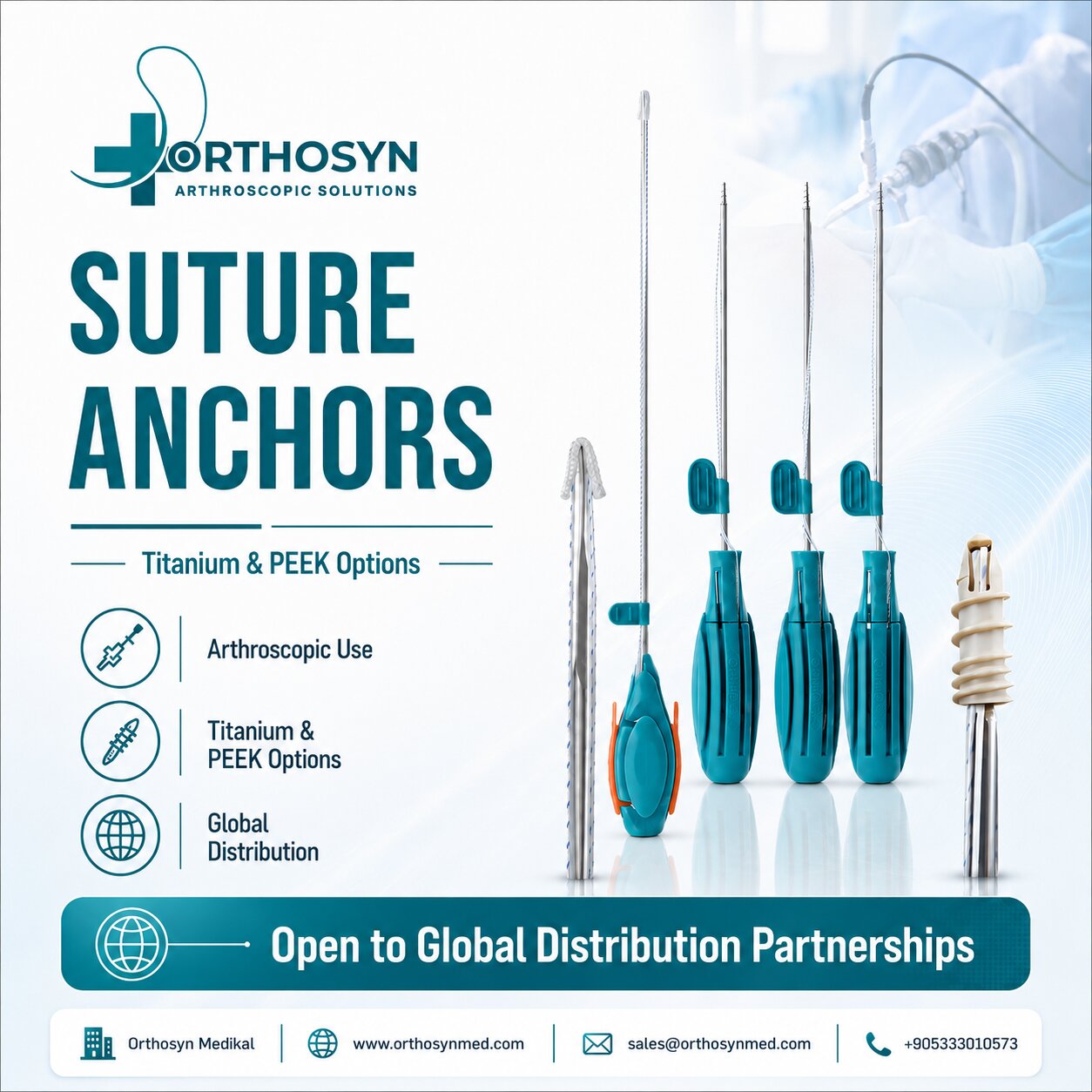
Suture anchors are widely used in arthroscopic procedures to secure soft tissue to bone. They play an important role in procedures such as rotator cuff repair, labral repair, Bankart repair, and other soft tissue fixation techniques.
Among the different materials available for suture anchors, PEEK (polyether ether ketone) and titanium are two established options.
Both materials can provide reliable fixation, but they differ in composition, imaging characteristics, mechanical behavior, and implant visibility.
Understanding these differences can help surgeons select an anchor according to the surgical technique, anatomical location, and clinical requirements.
PEEK is a high-performance thermoplastic polymer that has been widely adopted in orthopedic implant applications.
PEEK anchors are non-metallic and radiolucent, making them particularly useful when postoperative imaging is an important consideration.
Key characteristics of PEEK include:
Unlike bioabsorbable materials, PEEK is designed to remain within the bone rather than gradually degrading.
Orthosyn Medikal offers PEEK anchor solutions as part of its arthroscopic soft tissue fixation portfolio. You can view the product here:
Orthosyn Titanium & PEEK Suture Anchor
Titanium has a long history of use in orthopedic and trauma implants.
Titanium suture anchors provide rigid metallic fixation and combine high mechanical strength with relatively small implant dimensions.
Important characteristics include:
Titanium anchors therefore remain an important option for many arthroscopic soft tissue repair procedures.
Orthosyn's Titanium Suture Anchor options can be viewed on the same product page:
Orthosyn Titanium Suture Anchor
The most obvious difference is their composition.
PEEK anchors are manufactured from a high-performance polymer.
Titanium anchors are manufactured from a metallic biomaterial widely used in orthopedic implants.
This fundamental difference influences several other characteristics of the implant.
One of the main characteristics of PEEK is its radiolucency.
Because PEEK does not produce the same radiographic appearance as metal, it can facilitate evaluation of the surrounding anatomy during postoperative imaging.
Titanium anchors, on the other hand, are clearly visible on radiographs and may produce imaging artifacts depending on the imaging modality.
Both PEEK and titanium are designed to withstand the mechanical demands associated with soft tissue fixation.
Titanium provides the rigidity associated with metallic implants, while PEEK combines mechanical strength with the properties of a high-performance polymer.
However, fixation performance is not determined by material alone.
Other important factors include:
Titanium anchors are readily identifiable on X-ray imaging.
PEEK anchors are radiolucent, although their position may be identified through specific design features depending on the implant.
The preferred characteristic depends on the surgeon's postoperative assessment requirements.
Previous anchor placement can become relevant during revision surgery.
The surgeon must consider the position, dimensions, and material of the existing implant when planning additional fixation.
PEEK and titanium therefore present different considerations during postoperative assessment and revision planning.
Both anchor types can be used across several arthroscopic procedures.
Suture anchors secure the rotator cuff tendon back to its attachment site on the humerus.
PEEK and titanium anchors can both be incorporated into different repair configurations.
During shoulder stabilization procedures, anchors can be positioned around the glenoid to restore soft tissue attachment.
Small anchor dimensions and controlled placement are particularly important in these procedures.
Depending on implant design and surgical indication, suture anchors can also support various tendon and ligament fixation procedures.
There is no universal answer.
The selection of an anchor should not be based solely on whether the implant is polymeric or metallic.
The appropriate option depends on factors such as:
For this reason, having access to different anchor materials can provide greater flexibility when planning arthroscopic repairs.
Orthosyn Medikal provides different suture anchor solutions for arthroscopic soft tissue fixation.
The Orthosyn portfolio includes:
For conventional PEEK and Titanium Suture Anchors:
Orthosyn PEEK & Titanium Suture Anchors
For the PEEK + PEEK knotless fixation system:
Orthosyn PEEK + PEEK Knotless Anchor – Push Lock System
This portfolio provides multiple implant configurations for different arthroscopic repair techniques and anatomical requirements.
PEEK and titanium represent two different approaches to suture anchor construction.
PEEK provides a non-metallic, radiolucent implant platform, while titanium offers the structural characteristics and radiographic visibility of a metallic implant.
Neither material should automatically be considered superior for every procedure.
The optimal choice depends on the clinical indication, bone quality, fixation strategy, imaging requirements, and surgeon's preferred arthroscopic technique.