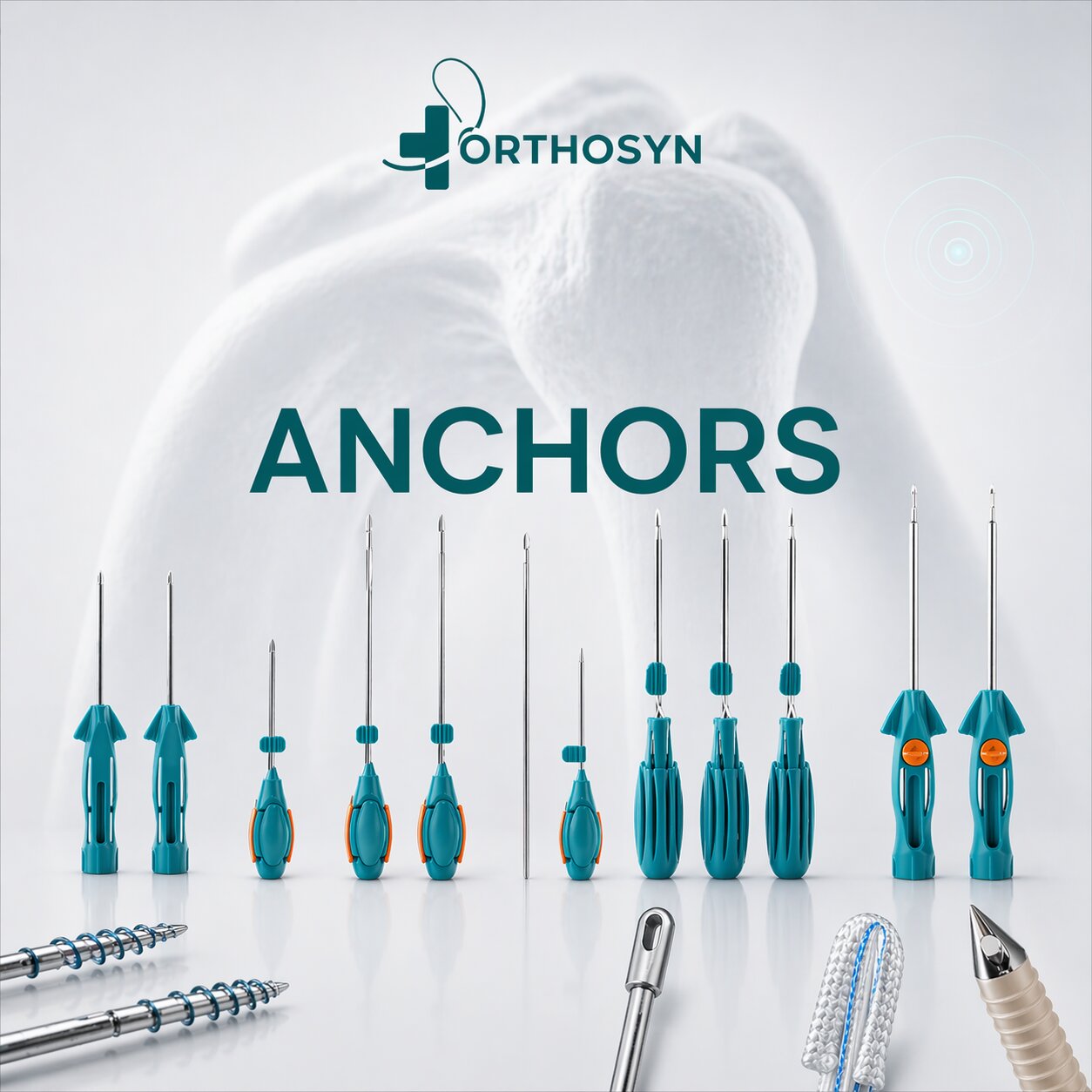
Suture anchors are fundamental components of modern arthroscopic soft tissue repair. They are widely used to secure tendons, ligaments, and other soft tissues to bone during procedures such as rotator cuff repair, labral repair, and shoulder stabilization.
One important decision in anchor-based fixation is whether to use a knotted or knotless technique. Both approaches are designed to achieve secure tissue-to-bone fixation, but they differ significantly in how sutures are managed and tensioned during the procedure.
Understanding these differences can help surgeons select the fixation strategy that best matches the anatomy, repair technique, and clinical requirements of each case.
A traditional suture anchor contains one or more sutures that are passed through the target tissue after the anchor is positioned in bone.
The surgeon then creates arthroscopic knots to secure the tissue against the bone surface.
This approach provides direct control over individual sutures and allows the surgeon to adjust knot configuration according to the repair technique.
Knotted anchors are commonly used in procedures including:
A knotless suture anchor eliminates the need to create an arthroscopic knot.
After the suture or suture tape has been passed through the tissue, it is secured through the anchor's fixation mechanism. The surgeon can establish the desired tissue position and tension before final fixation.
By removing the knot-tying stage, knotless systems can simplify certain steps of arthroscopic repair and provide a different approach to suture management.
Knotted techniques require the surgeon to manage multiple suture limbs and create secure arthroscopic knots.
Knotless techniques reduce the need for knot management and can simplify procedures involving several fixation points.
With knotless fixation, tissue tension can typically be established before final anchor seating.
Knotted techniques allow tension to be controlled through sequential knot placement.
Both approaches provide control, but they achieve it through different mechanisms.
Traditional fixation leaves an arthroscopic knot within the repair construct.
Knotless fixation avoids this knot stack, creating a lower-profile construct in the repaired area.
Arthroscopic knot tying requires specific technical skills and can add additional steps to the procedure.
Knotless systems can streamline suture management, particularly when multiple anchors are being used.
The choice is not simply a question of which anchor is "better."
Surgeons may select different fixation methods according to:
Knotless fixation systems can be incorporated into several arthroscopic procedures.
Knotless anchors are commonly incorporated into modern rotator cuff repair constructs, particularly techniques involving multiple fixation points.
Their low-profile fixation approach can be useful when repairing soft tissue around the glenoid.
Knotless systems can support controlled tissue positioning during selected stabilization procedures.
PEEK (polyether ether ketone) is widely used in orthopedic implants because of its mechanical properties and radiolucency.
In arthroscopic anchor systems, PEEK provides a rigid implant platform while allowing postoperative imaging without the radiographic artifacts associated with metallic implants.
Depending on the system design, knotless anchors can incorporate PEEK components or combinations of PEEK and titanium.
Orthosyn Medikal provides arthroscopic fixation solutions for different soft tissue repair techniques, including PEEK and knotless suture anchor systems.
The Orthosyn arthroscopy portfolio includes:
This range allows different fixation approaches to be selected according to the surgical technique and anatomical requirements.
Knotted and knotless suture anchors share the same fundamental objective: creating reliable soft tissue-to-bone fixation.
Their main differences lie in suture management, tensioning technique, knot profile, and surgical workflow.
Rather than representing competing solutions, both systems provide surgeons with different tools for different repair strategies. The appropriate choice should ultimately depend on the anatomy, tissue characteristics, repair configuration, and surgeon's preferred technique.