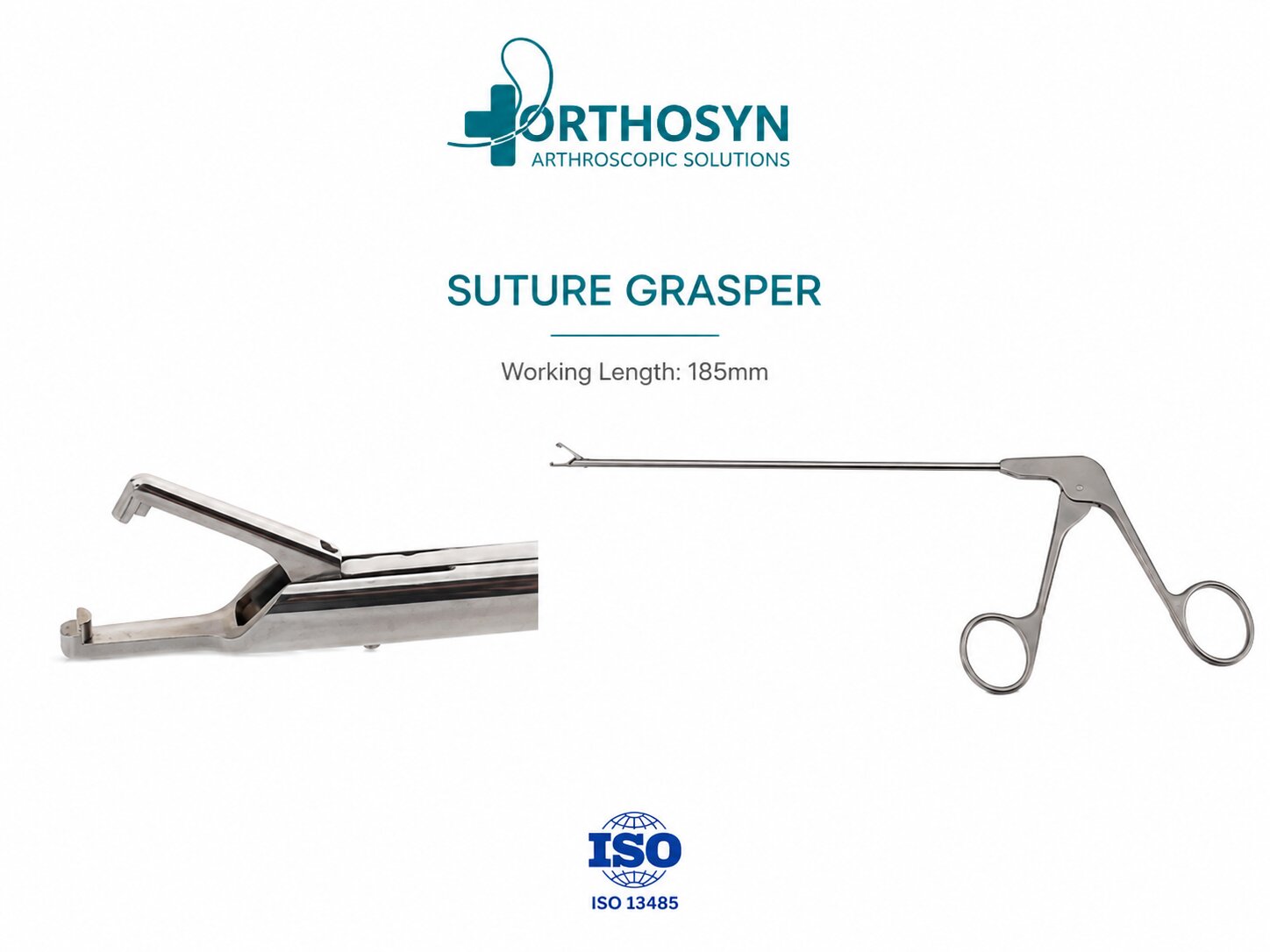
Successful arthroscopic surgery depends not only on implants and visualization but also on the surgeon's ability to manipulate soft tissue accurately. One of the most frequently used instruments for this purpose is the arthroscopic grasper.
Designed to securely hold, retrieve, and manipulate tissues and sutures within the joint, arthroscopic graspers help surgeons perform procedures with greater precision while minimizing unnecessary tissue trauma.
Although simple in appearance, graspers play an essential role in almost every arthroscopic procedure.
An arthroscopic grasper is a specialized hand instrument introduced through an arthroscopic portal to grasp soft tissue, retrieve sutures, or manipulate anatomical structures during minimally invasive surgery.
Different jaw designs are available depending on the intended application, allowing surgeons to handle delicate tissues safely and efficiently.
Working through small arthroscopic portals limits direct access to the joint. Arthroscopic graspers compensate for this by providing precise control of tissues inside confined spaces.
Their use allows surgeons to:
Reliable tissue control contributes to smoother surgical workflow and more accurate repairs.
Graspers help mobilize torn tendon tissue and retrieve sutures before fixation.
Used to position the detached labrum during suture anchor placement.
Assist in manipulating the meniscus during arthroscopic knee procedures.
Allow surgeons to safely retrieve cartilage or bone fragments from the joint.
Frequently used during diagnostic and therapeutic arthroscopic procedures.
Specialized jaw designs provide reliable grip while minimizing tissue damage.
Graspers simplify suture retrieval and organization throughout the procedure.
Accurate tissue manipulation supports optimal implant placement and repair quality.
Efficient handling of tissue and sutures contributes to a faster surgical workflow.
An effective grasper should provide:
These characteristics help surgeons perform precise and reproducible arthroscopic procedures.
Orthosyn Medikal offers a comprehensive portfolio of arthroscopic hand instruments developed for precision and reliability.
The product range includes:
Each instrument is designed to support minimally invasive orthopedic surgery while providing durability, ergonomic handling, and surgical efficiency.
Arthroscopic graspers are indispensable instruments in modern minimally invasive orthopedic surgery.
Their ability to securely manipulate tissue, retrieve sutures, and improve procedural efficiency makes them an essential component of successful shoulder and knee arthroscopy.