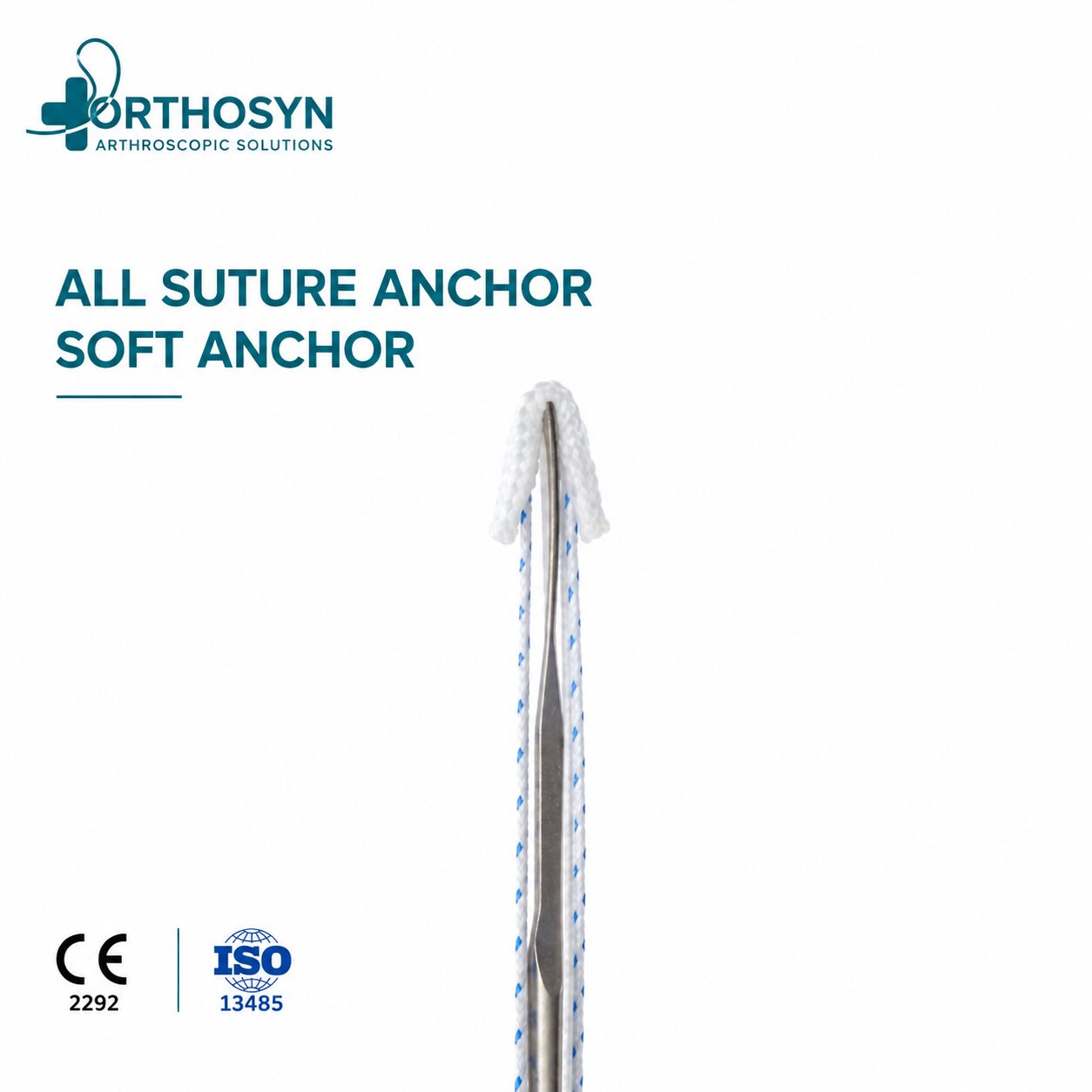
Advances in arthroscopic technology have led to the development of implants that provide strong soft tissue fixation while minimizing the amount of bone removed during surgery. Among these innovations, soft suture anchors have become an increasingly popular choice for shoulder arthroscopy.
Unlike traditional solid anchors, soft suture anchors are constructed primarily from high-strength suture material. Their smaller drill holes and flexible design help preserve bone stock without compromising fixation, making them valuable in many arthroscopic procedures.
A soft suture anchor, also known as an all-suture anchor, is a fixation device composed primarily of braided suture material rather than a rigid implant body.
Once inserted into a prepared bone socket, the anchor expands beneath the cortical bone to create secure fixation.
This design allows surgeons to achieve stable soft tissue repair while using a smaller bone tunnel.
Bone quality plays a significant role in the long-term success of soft tissue repairs.
Preserving bone stock offers several advantages:
Bone preservation has become an important consideration in modern arthroscopic surgery, particularly in younger and active patients.
Soft suture anchors are frequently used during:
To secure torn tendon tissue while preserving the greater tuberosity.
To stabilize the glenoid labrum using minimal bone removal.
To restore anterior shoulder stability with multiple fixation points.
To repair superior labral lesions while preserving glenoid bone.
Soft anchors typically require smaller pilot holes compared with traditional rigid anchors.
Minimal bone removal helps maintain structural integrity.
The absence of a rigid implant body allows the anchor to conform within the prepared bone tunnel.
Smaller anchor footprints allow surgeons greater flexibility when placing multiple anchors close together.
Modern high-strength suture materials provide dependable fixation for a variety of arthroscopic repairs.
The choice of anchor depends on several factors, including:
Each clinical case requires individualized planning to achieve the most appropriate repair.
Orthosyn Medikal offers soft suture anchor systems designed for minimally invasive shoulder surgery.
The product portfolio includes:
These solutions are developed to support secure fixation, efficient surgical workflows, and modern arthroscopic repair techniques.
Soft suture anchors have expanded the options available for arthroscopic soft tissue fixation by combining reliable fixation with excellent bone preservation.
As arthroscopic techniques continue to evolve, preserving native anatomy while maintaining strong fixation remains an important objective in modern orthopedic surgery.