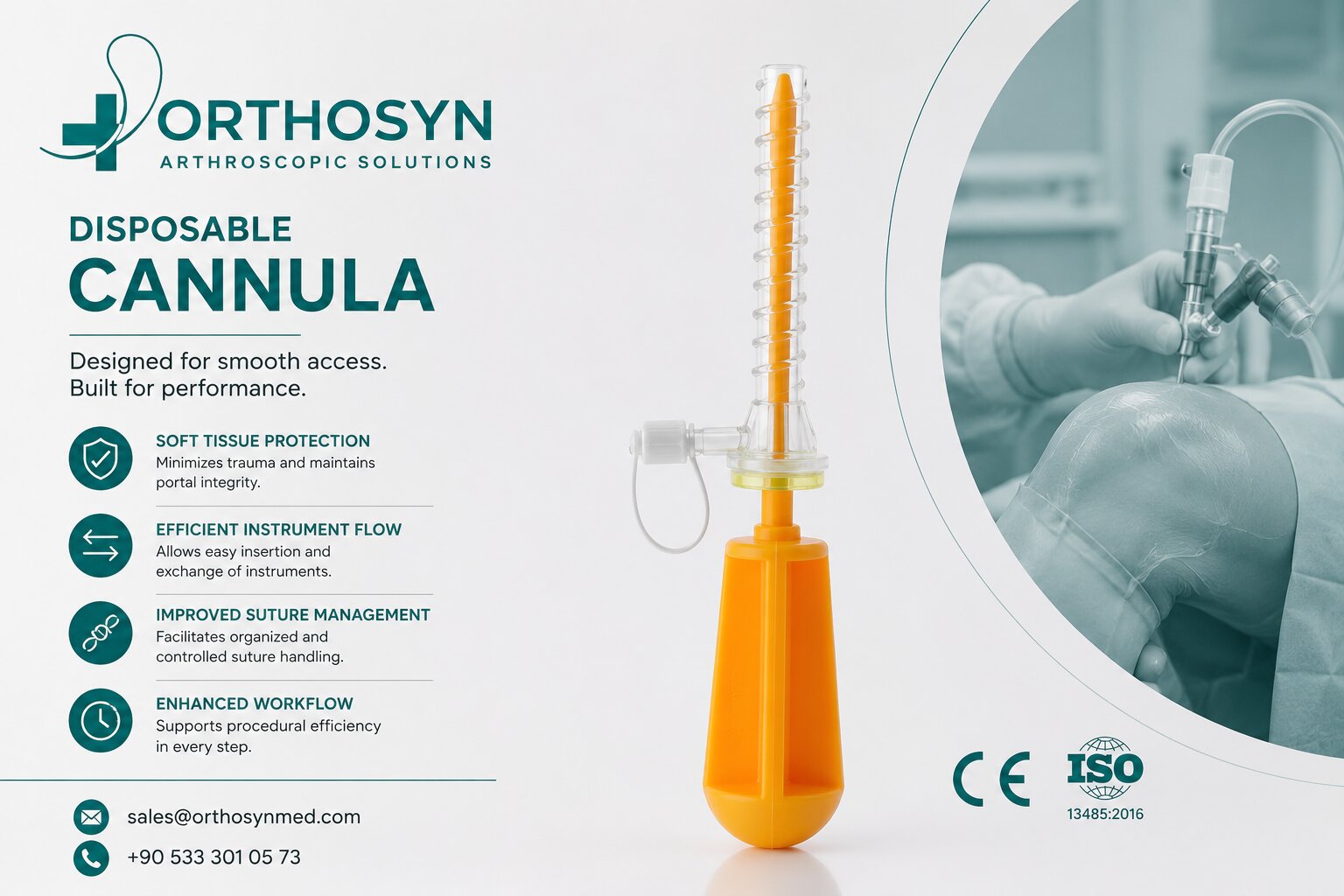
Modern arthroscopy is built on precision, efficiency, and minimal soft tissue disruption. While cameras, implants, and hand instruments receive much of the attention, one of the most important components of every arthroscopic procedure is the arthroscopic cannula.
Cannulas create a protected pathway between the skin and the joint, allowing surgeons to introduce and exchange instruments repeatedly without causing unnecessary trauma to surrounding soft tissues. Their role extends beyond simple access—they contribute directly to surgical efficiency, visualization, and tissue protection.
An arthroscopic cannula is a tubular device inserted through an arthroscopic portal to provide controlled access to the joint.
It serves as a working channel through which instruments, suture passers, graspers, knot pushers, probes, and implants can safely pass during surgery.
Cannulas are available in different diameters and lengths to accommodate various procedures and instrument sizes.
Repeated insertion and removal of instruments without a cannula may increase soft tissue irritation and make instrument exchange less efficient.
Using a cannula helps surgeons:
These advantages contribute to smoother surgical workflows and more efficient procedures.
Cannulas facilitate repeated suture management and anchor placement while protecting the surrounding soft tissue.
They provide controlled access for suture passers, graspers, and knot pushers during shoulder stabilization procedures.
Cannulas help maintain a clear working channel during capsulolabral reconstruction.
During meniscal repair and ligament reconstruction, cannulas simplify instrument handling and repeated portal access.
Smooth insertion and removal of surgical instruments increase procedural efficiency.
Cannulas reduce unnecessary contact between instruments and surrounding tissues.
They help organize multiple sutures while reducing the risk of entanglement.
Maintaining a stable working channel improves surgeon control throughout the operation.
Surgeons often evaluate cannulas according to:
Selecting the appropriate cannula depends on the specific surgical technique and the anatomical location being treated.
Orthosyn Medikal offers a comprehensive portfolio of arthroscopic instruments developed to support minimally invasive orthopedic surgery.
The product range includes:
Each product is designed to provide durability, precision, and ergonomic performance throughout the surgical procedure.
Although often considered a simple accessory, the arthroscopic cannula plays a fundamental role in every minimally invasive procedure.
By protecting soft tissues, improving instrument handling, facilitating suture management, and maintaining efficient portal access, cannulas contribute significantly to safe and successful arthroscopic surgery.